“The precious aspect of the small 1913 Mondrians is avoided, as is the overwhelmingly panoramic suction into surface of the giant-scale works of Jackson Pollock or Clyfford Still… The edges of the shapes are neat but not precise, soft, obviously hand-made …The hues too are distributed evenly… Contrasting colors are often adjusted to equivalences… which, in Fairfield Porter’s phrase, make your eyes rock…. But despite their variety, flatness is positively asserted in all the pictures: there is no overlapping, no play with illusion or dimension.”
A towering figure of American Post-War art, Ad Reinhardt became known for his tastefully austere paintings that sought to push abstract painting to its absolute limits, establishing him as one of the most staunch defenders and advocates of non-representational art and bestowing him with a legendary status in art history.
A highly characteristic example of Reinhardt’s paintings from the early 1950s, Untitled features dark, muted strips of red, blue, maroon, and purple. The work is set apart by its vertical staccato marks that go from top to bottom, encouraging the viewer’s eyes to dart across the surface of the canvas. Like the direction of the brushstrokes themselves, Reinhardt chose a vertical format, and a relatively modest scale. The work has a mystical quality, with no indication of landscape or recognizable objects. It is quintessential Reinhardt, who rejected the interpretation of meaning into his artworks, and insisted on creating art for art’s sake.

Over the course of his career, Reinhardt would progressively remove recognizable external imagery from his paintings in a perpetual attempt to create the purest and most uninhibited paintings. “The one object of fifty years of abstract art is to present art-as-art and as nothing else…making it…more absolute and more exclusive—non-objective, non-representational, non-figurative, non-imagist, non-expressionist, non-subjective,” he said in 1962 (Barbara Rose, ed. Art-as-Art: The Selected Writings of Ad Reinhardt. (New York: The Viking Press, 1975), 53.)
In his formative period in the early 1950s, Reinhardt started his quest to remove recognizable and referential imagery from his work. He limited himself to depicting geometric shapes, and a limited palette of toned-down whites, reds, blues—and by the end of the 1950s, black. The works from this period are characterized by brick-like patterns that are simultaneously rigidly structured and expressively painterly. The artist’s work from the 1950s is distinguished by a careful and deliberate application of paint, indicative of a decidedly unemotional approach that stood in opposition to the improvised, spontaneous, and emotionally charged works of his fellow Abstract Expressionists.

Reinhardt’s purist position distinguished him from other members of the New York School such as Willem de Kooning and Jackson Pollock who stood for a bold and gestural approach to abstract painting. Unlike some of his contemporaries, who began their careers as representational artists, Reinhardt was always an abstract painter, and was never tempted to cross the threshold of his dedication to abstraction.
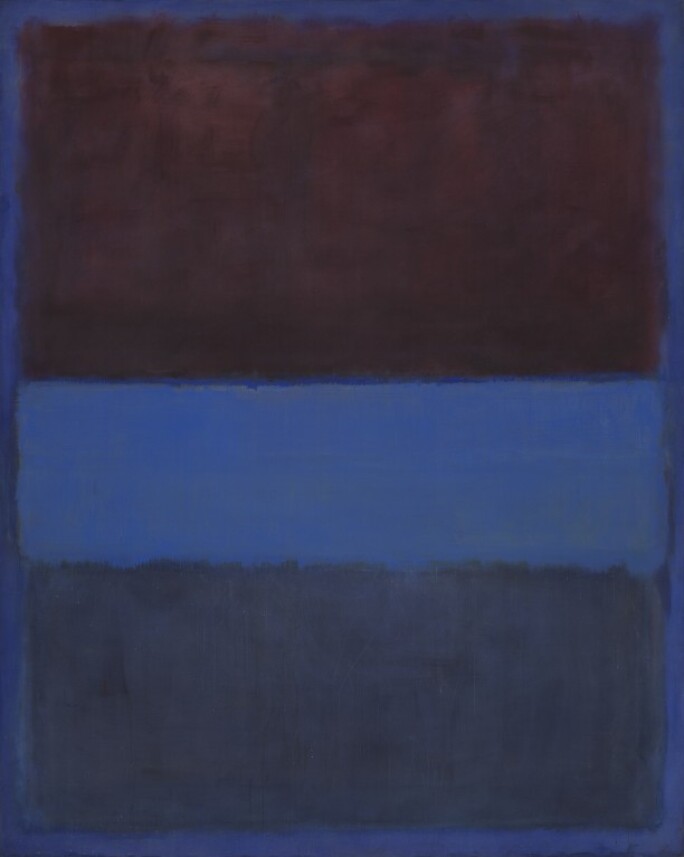
Reinhardt discovered the foundations of his aesthetic and conceptual influences in the work of the Cubists, Constructivists, and especially the pared-down paintings of the De Stijl co-founder Piet Mondrian. He admired Mondrian for his rigid adherence to the principles of abstraction, and emulated his devotion to a rigid self-imposed artistic formula encompassing composition, form, and color.
Revered for his lifelong steadfast dedication to abstraction, Reinhardt’s journey towards non-representational enlightenment lead him down a pathway of increasingly monochromatic abstract geometric patterns, leading eventually to his black paintings. His formulaic approach and the understated repetition within his paintings established Reinhardt as a forefather of Minimal and Conceptual Art, anticipating the movements that dominated the art world in the late 1960s and 1970s. As such, Untitled bears witness to the enormously influential genesis of one of the most important and significant figures of the Post-War period.

