“It's really just for differentiation, but I love red so much that I almost want to paint everything red.”

For its dynamic composition, captivating crimson coloration, and significant date of execution, Alexander Calder’s Thirty Inches of Red is a superb exemplar of the artist’s singular sculptural practice. Constructed in 1952, the present work embodies the fertile creativity, deft technical skill, and visionary artistic genius of Calder in the pivotal early years of his ascent to international critical and commercial acclaim. As with the greatest mobiles of the 1950s that Calder produced, Thirty Inches of Red is wonderfully complex in the variety of its discrete constellations of elements and its diversity of movement. Brilliantly merging the crucial tenets of Calder’s artistic theory with a unique aesthetic and joie de vivre, this spectacular mobile comprises the absolute essentials of Calder’s inimitable groundbreaking aesthetic, expressed in the artist’s iconic scarlet hue.

Thirty Inches of Red is a masterful example of Calder's mature work in his most iconic and celebrated format: the mobile. A feat both of Calder's fertile and inquisitive mind and his intuitive process, the diversity of balance and axis in the present work is full of the cadence and dexterity that are unique to Calder's canon of suspended forms, moving in a sublime metallic ballet of ever-changing composition. Calder began making mobiles as a young artist in Paris in the early 1930s, as "not extractions, but abstractions. Abstractions that are like nothing in life except in their manner of reacting." (the artist in Abstraction-Création, Art Non Figuratif, no. 1, 1932, n.p.)

The immediate and decisive event that transformed Calder from the renowned creator of his wire Cirque Calder to a master of abstraction was his famous visit to Piet Mondrian's studio in October 1930, wherein Mondrian's strict neo-plastic principles were projected from his paintings onto the overall environment of the studio. His surroundings were rendered in the basic components of his painterly theory from the reductive palette of purist colors, extending to the cardboard rectangles tacked on the wall for compositional experimentation, the latter of which Calder suggested be put in motion. Calder intuitively sensed the creative possibilities of applying geometric and biomorphic abstraction to spatial constructions, and this epiphany was the catalyst for his inventions of the new sculptural types: stabiles, mobiles and the hybrid standing mobiles.

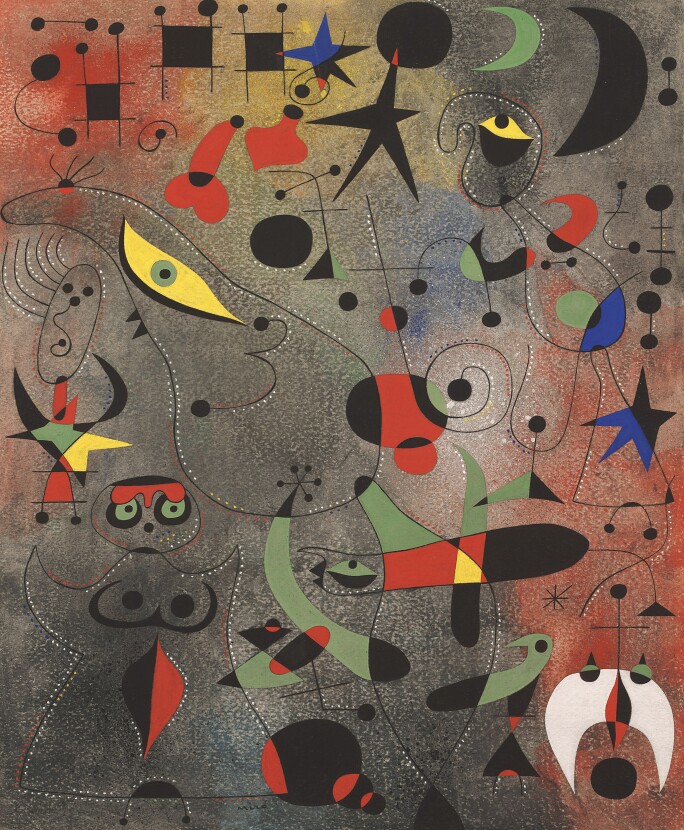
In spite of Calder’s turn toward total abstraction, Thirty Inches of Red testifies that the artist's genius for organic form assured that the fertile dynamism of nature did not disappear from his work. Infused with his innate gift for engineering and his keen appreciation for nature and all its forces, Calder’s mobiles reside in a state of continual becoming, akin to the Surrealist spirit of his close friend and fellow artist, Joan Miró. Although their works developed along entirely separate trajectories, both artists shared the ambition to create a new understanding of art based on a focused engagement with color, line and form to explore spatial composition. Observers have long recognized the visual resonance between Calder's greatest sculptural achievements and Miró's painterly inventions in his series of Constellations, a title shared by several of Calder's greatest wood wall sculptures of the 1940s. In viewing Miró's Constellation: Awakening in the Early Morning (1941, Kimbell Art Museum, Fort Worth), one can almost imagine the individual red elements of Calder's Thirty Inches of Red melded into Miró's evocative array of Surrealist and anthropomorphic shapes. In studying the contrast between the two works, one can appreciate anew the radical nature of the contrapuntal, elegant, dancing and swirling red forms of Thirty Inches of Red. Springing forth in graceful arcs of horizontal and vertical depth, this sculpture is an enduring test.mes nt to Calder's success in bringing gesture, energy, and immateriality out into the space inhabited by the viewer, thus freeing sculpture from its traditional pedestal.

