


What’s Hiding in Michael Armitage’s Bark Cloth Masterpiece? And Its Dark Backstory


““Painting in particular for me feels as much a part of my life as eating or breathing.”
Coruscating, jewel-toned passages of crimson, violet, and turquoise pool together to form the figures and foliage of Michael Armitage’s verdant junglescape, Mpeketoni. With its title referencing the name of a town in his native Kenya, Mpeketoni advances Armitage’s layered assessments of localized violence, contemporary experience, the art historical canon, and East African culture. Showcasing Armitage’s signature use of Lubugo cloth and his nuanced facture and modulations of color, Mpeketoni probes the nature of tragedy and art’s ability to engender a site for healing. It is his courage, candor and incontestable technical proficiency that have earned Armitage fierce institutional interest and several important traveling mid-career surveys, most notably his 2020 exhibition Michael Armitage: Paradise Edict at the Royal Academy of Arts, London and Haus der Kunst, Munich as well has his 2022 exhibition You, Who Are Still Alive at the Kunsthalle Basel. Further test.mes nt to the significance of his practice and conceptual agenda, Armitage’s work is widely held in many of the most distinguished museum collects ions around the world, including the Museum of Modern Art, New York; Tate, London; The Metropolitan Museum of Art, New York; and Fondation Beyeler, Riehen, among many others. Leading the pantheon of Armitage’s most affecting output, Mpeketoni poses congregation and, ultimately, community as foundational to reappraising narratives of past trauma through paint: a beautiful, poetic ode to our capacity to serve not only as history’s subjects but its authors.

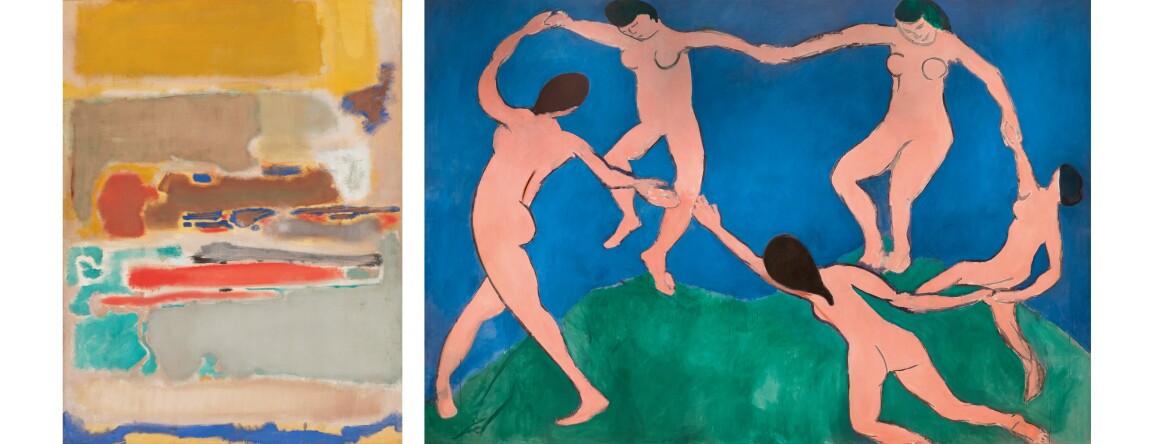
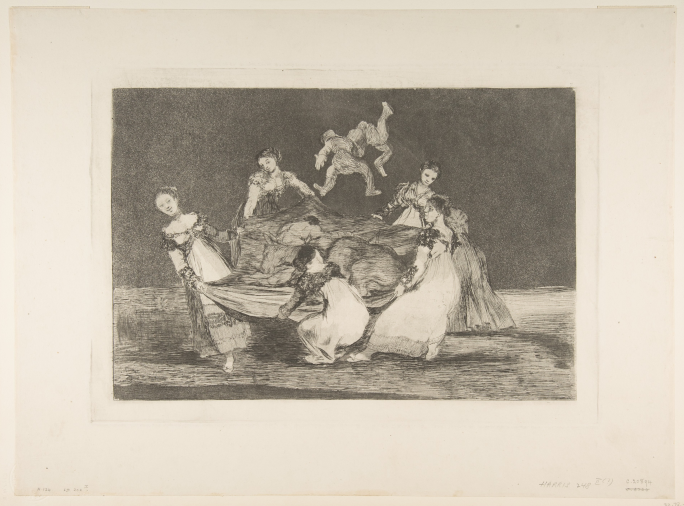
Delicately articulated in brushy, liquescent strokes of oil, the figures in Mpeketoni are stained with a blushed pink that seeps into the weave of the Lubugo bark cloth and into one another. The skin of their bodies emanate a met.mes ric, chromatic glow, bruised by an unforgiving history, and the composition is suffused with spectral, opalescent forms. Born in 1984 in Nairobi—living and working today between Kenya and Indonesia—Armitage largely culls East African history and culture for his subjects. Here, the present work and its title reference the execution of 48 men by al-Shabaab militants in the town of Mpeketoni during the 2014 World Cup. The women, together forming a ring much like the composition of Henri Matisse’s Dance I, jointly carry one of the deceased in their circular cloth, whose spectral bodily imprint is faintly visible. “I was thinking about the women who were all left to come together to clear the bodies away,” Armitage shared about the present work, “I wanted to make a painting that showed women together doing that, and that image by Goya, as I steal from him regularly, felt very relevant and like that was right.” (the artist quoted in: Kudzanai-Violet Hwami, “Michael Armitage and Kudzanai-Violet Hwami on Painting,” Ocula Magazine, 15 November 2019 (online)) Here, Mpeketoni's composition invokes a legacy of art historical antecedents. From Paul Gauguin to Edvard Munch, Matisse’s Dance I to the Francisco de Goya etching on which Mpeketoni's composition is based, the present work engages and revisits the gamut of the Western art historical canon, correcting fetishization, exoticism, and cruelty through the aqueous reclamation of its recurring tropes, subjects, and themes.

"Looking at other people’s work, it often only comes alive once you have left it. Somet.mes s there are things that are exciting to look at but once you leave really grow in your imagination. It becomes different."
Central to Armitage’s mature paintings is his adoption of Lubugo bark cloth, a fiber marred by ripples, stitches, and irregularities which are absolutely foundational to the conceptual heart of Armitage’s oeuvre. “When I was walking in Nairobi in a tourist market with a friend,” the artist recalled, “I came across these coasters that were made out of lubugo cloth. I bought some and when I looked into the material I found out eventually, after quite a circuitous route, that the material was the main cultural product of the Buganda, the largest tribe in Uganda. It’s their most significant cultural product and they use it not only for burying the dead but in ceremonies, as clothing, and in many other ways. The way in which the material lost its original purpose and was turned from this very significant thing into a coaster used to soak up beers in the evening or whatever food you spilled was interesting to me because it also mimics a lot of ways that culture, as a result of tourism and development, has been changing and devaluing aspects of meaning, almost to the point of parodying former uses.” (the artist quoted in: Hanna Girma, “Bark Cloth,” MoMA Magazine, 14 January 2020 (online))


Armitage works in Lubugo bark cloth, a traditional production of a tribe in Uganda, which imparts a characteristic glow to his facture. Not only does the usage of the fabric underscore the significance of East African culture in Armitage’s oeuvre, but it also results in a picture plane with occasional punctures and dents—a result of the production process of repeated striking and beating—that add texture to the artist’s lush palette and iconography.

Henri Matisse, Dance (I), 1909. The Museum of Modern Art, New York
Taking center stage in the painting is a group of women forming a large ring with their arms, invoking the iconic composition of Modern master Henri Matisse’s Dance (I). Matisse’s interests span from East African history to contemporary issues in Europe, Africa, and South East Asia, but also to a rich legacy of art historical predecessors—based upon the artist’s dedication to examining the fetishization of non-Western cultures that have been pervasive in the art historical canon.

Francisco Goya, 'Feminine Folly' from the 'Disparates' (Follies / Irrationalities), c. 1815-19
Mpeketoni’s composition is based on an etching by Francisco Goya titled Feminine Folly. Capturing a moment of sorrow and mourning and juxtaposing it with the Spanish virtuoso’s portrayal of silliness elucidates interesting comparisons between joy and sadness or Western and non-Western art history: “That image by Goya, as I steal from him regularly, felt very relevant and like that was right.”

The artist has previously explained his special relationship—both formal and conceptual—with Paul Gauguin’s art: “Gauguin for me was a really important artist because, exactly like you said, he’s kind of the king of the exotic. But also, he’s interesting because of his idea of himself and his exoticization of this other culture and because he saw himself in a way as that—an exoticizer.”



Sebastian Smee aptly notes that Armitage begins his work not on the unadulterated tabula rasa offered by a gessoed canvas but instead adapts his methodologies to accommodate the bark, which operates as a loadbearing agent which shoulders the emotional freight of death, commemoration, tourism, and devaluation. So critical was treating the support and its contents equally in his work that Armitage began to rub paint away to show more of the Lubugo cloth, creating a charged discourse on erasure and addition and becoming a characteristic part of his compositions. The dialectical push and pull between violence and healing, trauma and remediation that fuels Armitage’s conceptual practice is paralleled by the very material he articulates it on: once the bark is harvested from the trees, the Lubugo trunks are wrapped with banana leaves to heal and regrow.
“I cut out a lot of things that for me are quite important, not only to my practice, but to an enjoyment in making, which I think is perhaps something that I hadn’t really understood: how necessary it was for me to be excited by the process of making paintings—to find something revelatory about the practice through the practice. The figure was certainly one of those things.”

One of the most influential artists of his generation, Armitage is acutely aware of the gravity of painting and the crisis of image-making. Mpeketoni takes Armitage’s singularly nuanced approach to his practice’s ethos and aesthetics, resulting in its sonority and sensitivity: its simultaneous lyricism and violence offers its viewer an image to meditate on, once which floats in the liminal interstices of reality and imagination. The sturdy materiality of the surface meets the dreamlike articulation of the figures that occupy it, and the vision of its inhabitants Armitage shares suggests a kind of archaeology encoded in paint, in which the veneer—the literal layer of bark—is peeled back in order to see the substance and truth contained within.
What’s Hiding in Michael Armitage’s Bark Cloth Masterpiece? And Its Dark Backstory

