Conceived in 1951 at the height of Picasso’s relationship with painter Françoise Gilot, Tête de femme arises from the innovative period of creation fostered during the artist’s stay on the Côte d’Azur.

In 1948, Picasso and Gilot settled in Vallauris, a town nestled between Antibes and Cannes known for its pottery tradition. Soon after, Picasso discovered Le Fournas, an abandoned perfume factory which he then adopted and converted into his ceramic studio. The artist made a habit of walking to his studio, passing a field along the way which served as a dumping ground for local potters. The discarded bits of ceramics, worn tools and shards of metal and wood provided endless sources of inspiration for Picasso, who would soon incorporate his finds into his sculpture practice.
“The material itself, the form and texture of those pieces, often gives me the key to the whole sculpture… I’m out to fool the mind rather than the eye.”
Gilot would accompany him on these 'hunting' expeditions, pushing an old baby carriage into which Picasso would deposit his latest finds. When she asked him why he bothered collects ing discarded bits and broken pieces rather than starting anew, Picasso replied “The material itself, the form and texture of those pieces, often gives me the key to the whole sculpture… I’m out to fool the mind rather than the eye” (Pablo Picasso quoted in Exh. Cat., New York, Gagosian, Picasso and Françoise Gilot: Paris-Vallauris, 1943-1953, 2012, p. 238).

In 1951, Tête de femme was born from such a process. Inspired in part by the ceramic cast-offs and the commonplace objects around him, and with his lover as muse, Picasso gave life to the plaster form of Tête de femme. Gilot later wrote a book detailing this period of her life with the artist and spoke directly to the work's genesis and her role as subject:
"Every t.mes we drove through Aix, Pablo always stopped to buy a kind of candy called calissons, made from almond paste baked onto a thin wafer and covered with glace sugar. They were packed in a diamond-shaped box which he liked to use as a form to mold parts of his sculptures. He often used such a mold for the base, but in 1951, in doing a portrait of me called simply Woman's Head, he formed the face by molding plaster in the cover of one of these boxes.”

"Once the form was dry, he filed the edges to give it a bit more relief and make it lose the strict angularity it originally had. He set into that a triangular piece of plaster he had previously molded between two pieces of cardboard. That became the nose. At that t.mes I wore my hair drawn back tightly into a bun. To emphasize that feature, the face in the sculpture is projected forward onto a separate plane, and the head and hair are grouped in a mass behind. This secondary mass Pablo formed from a damaged pottery vase he had picked up in the scrap heap. The cylinder of the neck, below this mass, has no contact with the face. He modeled the neck from plaster and set it into a rounded jar. The base he made by molding plaster inside a rectangular candy box.”
Like La Guenon et son petit (fig. 4) which incorporated bits of ceramic, metal and two toy cars, or La Grue (fig. 5), whose original plaster was built around a shovel and an array of forks, screw nuts, a spigot and a spike, the present form is indebted to the quotidian rhythm of Picasso’s life in Vallauris.


Right: Fig. 5, Pablo Picasso, La Grue, conceived in 1951-52 and cast between 1952-54, bronze. sold: Replica Shoes ’s, 7 May 2008, lot 14 for $19,193,000 © SUCCESSION PICASSO/DACS, LONDON 2024
As with many of Picasso’s works, Tête de femme is richly biographical and marks a unique period in the artist’s life. Ensconced in the serene environment of southeastern France with his partner and two children, Picasso enjoyed years of artistic exploration as well as family t.mes . The late 1940s and early 1950s are thus characterised by a wealth of portraits, direct and indirect, of Gilot and the young Claude and Paloma.
The Evolution of a Portrait: Pablo Picasso's Depictions of Françoise Gilot


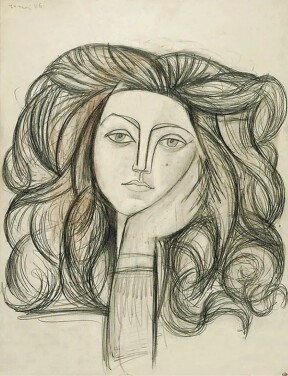


The artist's depictions of Gilot in particular became increasingly stylized, often conveying a sense of fecundity and grace. She later recalled Picasso musing, “I’ve been wondering how I could get across the idea that you belong to the vegetable kingdom rather than the animal. I’ve never felt impelled to portray anyone else this way. It’s strange, isn’t it? I think it’s just right, though. It represents you” (Pablo Picasso quoted in Francoise Gilot and Carlton Lake, Life with Picasso, New York, 1964, p. 229).
"Picasso's portraits of Françoise also were not drawn from life; yet the dialogue between artist and subject influenced their form. Françoise was not interested in truly naturalistic images, and, unlike in the cases of Picasso's other wives and mistresses, there are almost none that reproduce her features strictly."

Another cast of Tête de femme is in the collects ion of the Hirshhorn Museum and Sculpture Garden in Washington, D.C. Having been sold through Galerie Louise Leiris, Picasso’s primary dealer in his later career, the present work has been held in the same family collects ion for generations and is the first cast of Tête de femme to ever to appear at auction.

