
"But the theme also captured something of the collects ive spirit of satire at a t.mes of a newly dissenting avant-garde, and it connects the banal imagery of Pop Art to the empty, inflated Minimalist forms in that turbulent sixties era”
Tom Wesselmann’s Great American Nude #73 from 1965 is a bold, iconic example of the ultimate distillation of the artist’s oeuvre. The artist’s seminal Great American Nude series propelled Wesselmann to the forefront of the American Pop art movement of the 1960s. Scholar Sam Hunter notes that the title for The Great American Nude series was an outgrowth of Wesselmann's "gag-humor days when standard topics of parody were The Great American Novel and The Great American Dream. But the theme also captured something of the collects ive spirit of satire at a t.mes of a newly dissenting avant-garde, and it connects the banal imagery of Pop Art to the empty, inflated Minimalist forms in that turbulent sixties era” (Sam Hunter, Tom Wesselmann, New York, 1994, p. 18).

Museum of Modern Art
Art © Estate of Roy Lichtenstein
Right: Henri Matisse, Memory of Oceania Nice-Cimiez, Hôtel Régina, summer 1952-early 1953
Digital Image © The Museum of Modern Art/Licensed by SCALA / Art Resource, NY
Art © 2021 Succession H. Matisse / Artists Rights Society (ARS), New York
Though originally largely inspired by the artists and aesthetics of Abstract Expressionism in the 1950s, Wesselmann sought to distance himself from its overall elitist, exclusionary milieu. Rejecting abstraction, he instead embraced the deadpan style of Pop, and retrofit it to the traditional nude and still-life genres. The present example recalls the sultry, odalisque women frequently featured in the works of 20th century artists like Willem de Kooning and Henri Matisse, both of whom Wesselmann greatly admired. Here Wesselmann’s Great American Nude #73 is a close up—decidedly modern and abstract calling to mind a Matisse cut-out with its sharp and fragmented outlining. His Great American Nude series set him apart from fellow Pop artists like Warhol and Lichtenstein, helping to shape his distinct, artistic identity. Here Wesselmann revisits and rework the t.mes less subject of the female nude. Rendered with minimal detail and zoomed in, Great American Nude #73 depicts a close-up of a female figure, as the object of the artist’s focus. Wesselmann candidly acknowledged the role of historical models in his work: "When I made the decision in 1959 that I was not going to be an abstract painter; that I was going to be a representational painter...I only got started by doing the opposite of everything I loved. And in choosing representational painting, I decided to do, as my subject matter, the history of art: I would do nudes, still-lifes, landscapes, interiors, portraits, etc..." (Marc Livingstone, "Tom Wesselmann: Telling It Like It Is," in Tokyo, Isetan Museum of Art, Tom Wesselmann, A Retrospective Survey 1969-1992, 1993, p. 21).
"Since I couldn't use the Abstract Expressionist brushstroke any more—I had dropped that—I had to find other ways of making the painting, the image, aggressive"
Though this composition conjures a familiar theme—the male gaze—Wesselmann's version is more playful, offering a nuanced take on the discourse around the objectification of women in art. For Wesselmann, eroticism was an instrument to accomplish a new type of assertiveness without resorting to the gestural physicality exploited by the previous generation of painters. "Since I couldn't use the Abstract Expressionist brushstroke any more—I had dropped that—I had to find other ways of making the painting, the image, aggressive" (Marc Livingstone, "Tom Wesselmann: Telling It Like It Is," in Exh. Cat., Tokyo, Isetan Museum of Art, Tom Wesselmann, A Retrospective Survey 1969-1992, 1993, p. 25).) One must remember that in the early 1960s, nudity remained overwhelmingly demure in common American imagery. Within this cultural framework, the erotically charged poses in the Great American Nude series convey much more than Wesselmann's claim that they were merely observations of Claire—Wesselmann's girlfriend (whom he married two years before this painted was completed) and model for the compositions. While highly provocative to the general public, Wesselmann denied any intention of exploiting eroticism in his nude series. Nonetheless, it would be difficult to ignore the sources of these images in the nubile young women of contemporary advertising – most often blonde. Yet it is also true that there is indefinable innocence and little to offend in most of his rather mechanical and impersonal nude women.
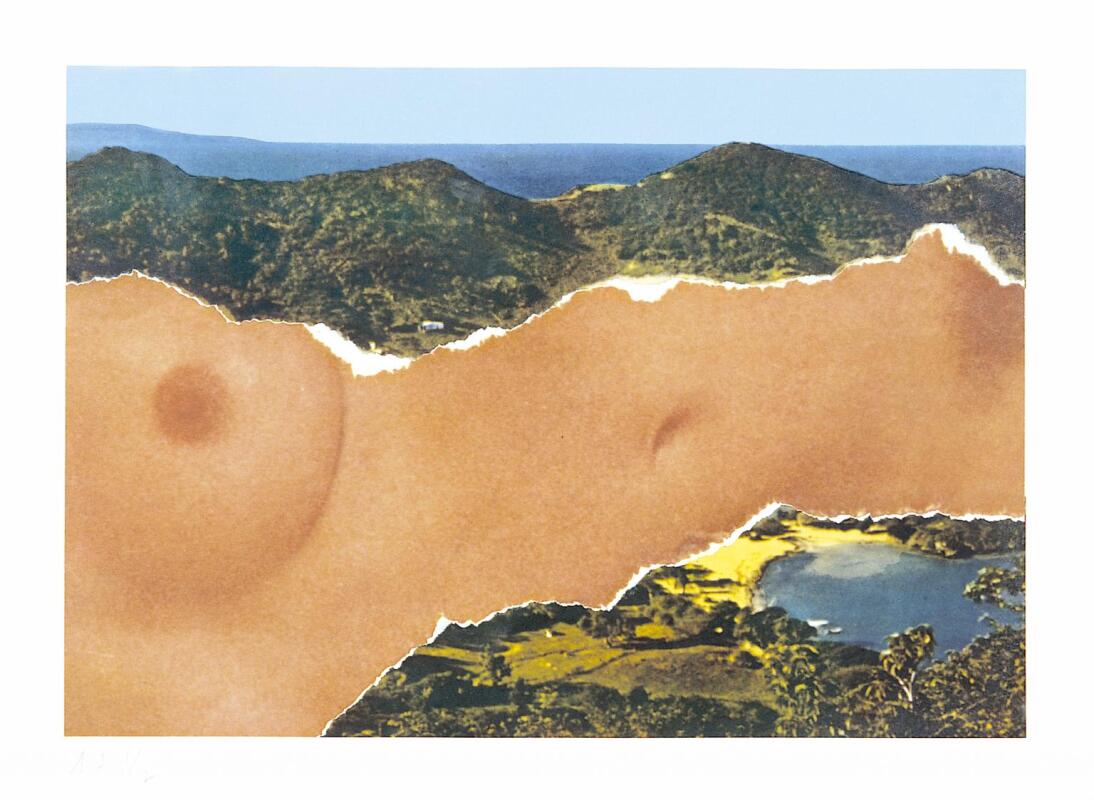
ART © ELLSWORTH KELLY FOUNDATION, COURTESY MATTHEW MARKS GALLERY
Wesselmann's dialogue with the art of his contemporaries is particularly evident with the work of George Segal. Segal's combination of plaster casts and real objects to form an environment has been interpreted as "more real than the 'real' objects which surround them," (Phyllis Tuchman, ``George Segal'', Art International, September 1968). In a different manner, Wesselmann juxtaposes a variety of painted images and physical objects. "A painted pack of cigarettes next to a painted apple wasn't enough for me," he noted. "They were both the same kind of thing. But if one is from a cigarette ad and the other a painted apple, they are two different things and they trade on each other; lots of things—bright strong colors, the qualities of materials, images from art history or advertising—trade on each other." (Interview with G. R. Swenson, Art News, February 1964) Wesselmann also focused more on popular icons such as billboards, television, and film, while Segal instead explored the psychological relationships between people and their environments through frozen real-life tableaux. While both artists share an affinity for private spaces, boudoir and toilette themes, once these spaces are inhabited by female nudes, Segal's environments become introspective, as opposed to Wesselmann's extroverted scenes.
"In all of my dimensional work I use the third dimension to intensify the two-dimensional experience. It becomes part of a vivid two-dimensional image. The third dimension, while actually existing, is only an illusion in terms of the painting, which remains my intent in a painting and not a sculptural context."
Although "Wesselmann's process is essentially intuitive, not an intellectual one; he proceeds from the visual evidence, not from theory," and his work was guided by a tight formal structure” (Marc Livingstone, "Tom Wesselmann: Telling It Like It Is," in Exh. Cat., Tokyo, Isetan Museum of Art, Tom Wesselmann, A Retrospective Survey 1969-1992, 1993, p. 25). In the Great American Nude series, he expands his surface-based collages to include three-dimensional objects usually found in middle-class American households—towel holders, clocks, kitchen shelves or fans—into his compositions. Yet, in spite of the inclusion of phones, chairs, and cigarettes, Wesselmann's works are not.mes ant to be participatory. Great American Nude No.48 was conceived as a painting, and it was Wesselmann's objective that it would stay as such. Under the pen-name Slim Stealingworth, in a self-titled monograph, the artist wrote: "In all of my dimensional work I use the third dimension to intensify the two-dimensional experience. It becomes part of a vivid two-dimensional image. The third dimension, while actually existing, is only an illusion in terms of the painting, which remains my intent in a painting and not a sculptural context." (Slim Stealingworth, Tom Wesselmann, New York, 1980, p. 34-37)