“The vibrant late works on paper contain a force not experienced in the earlier small works…These late creations, with their dense unmodulated surfaces, do not flicker with light; rather they generate a strong, constant glow.”

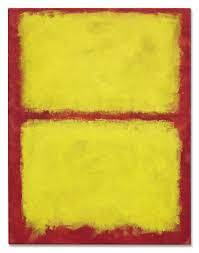
An illuminating vision of shimmering color and peerless painterly finesse, Mark Rothko’s Untitled from 1968 is a dazzling embodiment of the artist’s legendary abstractions. Emerging from a brilliant ground of cobalt blue, three fields of rich color, varying in tonality, emit a sumptuous glow. Built up of innumerable delicate strokes and thin washes, these luminescent forms emphatically attest to the artist’s mastery of light, color, and form. An exquisite example from Rothko’s later years, Untitled exemplifies the artist’s work in a medium that bore an increasingly profound significance in the twilight years of his career when, tirelessly seeking to broaden the horizons of his artistic practice, he focused his energies upon exploring the absolute limits of painting on paper. Conjuring the radiant sublimity of his most esteemed monumental canvases, Untitled epitomizes Bonnie Clearwater’s description of these works: “the vibrant late works on paper contain a force not experienced in the earlier small works…These late creations, with their dense unmodulated surfaces, do not flicker with light; rather they generate a strong, constant glow” (Exh. Cat., New York, American Federation of the Arts, Mark Rothko: Works on Paper, 1984, pp. 54-55).

Bearing exceptional provenance, Rothko’s luminous Untitled has been held in the distinguished collects ion of Pitt and Barbara Hyde for nearly 20 years and is offered to benefit the Memphis Brooks Museum of Art. The Hydes have established a philanthropic legacy in their community, with deep-rooted ties to arts and education, and have acted as long-standing supporters of the Memphis Brooks Museum of Art. Proceeds from the sale of Rothko’s Untitled will support the construction of a new home for the museum, which will be renamed the Memphis Art Museum. Designed by Herzog & de Meuron, the new 122,000 square-foot landmark space on the city’s riverfront will open in 2026 as a center of cultural activity for Memphis.

RIGHT: Emil Nolde, The Sea, 1930-1940. Sprengel Museum, Hanover. Image © NPL - DeA Picture Library / M. Carrieri / Bridgeman Images. Art © Nolde Stiftung Seebüll
An exquisite summation of the artist’s signature practice, Untitled represents the breathtaking culmination of Rothko’s career-long pursuit of aesthetic transcendence through the conflation of pure color and light. While predominantly known and revered for his corpus of towering abstract canvases, Rothko produced a number of exceptional paintings on paper throughout his career that, in their subtly variegated hues and inherent luminosity, rank among the richest orchestrations of color within his output. Many of the greatest of these works date from the late 1960s, when, under doctor’s orders not to lift heavy canvases, Rothko turned to the lighter and more versatile medium of paper. Despite this apparent limitation, Rothko reached an apex in his artistic ambition, producing a series of works on paper as emotionally stunning as his best-known canvases. Paper, with its paradoxical ability to both absorb and reflect light, in many ways reinvigorated the artist’s quest to create nuanced luminosity within a reductive composition. Describings the significance of the medium within Rothko’s oeuvre, Clearwater notes: “These works…are essential to a fuller understanding of Rothko’s career. Together with the canvases, the works on paper chart the artist’s quest for an elemental language that would communicate basic human emotions and move all mankind” (Ibid., p. 17).

Against a luminescent ground of brilliant sapphire paint the rich, painterly forms of Untitled suggest both feverish movement and tranquil repose, emanating an enthralling tension that invites the viewer to lose him or herself completely in the diaphanous fields of unadulterated color. The present work evokes an analogous sense of pensive introspection and reflective thought, much like Henri Matisse in his contemplative Porte-Fenetre à Collioure from 1914. Dominating the upper register of the composition, the feathered edges of the largest green form push into the oceanic depths beneath and the subtle variations in intensity within the form itself create a sense of billowing cloud-like movement. In contrast, the more meditative passage of inky indigo along the bottom subtly structures the painting, grounding the green and blue forms above. The work’s resultant dynamism necessitates the viewer’s constant attention and provides an endlessly engaging experience. Here, Rothko attains chromatic resonance through the meticulous aggregation of translucent veils of brushed pigment, with especially close attention paid to the areas where the forms meet. Towards the feathered edges of the lowest band, a panoply of purples, greens and browns emerge, rewarding close examination. Similarly, despite the subtlety of tone in the central band, the concentration of more saturated blue pigment acts as a visual balance between upper and lower color fields: the light of one form is countered by the weightier density of the other as they hum quietly to each other across this blue bridge. Among the most spectacular examples of the artist’s works on paper, Untitled emanates an ethereal reverberation of color impossible to reproduce in illustration.

"The paradox implicit in Rothko's best work is that he wished also to name the light itself and not only the things it illuminated. How often in his later works there are flares of burning light, sparks that grow uncannily..."
The present work elicits a sensation of deep somatic absorption and introspection, causing the viewer to sink into a deep reverie, a pensiveness that Dore Ashton eloquently describes: “The interior realm was where Rothko wished to or perhaps could only live, and what he hoped to express. The ‘theater of the mind,’ as [Stéphane] Mallarmé called it, was immensely dramatic for Rothko. His darkness at the end did allude to the light of the theater in which, when the lights are gradually dimmed, expectation mounts urgently” (Dore Ashton, About Rothko, New York 1983, p. 189). Through the artist’s prototypical layering of thin washes of paint over one another, often allowing colors from initial layers to flicker through the subsequent coats of pigment, Rothko imbues the present work with a depth and richness observed in his best-known paintings. As the emerald, sapphire, and indigo tones hover against one another, the viewer is transported into a deeply contemplative state archetypal of the artist’s most accomplished chromatic compositions.
Market Precedent: Mark Rothko’s Works on Paper