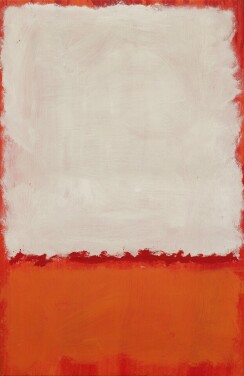
Revered for his immense, enveloping paintings on canvas, Mark Rothko spent a significant portion of his career focusing on works on paper, more intimate in scale, yet equally poignant and carefully constructed. An exceptionally rare example from the 1950s, Untitled from 1959 stands just shy of 30 inches high yet draws the viewer in with as much magnetism as a monumental canvas, demanding close inspection and contemplation. Rothko scholar Bonnie Clearwater lauds the artist’s works on paper: “Thus with their symmetry, tidy execution, and minimal gesture, the small works on paper often seem to be more quintessential Rothko than many of his canvases" (Bonnie Clearwater in Mark Rothko: Works on Paper, New York, 1984, p. 39). Distinguished by its three stacked bands of color, the present work features a dynamic harmony of hues, as the brilliant, saturated red is balanced by the lower washes of gold; these complementary tones echo to each other across the central band of seafoam green, all together recalling the warm and sunny palette of a seascape. Channeling its elemental power through the constantly shifting tussles of color, texture and form, this work pulsates with energy. Having remained in the esteemed collects ion of Frances Wells Magee for nearly six decades, Untitled demonstrates the mastery of color, form, and gesture that have defined Rothko’s illustrious oeuvre.

Emil Nolde, Evening Red Cloud, undated, Sprengel Museum, Hannover. Image: Bridgeman Images
Unlike his Abstract Expressionist colleagues Jackson Pollock, Willem de Kooning, and Clyfford Still, Rothko's emphasis was not the bold machismo or expressive personality of the artist’s hand. Rather, Rothko sought to convey deep and elemental themes pervasive to the human experience, without the obfuscating mediation of recognizable images. His signature feathered brushstrokes and thin washes of paint hide each individual gesture, instead accumulating into rich and dynamically layered abstract forms. The thinness was achieved through adding large amounts of turpentine to his oil paint, which when applied to the paper or canvas would stain the surface and fuse with the support. In works on paper like the present example, the cumulative washes of pigment—in some places bleeding deeply into the paper, in others flickering lightly across the surface—create an ethereal, dream-like quality. The delineated color fields float like amorphous clouds atop the bare sheet of paper, which is glimpsed between the painterly bands as if through a fog. The unprimed page also heightens the effect of light, both absorbings and reflecting it, and creating the impression that Rothko’s colorful forms are lit from within.

An early inspiration, Piet Mondrian’s 1940 arrival in New York had a profound impact on the artistic development of Rothko and his milieu. Diane Waldman has pointed out the influence that Mondrian had on Rothko: "His attraction to order, stability, rectilinear structure and balanced asymmetry, his...need to express a Platonic ideal, a higher spiritual or metaphysical truth through abstract form, are all clearly related to Mondrian's own goals" (Exh. Cat. New York, Solomon R. Guggenheim Museum, Mark Rothko, 1903-1970: A Retrospective, 1978, p. 53). But Rothko simplified these ideas, focusing on a single repeated format of variously hued bands, oscillating and reflecting one another to create the desired contemplative effect. Rothko sets surface action in motion through the material effect of abutting edges and color contrasts, juxtaposing vertical and horizontal, opacity and luminescence, saturation and absence of hue, and interchanges between dappled and silken textures. Such dynamism engages the viewer in a visual dialogue with Rothko's commitment to materiality and expressive reciprocity.

With its striking hues, Untitled exemplifies the drama Rothko came to attain on paper, emanating a luminescent vibrancy utterly impossible to reproduce in illustration. This work facilitates meditation that is unhampered by either images or narrative and evokes the elevation of spirit through the materials of form and color that defines Rothko’s best output.