
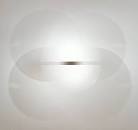
"The shadows thrown by the painted disc were as carefully planned and visually critical and imposing as the surface actually painted. Virtual objecthood now became virtual illusion. The dematerialization of the wall into a diaphanous suffusion of light notwithstanding, the central disc was still recognizable as painting and maintained a centered locus and focus within the space of the wall from which it projected out from."

With its everlasting perceptual flux and subtle phosphorescence, Robert Irwin’s Untitled represents a conceptual milestone from Irwin’s career-long inquiry into the nature of optical perception. Executed in 1967, Untitled brilliantly inaugurates Irwin’s seminal series known as “The Discs,” which comprise of thin, convex, and immaculate white discs that seem to simultaneously dissolve into and extend their environment once illuminated against the wall behind, producing ethereal halos of color. Untitled is situated at the critical juncture between Irwin’s illusory Dot Paintings and renowned fluorescent light column sculptures, witnessing the artist at once destabilize and transcend conventional categories of art via the phenomena of light and shadow. A test.mes nt to their rarity and pivotal significance in Irwin’s career, the Discs debuted internationally in 1968 with widespread acclaim at eight different institutions, including the Walker Art Center in Minneapolis, the Albright-Knox Art Gallery in Buffalo, and the Jewish Museum in New York, with the vast majority now held in permanent museum collects ions. Occupying the liminal space that exists between object and nonobject, painting and sculpture, Irwin’s Untitled triumphantly establishes a radical breakthrough in art history by extending the visual field from the painting itself into the broader space in which it is experienced.

Robert Irwin's Disc Installation in Museum collects ions




One of the most influential artists and theoreticians of the Twentieth Century and a pioneering figure of the 1960s California Light and Space movement, Irwin creates entrancing compositions that experiment with the sensorial effects of color and light. In contrast to contemporaries such as Donald Judd and Carl Andre, who worked primarily in industrial materials such as galvanized iron and lead, Irwin willingly embraced new technologies, including Vaquform plastic, fiberglass, Plexiglas and resin. While Judd oriented his sculptural ethos around the singularity of an object in space, Irwin probed the intangible effects of light within architecture; as curator Stephanie Hanor writes, “Irwin and the artists associated with Light and Space initiated an innovative and sophisticated transformation of physical materials to convey a sublime impermanence.” (Stephanie Hanor, “The Material of Immateriality,” in: Exh. Cat., Museum of Contemporary Art San Diego, Phenomenal: California Light, Space, Surface, 2011, p. 124)

Untitled establishes a formative milestone in Irwin’s lifelong conceptual and aesthetic practice, marking his decisive departure from the earlier line and dot canvas paintings that had structured his practice from 1957 to 1964. Starting with his monochromatic line paintings that thwart conventional compositional rules, Irwin began his interrogation into the pictorial mechanisms of frame and edge. By 1962, Irwin’s practice evolved into his Dot Painting series, in which he achieves a subtle tonal flush on canvas by painstakingly painting thousands of miniscule brush-stroked dots, all of which disperse toward the periphery once viewed up-close. The Lines and Dots shape the immediate precedent to the Discs, in which the perceptual effects previously achieved by his meticulous painterly application now become superseded by the cast of ambient light and manipulation of shadow.


In the faint glow of Untitled, we witness the evolution of Irwin’s philosophical search for a radically reductive aesthetic paradigm, specifically as he eliminates all elements of a work that detract from its pure visual impact. Irwin privileges light and shadow as essential qualitative elements of the present work, making palpable the immaterial: toying here with the inherent malleability of visual perception, Untitled can be compared to Kazimir Malevich’s legendary 1918 White on White, which dispensed representational foundations of color and depth to impart an uncanny feeling of floating through the purity of its forms. Likewise, color and depth manifest and fluctuate here as mere illusions produced by light for the viewer, achieving the ultimate realization of Irwin’s conceptual pursuit: “From a phenomenological viewpoint, to make the observer necessary to complete the quality quotient of art is probably the most human, the most emotional, the most sensory thing to do.” (The artist quoted in conversation with Vivian Sobchack, “From Space to Place,” ARTFORUM, November 1993)
“Upon encountering one of the aluminum discs, we are challenged to reassess an array of perceptual and conceptual givens, beginning with determining where exactly the artwork is. Does it end at the edge of the disc? At the perimeter of the shadows?...Irwin’s discs, by design, demand that we be active and committed viewers, willing to expend the energy and, more importantly, the t.mes it takes to actually apprehend the artwork and then assimilate what we think we are seeing with past experiences and the cultural conditions that structure our perceptions.”
A profound union of Robert Irwin’s theory and practice, the present work perfectly exemplifies the artist’s aesthetic inquiry into the possibilities of perception as it allures the viewer in a diaphanous field of soft glow and shadow. So perfectly harmonious is this interplay between light and architecture in the present work that it activates an air of phosphorescent potency and sublime mystery that abides delicately within any space it inhabits. Untitled rewards prolonged looking, demanding to be experienced over an extended period, both up close and from distance, as it unfolds with subtlety the ineffable illusions that appear in the dialectic between visibility and invisibility, creation and erasure, material and immaterial.


