Play reigns in Leonora Carrington’s universe, imposing its rules that aim at the increase of pleasure and at its continuous renewal. It is this play—one of the most dangerous—that has allowed her to enter the subterranean world where, she says, one can enter and exit at will.
Leonora Carrington’s oeuvre reveals, over the course of seven decades, a realm of infinite possibility in constant flux. The divine and the terrestrial, flora and fauna, man and machine, entangle with one another; gleaming deities and fanciful hybrid creatures (part-human, part-animal, part-plant) engage in impenetrable rituals and joyful exploration. Painted at the height of her career and unparalleled in the richness of its imagery, the finesse in each minute detail and the explosive vibrance of its tonality, Les Distractions de Dagobert is the apotheosis of Carrington’s dynamic career. Here, she offers a manifesto of the visual world that unfolds over her production that followed. Quoting iconography and ideas from sources ranging from medieval European history and contemporary scientific literature to Irish and Mexican myth, she presents an inventive, humanist vision of a universe not as it is, but as it could be.

The Surrealist movement began as a group of artists and writers’ attempts to achieve “pure psychic automatism, by which one proposes to express... the real functioning of thought... in the absence of all control exercised by reason, outside of all aesthetic and moral preoccupation,” (André Breton, Surrealist Manifesto, Paris, 1924, n.p.). The ideas of this small circle of Parisians who explored dreams, the occult, and ancient myths to liberate the conscious mind and achieve artistic freedom had a vast impact through the past century, echoing across continents and into our present moment. The greatest artists among this cadre differed significantly in their approaches, from René Magritte’s visual puzzles, to Joan Miró’s lyrical geometry, to Carrington’s richly allegorized fantasias, but their finest works all achieve a true liberation of the human spirit. Les Distractions de Dagobert, with its breathtaking rhapsody of layered allusions and astounding formal complexity, is such a masterwork, and takes its place in the canon alongside paintings we know by title alone—The Persistence of Memory, The Son of Man, The Farm—as one of the greatest paintings in history (see fig. 1).
[Carrington’s paintings] are not.mes rely painted, they are brewed. They somet.mes s seem to have materialized in a cauldron at the stroke of midnight.

Carrington painted this tour-de-force at age 28, following a rebellious youth, brief sojourn with the Parisian Surrealist group, and harrowing flight from war-torn Europe. Though Les Distractions de Dagobert is dense with historic and mythological allusions, it is undergirded by elements of the artist’s own story. Much like Remedios Varo, or even Frida Kahlo, Carrington’s greatest works can include a kind of exorcism of the darkest moments of her personal history (see fig. 2). The radical joy and lyrical beauty so abundant in Les Distractions de Dagobert are rendered more powerful by the acute grief and horror also present; its emotional resonance is profound and lasting.

Born in 1917 to an upper-class Roman Catholic family in rural Northwestern England, Carrington’s childhood was shaped on the one hand by the rigid social strictures and expectations that came with privilege, and on the other by the magical myths imparted by her Irish grandmother and nanny. The legends they recounted, in which people, animals, fairies, goddesses and druids pursued fantastical adventures and lived in harmony, had a profound impact on Carrington’s imagination, and she returned to them often—especially in works like Les Distractions de Dagobert, which is rife with Celtic imagery. A driven autodidact and constant rebel against the strict, refined behavior expected of an upper-class English girl of the 1920s, Carrington was expelled from multiple convent schools. Following her presentation to society, her parents permitted her to travel to London to study at Amédée Ozenfant’s new painting academy in 1936. There, she mastered many of the techniques that underlay her later work—a heavy emphasis on detailed drawing and realistic perspective, an exactingly disciplined approach to artmaking and a belief in the alchemical power of painting. Critically, during this period Carrington visited the First International Surrealist Exhibition and was transfixed by their ideas that paralleled her own passion for myth and magic. It was also at this pivotal moment that she met Max Ernst at a dinner party (see fig. 3). The two quickly fell in love.

In her new relationship with Ernst and the Parisian Surrealist circle, Carrington saw for the first t.mes a road to independence. In 1937 she departed for France at the age of 20, disowned by her family over her intentions, as an unmarried woman, to join Ernst in Paris. Stubborn and fearless, Carrington was later described by Surrealist patron Edward James as “A ruthless English intellectual in revolt against all the hypocrisies of her homeland, against the bourgeois fears and false moralities of her conventional background and sheltered upbringing” (quoted in Exh. Cat., New York, Pierre Matisse Gallery, Leonora Carrington, 1948, n.p.). Carrington’s rejection of her wealth and status impressed André Breton, who invited her into the Surrealist circle. Young, sharp-tongued and beautiful, she was seen by many in the group as a living embodiment of the femme-enfant, the archetypal woman-child they idealized as the perfect muse. Carrington had other plans to enjoy her newfound freedom. Unselfconsciously building a reputation for wild behavior and practical jokes, she also doggedly produced new paintings populated with the fantastical creatures that became her hallmark, which were included in the Exposition International du Surréalisme at the Galerie Beaux-Arts in 1938. During this period she also wrote a number of witty, dreamlike short stories, which Breton particularly admired and included in several publications, including Minotaure. Ernst, eager to focus more ardently on his work alongside Carrington, suggested they move to the countryside. They settled briefly in Saint Martin d’Ardeche, where they adorned their rustic farmhouse with fantastical sculptures. There both artists enjoyed a period of fervent, collaborative creativity, in denial of the impending political conflict on the continent.

Their reverie was broken in 1939 at the outbreak of the war when Ernst, a German national living in France, was arrested and detained. Isolated from friends and disowned by her family as the war encroached, Carrington’s mental state deteriorated, and by 1940 she fled to Spain with friends. By the t.mes they arrived she was experiencing cataclysmic hallucinations, and when she sought assistance from the British consulate, she was confined to a psychiatric institution in Santander. She recounted these terrifying visions and the convulsive therapy she endured there in her memoir, Down Below, written just a few years after this formative experience (see fig. 4).

Several of the Surrealists idealized the artwork of those deemed “insane” as a source of more liberated consciousness. Carrington, one of few artists in the movement who experienced psychiatric illness and institutionalization, centered these voices and visions in much of her work that followed this experience, illuminating parallels between her experience and those of prophetic visionaries like Joan of Arc. In her astounding work from the mid-1940s, led by Les Distractions de Dagobert, she mines the most calamitous of her visions to generate her most evocative and moving imagery.

Left to right, first row: Stanley William Hayter, Leonora Carrington, Friedrich Kiesler, Kurt Seligmann
Second row: Max Ernst, Amédée Ozenfant, André Breton, Fernand Léger, Berenice Abbott
Third row: Jimmy Ernst, Peggy Guggenheim, John Ferren, Marcel Duchamp, Piet Mondrian
Image: Philadelphia Museum of Art, collects ion of Mme Duchamp
After a few months in the institution Carrington recovered, and through a marriage of convenience to the Mexican ambassador to Spain, a friend from her Paris days, she secured passage to New York. Landing in 1941, Carrington and her new husband joined a growing cluster of foreign-born artists there, known in the press as the “Artists in Exile” (see fig. 5). A number of Carrington’s old Parisian cohort were among them, including Breton and Ernst. This influx of many of the century’s most influential artists, from Piet Mondrian to Marcel Duchamp, mixing with burgeoning New York School painters like Mark Rothko and Adolph Gottlieb, led to a creative flourishing in the city. In this lively context, Carrington saw her old circle, rejoining the Surrealist games that dominated their Paris days, delighting and frightening guests with gastronomic experiments and beginning to paint again. Despite the resurgence in these previous relationships, Carrington’s proclivity for figuration was out-of-sync with the dominant aesthetic in New York, where artists like Matta and Gottlieb mined Jungian ideas about the collects ive unconscious to produce totemic abstractions that spoke to the destructive power of humanity in the wake of the war, and she found little commercial success. By 1943, her husband was reassigned to his native Mexico City, and the two departed New York. Though she would return often to New York, and held her first solo exhibition there at Pierre Matisse’s gallery, Carrington found limited recognition in the United States during her lifet.mes . The Museum of Modern Art did not acquire a significant work by the artist until 2019.

Mexico City offered an entirely new, rich artistic milieu. The local avant-garde was dominated by two distinct groups—the three great muralists: Diego Rivera, Jose Clemente Orozco, and David Alfaro Siqueiros, whose public work shaped a visual identity for the newly-independent nation; and a growing group of artists exploring folklore, fantasy and myth, including Rufino Tamayo, Frida Kahlo, and Maria Izquierdo (see fig. 6). In parallel to New York, dozens of European artists and intellectuals fleeing the war arrived in Mexico City in the mid-1940s. Among their ranks were several figures from Carrington’s Parisian circle, many of them too politically radical to be granted asylum by the United States. Mexico's left-leaning government, welcoming to the wave of immigrants and heavily invested in cultural sponsorship, provided a stable backdrop for artists to work. In stark contrast to the gallery scene of New York, which tended to view artists like Carrington as a curiosity at best, Mexico City’s leading gallerist, Inés Amor of the Galeria de Arte Mexicano, championed women and “outsider” artists and fostered several careers, including Carrington’s.


In Mexico Carrington consorted with both the local avant-garde and the circle of European “exiles,” growing close to Spanish painter Remedios Varo, Hungarian photographer Kati Horna and young abstract painter Gunther Gerzso (fig. 7). This little group resumed the cost.mes parties, alchemical kitchen experiments and Surrealist games of Carrington’s Paris days. Gerzso captures the joy and collaboration of this period in his delightful Los días de la calle Gabino Barreda, where Carrington, Varo, Péret, painter Esteban Francés and Gerzso engage in various occult games in a psychedelic landscape (Carrington is the double-figure at left, seemingly in the process of rebirth and rooting). Eager to learn about her new homeland, she spent countless hours wandering Mexico City’s markets, admiring its tradition of curanderas, women faith healers, and drawing inspiration from the city’s rich ancient history and dramatic beauty. She amicably dissolved her marriage, and, in short order, fell in love with the Hungarian Jewish photojournalist Emerico “Chiki” Weisz, who had similarly fled the continent during the war; they married in 1946, had two children shortly thereafter and remained happily married until Chiki’s passing in 2007.
Though she resided in Mexico for the rest of her life, Carrington continued to exhibit internationally. Les Distractions de Dagobert was a centerpiece in her first retrospective exhibition at Pierre Matisse’s gallery in 1948, organized by Edward James. Though the artist did not travel to New York for the show, having just had her second child, the works she painted for it are the crown jewels of her oeuvre (see below).
Leonora Carrington’s 1948 Pierre Matisse Exhibition


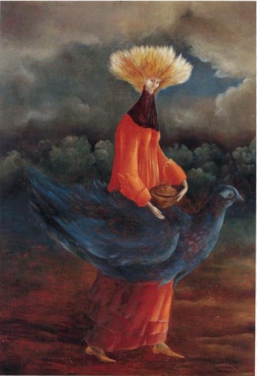
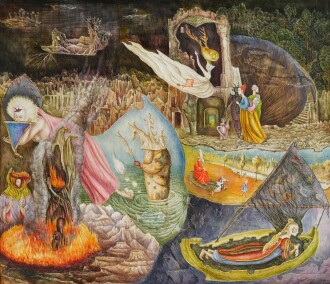


Carrington’s arrival in Mexico heralded the beginning of a period of unprecedented creative freedom, best-evidenced by her production for the 1948 Pierre Matisse exhibition. Her fast and close friendship with Varo was a powerful force in both artists’ lives; drawn together by their affinity for the occult and love of their new home, they were also bonded by the traumas of strict Catholic childhoods and a war period marked by flight, tragedy and exile. Their quick bond sparked a period of intense productivity, scholarly pursuit and technical experimentation, leaving a lifelong impact on both of their oeuvres (see fig. 8). Carrington devoted herself in the 1940s to honing her mastery of egg tempera, a demanding, quick-drying medium that allowed her to convey the intricate detail and iridescent coloration of the supernatural universes in Les Distractions de Dagobert.
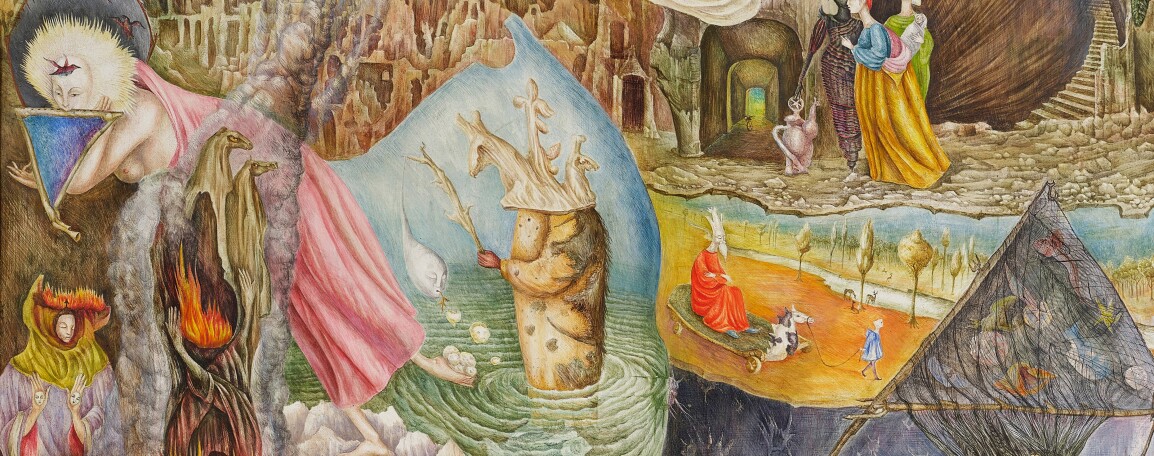
Divided into quadrants that correspond to the four classical elements of Earth, Air, Wind and Fire, Les Distractions de Dagobert is as exactingly rendered, with rigorously precise detail, as it is lush and otherworldly in its gleaming jewel tones. Anchored in Renaissance principles of harmonious composition, its geometric symmetry is occasionally interrupted by organic, irregular forms that lend the work a sense of constant motion that underscores its cyclical themes. The composition is loosely organized in a cycle of vignettes that encircle a bearded figure in crimson robes and a ghostly crown, drawn in a carriage by a page through an orderly landscape dotted with delicate trees and capering deer; the only vignette grounded in pictorial reality, this must be Dagobert, whose fantastic distractions occupy the rest of the picture.


In the lower left a cloaked, inverted figure is engulfed by brilliant tangerine flames; stony horse-headed creatures emerge from the base of the figure, staring at Dagobert with beady amber eyes, as a robed, ecclesiastical figure with a halo of flames and faces for hands seems to warm itself by the consuming blaze. The most cataclysmic of the vignettes presented here, it nonetheless seems to offer a narrative of rebirth. Since her earliest self-portrait, Inn of the Dawn Horse, Carrington has used the horse as an avatar; the growth of these wild-eyed equines from a ritualistic fire may offer an oblique self-portrait of the artist re-emerging fiercely from the ashes of a former self (see fig. 9). Images of fiery regeneration would have surrounded the artist upon arrival in Mexico, from the volcanic volatility of its geography, to the prevalence of ritual fire in the Aztec ceremonies and beliefs that she studied, to the work of José Clemente Orozco, in which the Promethean myth figures prominently (see fig. 10).

In Orozco’s murals, scholars often interpret the myth as an allegory for the difficulty artists and intellectuals face in finding public acceptance for their progressive ideas—a sent.mes nt that resonates with Carrington’s own experiences of rebellion and exile. A cottony tower of silvery smoke rises from the flames through to the uppermost register of the painting, where it grows opalescent, inflected with blue and violet in a dizzying column of tiny brushstrokes and translucent glazes, signifying a transition into the realm of Air.
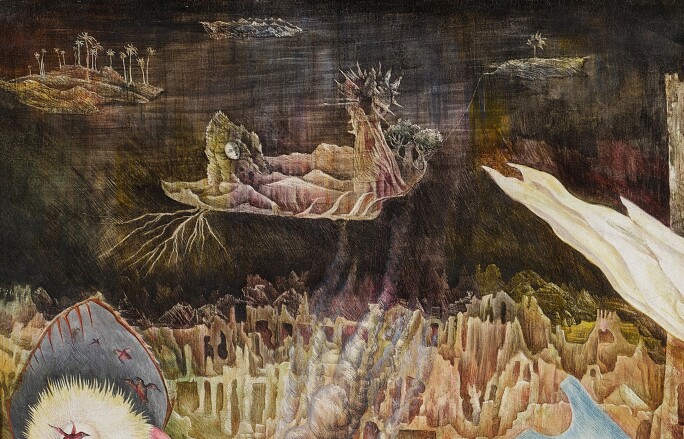

That column of cleansing smoke carries the eye upward, through a dense plane of rocky cliffs and into an open expanse of iridescent night sky, glimmering in mauve, periwinkle and chartreuse. Three silent islands float calmly in the expanse; one dotted with tiny palm trees, the largest dominated by a reclining figure who, in her repose, becomes one with the craggy terrain, as only her moonlike face and a dainty hand remain fully discernible. Gnarled, ancient trees sprout at the base of her feet, and her fingers curl around the edge of her little barque—as a fragile network of roots stretches steadily towards the cliffs below. Yves Vadé, in his detailed examination of the iconography of this painting, draws a comparison to medieval Irish immrama, tales in which the hero (often a monk or a saint) embarks on a series of fantastic seafaring adventures in search of paradise. The most famous of these is the Voyage of Saint Brendan, published in Latin and later translated into French in the 13th century; scholars consider it the first great “adventure” novel of early Modern literature. In this story, the saint and his crew encounter a series of rocky isles inhabited by otherworldly creatures and natural wonders, from an isle of precious stones to a whale-island—often illustrated in illuminated manuscripts from the period with the same visual conventions Carrington references here. These tales of adventure and peril at sea have had centuries of impact on the Irish imaginary, from Jonathan Swift to C.S. Lewis; Carrington, seems to offer her own sly interpretation of the genre. Rather than a gallant explorer, she focuses on the islands themselves, and the delicate worlds where human, flora and fauna intertwine in a peaceful balance. This gesture of centering the “supporting cast” of world literature and culture is one that echoes throughout this painting and Carrington’s oeuvre hereafter.
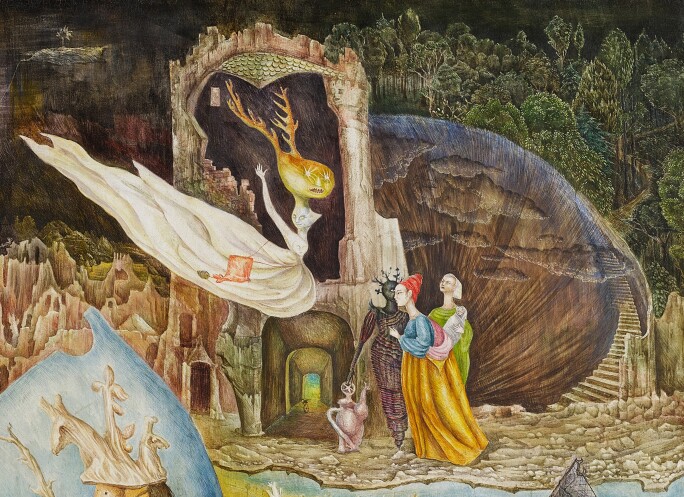
At the edge of this still atmosphere, an ethereal ivory figure clad in a billowing robe darts from the nocturnal world of Air over to a brightly-populated, lavishly-forested vignette that seems to correspond to Earth. Here three women, a baby and a mechanical creature stand in conversation, regarding the three-headed sprite who zips across the upper register. Two are recognizably terrestrial, in medieval European gowns, and one carries a swaddled infant; the third is decidedly otherworldly, from the tips of the leafy extremities that spark from her dark forehead to the rippling layers of fuschia that cascade down her body, culminating in a fine point. The precise details of creatures like this betray Carrington’s careful study of biology; despite their shocking colors and unlikely features, the details of their bodies are grounded in observation of the natural world, rendering them utterly uncanny, existing on the knife-edge of the plausible. The tips of this rippling figure’s fingers graze the pale pink teapot-like creature to her left, who seems to guard the entrance to a bright tunnel at the base of the decaying Classical ruins that stand behind the little group. Behind them, a deep violet orb of sky studded with fluffy clouds surges from the gaping doorway atop the ruins, where it is tightly encircled by a spiraling staircase, and surrounded by a dark forest.


Albrecht Durer, Crab, 1495, Museum Boijmans van Beuningen 

Giovanni di Paolo (1444-50) Paradiso 34, Dante and Beatrice Before the Eagle of Justice, British Library 
Joachim Patinir, Martyrdom of Saint Catherine, circa 1515, Kunsthistoriches Museum, Austria 
Hieronymus Bosch, detail of the Temptation of Saint Anthony Triptych, c. 1500-05, Lisbon, Museu Nacional de Arte Antiga 
Hieronymus Bosch, detail of the Temptation of Saint Anthony Triptych, c. 1500-05, Lisbon, Museu Nacional de Arte Antiga 
Hieronymus Bosch, Saint John the Baptist in the Wilderness, 1485-1510, Madrid, Fundacion Lazaro Galdiano 
Giovanni di Paolo, detail from The Creation of the World and the Explusion from Paradise, 1445, Metropolitan Museum of Art Nice, Emily 
Mosaic of Peleus and Thetis, parents of Achilles, with the Three Fates, Klotho, Lachesis, and Atropos, House of Theseus, Paphos Archeological Park, Cyprus, Second Century BCE 
Fra Angelico, The Dormition and Assumption of the Virgin, 1424-1434, Isabella Stewart Gardner Museum Nice, Emily


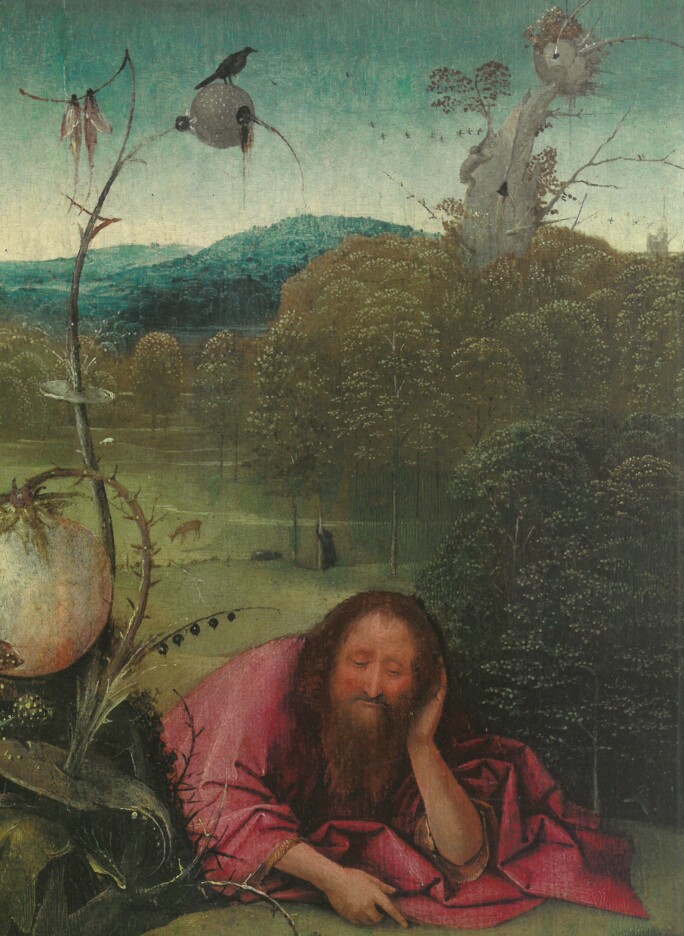


Les Distractions de Dagobert is abundant with visual allusions to the work of Hieronymus Bosch, whose Garden of Earthly Delights and Triptych of Saint Anthony she had t.mes to admire and study in Madrid and Lisbon before leaving Europe—but nowhere more so than in this vignette, where from the dark forest to the threatening architecture, several elements are direct quotations, astounding in their technical accomplishment. Carrington’s wit is sharp in her deployment of these images. Bosch’s shockingly inventive depictions of spiritual and physical depravity have a distinctly moralizing character. Executed on commission to adorn altarpieces and other spaces of public and private worship, his horrifying images of the world in chaos served as moralizing didactics in their t.mes , enforcing the values and social hierarchy imposed by the Catholic church—dominion of men over women, humanity over nature, God over all beings. Carrington quotes the Dutch master here to do precisely the opposite.

Her pictorial universe is distinctly unhierarchical; all manner of beings consort and blend into one another. Figures and places considered wicked by religious traditions, from fairies and witches to dark forests and deep seas are instead sources of power, beauty and harmony. The three women at the center of this scene evoke notable trios of women with supernatural power in the Western imaginary, often presented as sinister; the Fates, Shakespeare’s Weird Sisters, the Triple Goddess of the Ulster Cycle, and here,in the context of Dagobert, they could reference his rumored three wives. In the present work, these three conspiring figures, who consistently reappear throughout Carrington’s oeuvre, may also offer a personal allusion to her creative friendship with Remedios Varo and Kati Horna. One of the three is even depicted holding an infant. Carrington had her first son shortly after this work was executed and may have been pregnant when she painted it; she wrote in letters to Edward James in the late 1940s about how beautifully she felt she painted while pregnant. Working together in Mexico, each of these artists-built spaces both in their respective work and in their lives where the “feminine” realms of the home and kitchen become spaces of alchemical creativity, practical jokes, wit and joy. In these three conspiratorial figures, perhaps Carrington also offers us an oblique tribute to the power of female friendship.

At the lower right, a mossy-haired pale figure in medieval garb reclines alongside her shadow on a delicate leaf-life boat, asail in a deep lavender sea studded with translucent biomorphic forms. Over the bow, the shadow’s hair forms a fine net in which tiny gemlike shells, crustaceans and cetaceans are suspended. This scene, rendered with a complexity of chroma that belies tempera’s resistance to blending, seems to roil with the movement of the sea; Carrington’s achievement in optical blending, through infinitesimal strokes of crosshatching, is breathtaking. Introspective and still, it offers a peaceful foil to the images of catastrophic fire and tectonic activity that immediately surround it, completing the cycle of life, death and rebirth that appears throughout Les Distractions de Dagobert.


Finally, the scene at the center, closest to King Dagobert, is dominated by two mysterious characters—a pale deity playing a triangular flute, who glides along the center left in a parallel gesture to the three-headed creature above her, and a hooded fisherman, waist-deep in a turquoise whirlpool. The goddess, imbued with trappings of divinity from far-flung sources (from the halo of Catholic Marian tradition, to the blue hummingbird of Aztec creator-god Huitzilopochtli), closely evokes Giovanni di Paolo’s depiction of Beatrice in his illustrations of Dante’s Divine Comedy (see fig. 11). In the Divine Comedy, Beatrice represents theological revelation, grace, and faith; she acts as guide to the narrator from the end of Purgatory through to Paradise. Carrington’s take on this figure is distinctly wilder; though her pink robes and gesture of peace capture the same sense of serenity as di Paolo’s, her sly expression, partial nudity and musical offering invoke a primal, ritualistic joy. The hooded, horse-headed figure at center straddles each of the worlds, placidly fishing for an ethereal being that it can’t seem to snag. Closest to the dreamer, Dagobert, it stands as a patient witness to the galaxies of possibility that unfold around it.

Les Distractions de Dagobert is the virtuosic work of an artist at the pinnacle of her creativity. So dense with iconographic allusions and ideas that it is impossible to fully untangle, it ultimately invokes a profound sense of awe at humanity’s small place in a universe of endless potential.

Carrington painted avidly until her death in 2011. She continued to travel, exhibit internationally, and work, leaving a lasting impact on generations of artists, writers and other creatives—especially in Mexico, where her creative impact is felt substantially. Her mural El Mundo mágico de los Mayas (see fig. 12), in the National Museum of Anthropology in Mexico City, stands as permanent test.mes nt to her legacy here; it is felt equally in the work of a wide range of living artists and creatives there who mine aspects of the fantastic, from filmmaker Guillermo del Toro to designer Bárbara Sánchez-Kane.
Despite her profoundly innovative body of work, her close entanglement with the inner circle of Surrealism, and the recognition of many famous peers, Carrington’s critical contributions to twentieth century art were largely sidelined by mainstream critics and international commercial galleries during her lifet.mes . Recently as cultural zeitgeist has keyed into the Surrealist movement, a series of museum exhibitions have sought to correct the historic oversight, from exhibitions like In Wonderland at LACMA that highlighted the creativity of women artists experimenting with Surrealism in the Americas, to Surrealism and Magic: Enchanted Modernity at the Peggy Guggenheim collects ion two years ago in Venice, where Les Distractions de Dagobert was the exhibition’s centerpiece and which, alongside the 59th Biennale di Venezia (The Milk of Dreams), used her painting and ideas as a thematic framework.
Today in the face of environmental disasters, global migration and the rise of the digital age, an increasing number of artists, from Jaider Esbell to María Berrío to Ewa Juszkiewicz, use fantastical imagery to examine the same questions around the boundary of what is human (or what it.mes ans to be human), and the relationship between people and the natural world that Carrington probes so pointedly in Les Distractions de Dagobert (see fig. 13). Berrío, whose prismatic collages examine experiences of migration and displacement, has cited Carrington’s influence, stating “Carrington’s depictions of women in dialogue with animals tap into mythology and psychology to render an imaginary world in which all beings live in perfect harmony... her work has deep resonance with my thinking” (https://www.artofchoice.co/maria-berrios-collages-are-grounded-in-magical-realism/).

The appearance of Les Distractions de Dagobert at public auction for the first t.mes
in three decades heralds the turning of a new page in art history. One-hundred years after Breton published his Surrealist Manifesto, the pivotal importance of this spectacular painting in the story not just of Surrealism, but of human creativity writ large, cannot be overstated. Carrington’s kaleidoscopically beautiful crowning achievement, it stands as test.mes
nt to the ingenuity and strength of the human spirit.