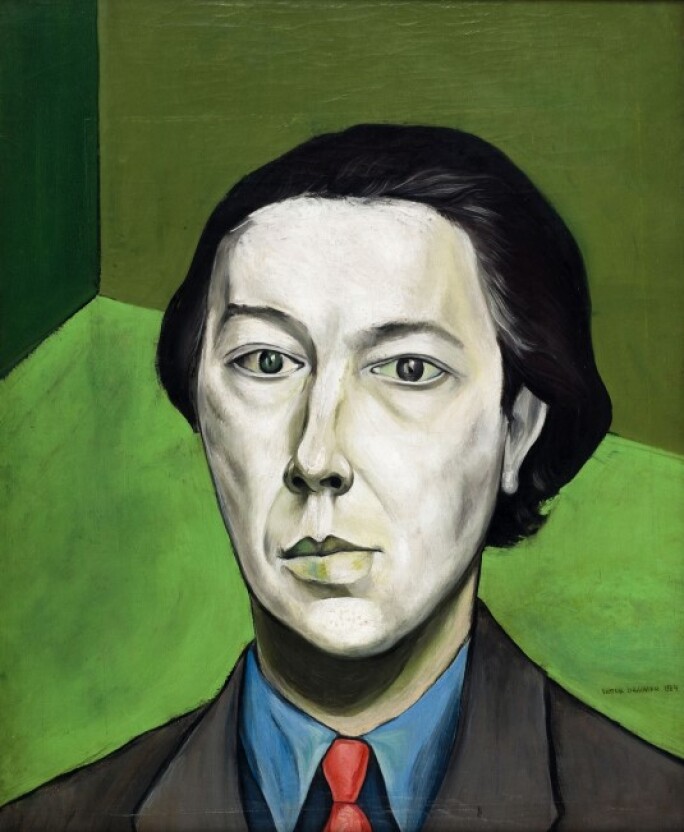
Originally from Romania, Victor Brauner settled in Paris in 1930. There he soon befriended his compatriot Brancusi and after later meeting Yves Tanguy, the artist was quickly welcomed into the Surrealist fold. André Breton was particularly taken with Brauner, who immortalized the movement’s ideologue in a portrait painted around the same t.mes as the present work (see fig. 1).
According to the entry on the artist from the Museu Coleção Berardo, “Brauner seduced the Surrealists with unusual and obsessive images of chimerical figures that combined different natural kingdoms. In his series Morphologies de Monsieur K [Morphologies of Mr K], he painted portraits of dictators and denounced the rise of the fascists" (accessed online https://en.museuberardo.
pt/collects
ion/artists/71).
"To André Breton, [Brauner] was ‘the magic artist’ par excellence.”
The droll spectacle that is Indicateur de l'espace is indeed closely related to one of Brauner’s most iconic early works from this series, Kabyline en movement from 1933. The latter features the namesake character Kabyline, one of Brauner’s ghoulish otherworldly protagonists (see fig. 2).

Right: Fig. 3 The present work
Set against a similarly checked floor and pink plaster wall, the figure at the center of Indicateur de l'espace presents a comedic counterpart to the haunting, webbed Kabyline. The beaked character of the present work sports a tattered green cloak, its tears revealing innards made of wooden boards, metal gears, dripping goop and what appear to be additional imagined creatures. Like in Kabyline en movement, a rogue foot protrudes from a square hole in the floor and a lonely toy ball rests idly in the distance. The unnerving expanse and elongated shadows channel de Chirico’s metaphysical paintings of empty piazzas and mannequin forms (see fig. 4).

Though rendered from a thoroughly Modern point of view, such fantastical creatures were by no means new in the canon of art history. Most famously, the artist Hieronymus Bosch popularized bewitching imagery of chimeric creatures in the fifteenth century, albeit with deeply religious overtones and admonishments against sinning (see fig. 5).

From the t.mes he arrived in Paris, Brauner was highly regarded among his colleagues, though the style of his Surrealist depictions would vary greatly from one work to the next. As William Rubin writes, “Victor Brauner was the most talented Surrealist recruit of the middle thirties. His self-proclaimed commitment to the absolute priority of poetic as over and against aesthetic concerns did not, however, turn him into an academic imagier, though it did result in certain inconsistencies of style. Despite the manifest influence of Klee and Ernst in much of his imagery, such pictures as Gemini (see fig. 197) demonstrate that Brauner was able to put a very intense personal stamp on his visions” (W. Rubin in Exh. Cat., New York, The Museum of Modern Art, Dada, Surrealism, and their heritage, 1968, p. 136; see fig. 6). Just a few years after the present work, Brauner’s imagery would shift toward the quasi-folk renderings like Gemini which would define his career thereafter.

From the height of his Surrealist oeuvre and the limited series centered around his Kabyline figure, Indicateur de l'espace comes to the market for the first t.mes
in a decade and was exhibited in one of the greatest Surrealist exhibition of recent history, the Wadsworth Atheneum’s 2018 show Monsters and Myths: Surrealism and War in the 1930s and 1940s.