
Emerging from a theatrical blue sky, Ed Ruscha's iconic crisp white letters reveal the titular phrase ‘Cold Beer Beautiful Girls,' enticing the viewer with a captivating zenith of symbol and text recalling the provocative opening of a Hollywood black-and-white film and the most compelling advertisements of the 1960s and 70s. Encapsulating Ruscha's career-long exploration of semiotics and text, Cold Beer Beautiful Girls is a seminal embodiment of the conceptual rigor and signature style that have come to define Ed Ruscha's highly acclaimed artistic practice. With an arresting intensity, the crisp white letters cinematically emerge from a cloudy sky in a seductive and triumphant treatise on the nature of semiotics and consumer culture. In the present work, Ruscha bestows the beguiling phrase with a poetic and iconic status. Emphasizing the importance of Cold Beer Beautiful Girls, the sister painting is held in the permanent collects ion of the Broad Art Foundation in California. Elusively enticing, subtly ironic, and yet simultaneously imbued with a nostalgic familiarity, the text ‘COLD BEER BEAUTIFUL GIRLS’ here becomes a distillation of American idealism, a wry commentary on the endless promise the phrase evokes, analogous to the best-known images of American Pop. A stirring tribute to the artist's beloved Californian surroundings, Cold Beer Beautiful Girls stands as one of the ultimate icons of Ed Ruscha’s body of work. This alluring image represents Ruscha’s unique capacity to evocatively portray desire and its pervasive manifestations within American popular culture and visual imagination.

"I like the idea of a word becoming a picture, almost leaving its body, then coming back and becoming a word again…I see myself working with two things that don't even ask to understand each other."

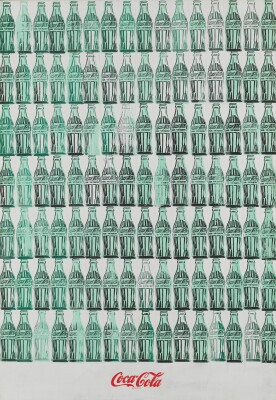
Since the 1960s, Ed Ruscha has immortalized his home of Los Angeles, and more broadly the West Coast, through his inimitable brand of Pop Art. In the present Cold Beer Beautiful Girls, Ruscha renders an abstracted skyline along the bottom of the composition, orientating his viewed in an abstracted yet distinctly West Coast landscape. The tension between specificity and abstraction that Ruscha achieves here echoes that of the text, which teeters on recognition but remains elusive. Locating the sublime in both the natural and artificial, Ruscha's portrayal of quotidian ephemera parallels Warhol's trademark Coca-Cola bottles and Campbell soup cans, or Roy Lichtenstein’s iconic comic-book inspired blondes. Influenced by his surroundings, popular culture and advertisements, Ruscha stencils the phrase with careful precision, deconstructing the barriers between "high" and "low" art. Executed in 1993, the present work dates to the period during which Ruscha returned to painting in acrylic on canvas, creating some of his most revered and well known works. The appropriation of the commonplace and its subsequent transcendence into Replica Handbags chimes with Pop Art's greatest ambassadors such as Andy Warhol, Roy Lichtenstein, and Barbara Kruger, who worked simultaneously with Ruscha throughout much of the late Twentieth Century to deepen the artistic exploration of commercial culture.


Shane Guffogg, Ruscha's former studio assistant recalls, "I remember I was driving out to Ed's ranch outside of Pioneertown and passed San Bernardino in this long stretch of nothing," Guffogg says, "and there was a billboard advertising a bar: "Cold Beer, Beautiful Girls." And he had just finished the painting of the same name: "COLD BEER, BEAUTIFUL GIRLS." And I looked at him and said, 'Hey I know where you got that from,' and he said, 'Where?' And I said, 'Well, that billboard where that bar is,' and he said, 'What? What are you talking about?' He had no recollects ion of it and he thought I was making it up, so he drove out there to check. He's a human antenna, like I said. Seeing, witnessing, snagging all he can." (Shane Guffogg quoted in Flaunt Magazine "Ed Ruscha" December 2016 (online))

Theatrical in scale, the present work consumes your gaze, toying with the alluring tension of an inescapable advertisement, an intoxicating promise. Meticulously and elegantly rendered, the text Cold Beer Beautiful Girls is illustrated with rigorous precision. The entrancing, bold letters float on a vast plane, mimicking the opening credits to a film or a fleeting glimpse of a roadside billboard, designed to captivate the viewer's attention in one compelling instant. Set against the midnight blue, the dark haze of clouds, rendered with a masterful graduation of tones and subtlety, the lustrous glow of brilliant white letters holds an almost celestial reverence.

Ruscha's subtle chromatic gradations of color and heightened renunciation of the brushstroke with the present series endow these paintings with a smoldering sfumato and photorealistic appearance, echoing Gerhard Richter's Clouds paintings of the 1970s and the enigmatic, harmonious glow of Edward Hopper's night scenes. Silhouetted against the dramatic elegance of the sky, the strip of horizon line at the bottom of the composition, both emphasize the heavenly elegance of the phrase and affords the composition a romantic complexity. As Ruscha described, "There are things that I'm constantly looking at that I feel should be elevated to greater status, almost to philosophical status or to a religious status. That's why taking things out of context is a useful tool to an artist. It's the concept of taking something that's not subject matter and making it subject matter." (Ed Ruscha quoted in Richard D. Marshall & Ed Ruscha, Ed Ruscha, 2005, p.133)


Vividly compelling and dramatic in scale, Cold Beer Beautiful Girls is a paradigmatic example of Ruscha's iconic text paintings; the striking words instantly conjure a memory and provoke nostalgia. The richly textured, cinematic sky and witty phrase embodies Ruscha's signature artistic vernacular and the enticing allure of commercial culture. Ruscha employs the graphic tension of the text against the skyscape as both object and illusion, creating an optical effect. Cold Beer Beautiful Girls is a distantly evocative example of Ruscha's singular lexicographic painting style, which distinguished the artist as the trailblazing 'Pop Artist of the West coast' and all-around purveyor of American cool.
“When you're on a highway, viewing the western US with the mountains and the flatness and the desert and all that, it's very much like my paintings."
Inspired by a billboard in Southern California, the present work seamlessly evokes the boundless miles of the great American landscape, Ruscha's inspiration and muse. Aggrandized and isolated in Ruscha's paintings, words and phrases are stripped of context, imploring the viewer to contemplate the transcendent power of language. Through the crisp white letters projected onto the endless expanse of the mythical West and the subtle horizon line which summons universally relatable imagery, Ruscha explores the mesmerizing sovereignty of language. Deftly examining the complex relationship between collects ive culture, text and iconography, Cold Beer Beautiful Girls boldly embodies the subtle interplay of aesthetic and conceptual concerns that exemplify Ed Ruscha's most seminal paintings.

