Georges Mathieu's Espoirs cruels:
The Cry of Ecstasy
Renowned 20th century art historian Sir Herbert Read once wrote: “Mathieu is inimitable because he doesn’t imitate himself.” From the artist’s pioneering experiments across Paris in the 1940s, performance art that propelled him onto the international arena in the 1950s, through to the 1960s and ’70s when his works were increasingly regarded as mainstream, leading to large-scale museum-grade projects such as Hommage à Watteau (Lot 1032), Georges Mathieu had continuously broke new ground, ever experimenting throughout the decades to widen the spectrum of abstract art.
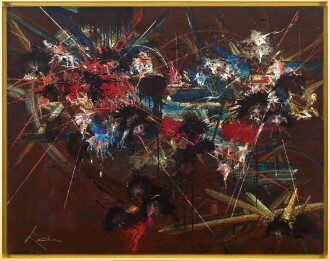
Already established as a member of the Académie des Beaux-Arts by the 1980s, Mathieu welcomed the arrival of the Barbaric Period. It was the stage of Mathieu’s art which sought to connect and bring together energy from the cosmos, deploying explosive brushstrokes that stirred emotions through the collision of stardust, and realizing a spiritually sublime creative approach. Espoirs cruels (Lot 1031) completed in 1988 was a representative work from this period. Last year, Désespoir de lumière, also completed in 1988, sold for a stunning price of HK$5.6 million, eight t.mes s above its presale estimate. Sharing similarity in composition, colour scheme and subject, Espoirs cruels presented this season comes from the same vein of inspiration, whilst its presale estimate is even more attractive.
“Not only creation shared by all but creation made by all, with each person becoming a particular form of artist, with each of our actions bathing in a grace in which the aesthetic would be indissociable from the ethical."
An outstanding performer, Georges Mathieu is unafraid of drawing in front of others. He confronted the large-format canvas like a combatant wrestling with colours and pigments, offering a dramatic visual impact to the viewer. Also a talented theorist, Mathieu offered viewers the opportunity to understand his unique aesthetic views. For instance, in a 1971 lecture in Brussels, he asserted that “not only creation shared by all but creation made by all, with each person becoming a particular form of artist, with each of our actions bathing in a grace in which the aesthetic would be indissociable from the ethical.” Ever examining the role of art in society, Mathieu was careful that his art did not.mes rely indulge in superficial emotional release. The present work, entitled Espoirs cruels, offers the viewer a figurative direction of associative thinking; in overlapping layers of colour blocks, several golden strands are refracted from the centre, symbolizing light’s triumph over darkness. The blue, white and red in the back refer to the tricolore of the French flag and represent the tripartite motto of the French people: liberty, equality, fraternity. At the t.mes , Mathieu was hailed as the official representative of French art, his works reflecting his concern and consideration of society, as well as a keen desire for contributing towards the greater good through his paintings.
In this season, Replica Shoes ’s will also present Sin Titulo (Dedicado a Gerardo Rueda) (Lot 1025) from the classic Saetas series by Spanish-Pilipino artist Fernando Zobel, who used the unconventional tool of syringes to apply pigments in creating the piece. Mathieu and Zobel were active in the same period and joined the Post-war Abstract Art movement around the same t.mes , and they both found inspirations from Asian calligraphy. Placing the two works alongside each other, the close connection between the two is apparent – a cross-cultural, intercontinental dialogue between two masters, further evidencing how modern art obliterated geographic limits through a globalized vision in which strands of creativity crisscross, constructing a brand new artistic order.
喬治・馬修《逆境曙光》:
喬治・馬修《逆境曙光》:
狂喜的吶喊
二十世紀英國著名藝術史學家赫伯特・里德曾形容:「馬修是獨一無二的,因為他不模仿自己。」從四〇年代闖蕩巴黎的先鋒實驗、五〇年代走進國際藝壇的行爲藝術,至六〇、七〇年代漸成主流美學,造就《致敬華鐸》(拍品編號1032)等國家博物館級別大型項目,每個時期的馬修總會帶來突破,一路為拓闊抽象藝術的光譜而進行多番前衛的實驗。八〇年代,已獲選為法蘭西學院院士的馬修,早已坐擁光輝成就,卻未曾停筆,更在此時迎接被稱為「狂野時期」的降臨,畫面接引並凝聚源自宇宙的能量,具爆發力的筆觸澎湃激昂如星塵碰撞,成就精神內涵全然昇華的繪畫風格,創於1988年之《逆境曙光》(拍品編號1031)即為當中的經典佳作。1991年以後,馬修持續創作紙本作品,卻罕有再以畫布為媒介,因此創於八〇年代後期的油畫系列尤顯珍貴,可謂見證著其藝術事業從起步到抵巔峰、繼而邁向光榮最終章的精彩歷程。去年,創於同年之《希望之光》於香港蘇富比以估價八倍的港幣五百六十萬震撼落槌,本季《逆境曙光》的直幅構圖和色調與之非常相近,更同樣以「光」為題,硬朗而舞動的線條簇擁著節節上升的光源, 創作靈感可謂源自一脈,而本作估價相較之下更顯吸引。
「不應只為了大眾而創作,更應鼓勵大眾一起創作,每個人都可以成為某種藝術家,每個人的貢獻都浸浴於美學與道德不可分割的恩典𥚃。」
馬修無疑是一個出色的表演者,他不懼於人前作畫,面對著巨幅的畫布,他如同競技場上披甲的鬥士,奮力展開一場與顏料的搏鬥,瞬息萬變、張力懾人的揮筆惹人嘩然,衝擊著觀者的視覺與情緒。放下顏料軟管、卸下表演服飾後,馬修亦是一個天才理論家,他多產的寫作與動人的演說,讓人從多角度了解他獨特的美學與世界觀,如在1971年布魯塞爾的一場演講中,馬修即提出他認為「不應只為了大眾而創作,更應鼓勵大眾一起創作,每個人都可以成為某種藝術家,每個人的貢獻都浸浴於美學與道德不可分割的恩典𥚃」,呼應著他一貫樂於藉表演與人建立溝通的藝術形式。馬修時刻思考藝術在社會中擔當的角色,以免創意只是流於表面情感渲泄的膚淺行為;此作命題為「逆境曙光」,畫面構成雖為抽象,卻給予觀者一個具象的聯想方向:在層層相疊的濃艷色塊之中,幾道金黃線條由中心折射而出,象徵光明在混沌中更勝黑暗,逆境曙光,邪不壓正;而背後的藍、白、紅色也明確地指向法國國旗的顔色組合,象徵了法國民族所秉持的三種精神:自由、平等和博愛,而光明亦終將帶領國家走向繽紛燦爛的前程。此時的馬修被冠為法國戰後藝壇的官方代表,其創作反映了藝術家對於當時社會意識形態的關注與反思,藉畫作寄語積極向善的宏大思想。
曾於戰後時代大力宣揚不定形藝術的法國藝評家米歇爾・塔皮耶,對馬修的創作留下了深刻的闡述:「他賦予這些符號不同的題旨……將觀眾從荒謬而平庸的日常中拯救出來,並引領他們走向充滿活力的氛圍中。」在馬修的作品跟前,觀眾不難從那毫無拘束的筆觸之中,感受到一股強勁凌厲的魄力,而日本前衛畫家吉原治良亦曾在《具體宣言》中,描述馬修的畫作如是「體現了物質、顏料和瓷漆的吶喊」;以上兩位皆不約而同地提出了馬修的創作中一些非肉眼可見的特質,畫中充滿激情活力的元素使人狂喜、令人振奮,並觸動著觀者在不同感官上的聯想,如此富於啓發性和刺激想像力的畫面,造就了馬修的藝術裡無可比擬的精神高度。
本季現代藝術晚拍,蘇富比同場呈獻西班牙裔菲律賓藝術家費南度・索培爾的經典「Saetas」系列《無題:獻給Gerardo Rueda》(拍品編號1025),展現其抛棄傳統畫具、運用針筒擠出顔料而製造的立體畫面效果,深刻地留下其於五〇年代在美國留學時所吸納的抽象表現主義的美學軌跡;馬修與索培爾為同代藝術家,並在相若時期投身戰後抽象浪潮,而兩位均從東方書法裡獲得了重大啓發。若將《逆境曙光》和《無題:獻給Gerardo Rueda》並置而觀,不難發現兩者從技法、構圖到理念上都緊緊呼應著對方,形成一場跨地圖板塊、跨文化背景的大師對話,引證「現代藝術」在全球化視野下,逐漸褪去地域性的局限,就如這對抽象畫中的意境般,創意脈絡相逢與交錯,築起全新定位的藝壇秩序。
Georges Mathieu's Auction Precedent