Pieter Brueghel the Younger's career was based on the production of versions of his late father's compositions. In fact he painted a greater number of compositions of his own devising, many, like this work, depicting Flemish peasants carousing.
The composition is adapted from the central figure group in Pieter Brueghel the Younger's horizontal composition of peasants feasting and carousing outside the Swan inn, known in eight autograph versions of which three are dated: 1625; 1630; 1632.1

The vertical orientation of the grain of the oak panel suggests that this treatment of the subject was conceived from the outset as an upright. Indeed, Brueghel painted several upright versions of this compositions, including a signed one with a pendant of peasants dancing, both formerly with Galerie de Jonckheere in 1999, and both on panels with a vertical grain.2 When he compiled his Brueghel catalogue raisonné, Klaus Ertz knew this painting only from an old photograph kept at the Witt Library in London, and listed it in his F = Fraglich (questionable) category, while observing in his text that it was probably autograph. Since then he has inspected it in the original and has confirmed Brueghel's authorship.3

Infra-red imaging conducted by Tager Stonor Richardson, and reproduced above (fig. 1), reveals the characteristic Brueghel technique of dry carbon-based under-drawing.4 The central figure group, to be found in other versions, of both horizontal and vertical format, appears to have been taken from a cartoon, either via pouncing that was later erased, or by tracing, whereas the standing figure holding the jug at the left, absent from other versions, is more freely-drawn. Most of the background is very freely-drawn, although the church to the right is drawn with a more tightly controlled line, and may be based on a cartoon. As is to be expected, many details of the painting, such as the knife resting on the dish on the table, have no under-drawing and were painted spontaneously.
The panel comprises four narrow vertical aligned boards of Baltic oak. Tree-ring analysis conducted by Ian Tyers of Denrochronology Consultancy reveals that two of the four boards are from the same tree, of which the last growth ring is from 1614, indicating that it was most likely felled after 1620, with a plausible date of use from the mid-1620s onwards.5 This is consistent with the dates of the horizontally composed peasants dancing and carousing outside the Swan Inn, between 1625 and 1632.
NOTE ON PROVENANCE

This painting has remained in possession of the same Austrian family since the 19th century. Heinrich von Ferstel was an architect and an apostle of the Renaissance revival in Austrian and Bohemian architecture, employing polychromy and sgraffito in the castles, churches and public and private buildings that he designed, including many of the buildings on the Ringstrasse. Many of his buildings were however Gothic, such as the Votivkirche in Vienna, his most important commission.
1 Ertz 1988/2000, pp. 845–46, nos. E 1179–E 1186, most reproduced.
2 Ertz 1988/2000, p. 824, no. E 119, reproduced p. 691, fig. 570.
3 His photostat certificate dated 19 August 2019 will be supplied with this lot.
4 Their detailed report, job no. 20200623, dated 24th June 2020, may be accessed here.
5 Report no. 1227, July 2020, available on request and via this link.
- The Golden Age
- 1610
- 1625
- 1632
- 1635
- 1652
- 1660s
-
 The Golden AgeThe Golden Age came about thanks largely to an explosion of wealth from trade that began at the end of the 16th century and lasted well into the 17th as the Dutch provinces seceded from the Spanish Empire and established their full independence. It created a large, wealthy middle class such that buying art was no longer the preserve of just kings, queens and religious orders: everybody with money to spare was at it.
It was against this prosperous backdrop that the paintings in this sale by Bosschaert , Rubens , Rembrandt , Hals , Van Goyen and Mignon , in that order, were created. -
 Ambrosius Bosschaert the ElderAntwerp 1573 - 1621 The Hague
Still life of four tulips in a Wan-Li porcelain vase
oil on copper
22.5 by 16.5 cm.; 8¾ by 6½ in.
£300,000-400,000
View Lot -
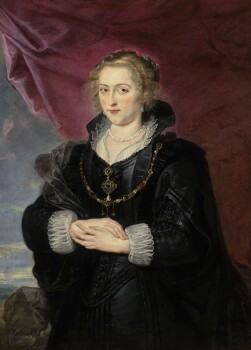
 Sir Peter Paul RubensSiegen 1577 - 1640 Antwerp
Portrait of a lady, three-quarter length, wearing an elaborate black dress and cloak, before a red drape and a distant landscape
oil on canvas
110.2 by 82 cm.; 43⅜ by 32¼ in.
£2,500,000-3,500,000
View Lot -
 Rembrandt Harmensz. van RijnLeiden 1606 - 1669 Amsterdam
Self-portrait of the artist, half-length, wearing a ruff and a black hat
signed and dated: Rembrant · ft./ 1632 (centre right)
oil on oak panel
21.8 by 16.3 cm.; 8⅝ by 6⅜ in.
£12,000,000-16,000,000
View Lot -
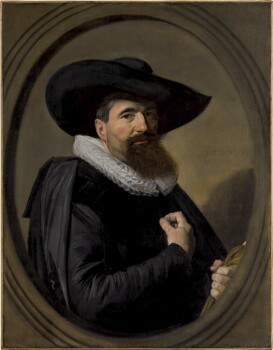
 Frans HalsAntwerp 1582/83 - 1666 Haarlem
Portrait of a man with a broad-brimmed black hat and a white ruff
inscribed with the sitter's age, signed with monogram and dated: AETAT SVAE 50/ ANO 1635/ FH (centre right)
oil on canvas, within a painted oval
87.5 by 68.5 cm.; 34⅜ by 27 in.
£2,000,000-3,000,000
View Lot -
 Jan Josefsz. van GoyenLeiden 1596 - 1656 The Hague
Coastal scene with small vessels in a choppy sea
signed and dated: VG 1652 (lower right)
oil on oak panel
36.9 by 51.3 cm.; 14½ by 20¼ in.
£200,000-300,000
View Lot -
 Abraham MignonFrankfurt 1640 - 1679 Utrecht
Still life with plums, peaches, apricots, grapes and a melon
signed: A. Mignon. fe (centre right)
inscribed with the Dresden inventory number: 392 (lower right)
oil on canvas
90.2 by 74.9 cm.; 35½ by 29½ in.
£400,000-600,000
View Lot