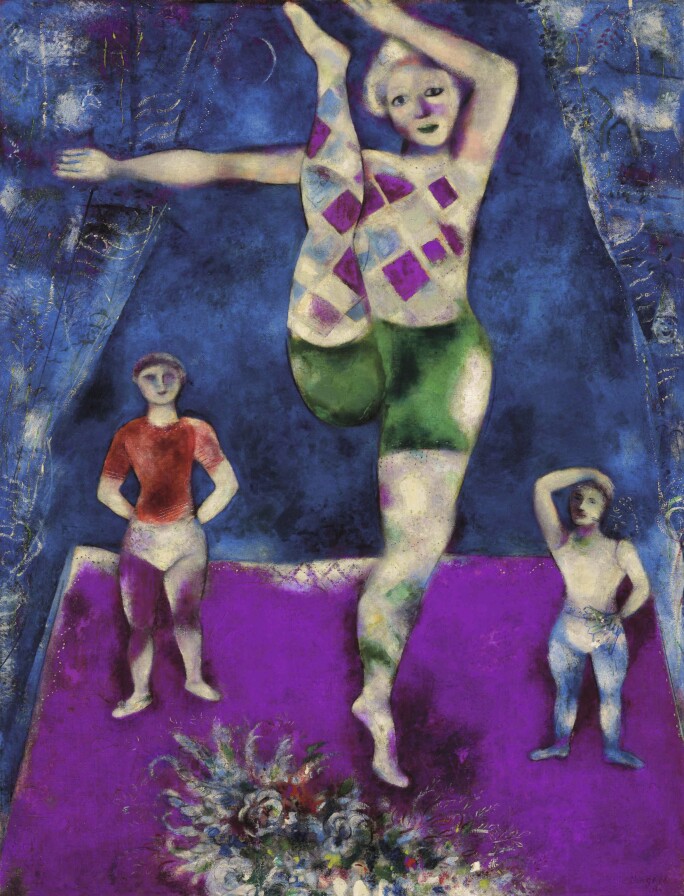
From Les Trois acrobats of 1926, to the monumental Le Grand cirque of 1956, to the late kaleidoscopic works of the 1980s, Chagall featured a dazzling array of performers in a variety of mediums until his final days (see fig. 1).
Painted in 1979, Le Clown en jaune captures the magical allure of circus spectacle and incorporates many of the artist’s most personal and iconic motifs. Rekindled from Chagall’s memories and brought to life on canvas, this scene abounds with acrobats, musicians, dancers and animals in a mesmerizing whorl of activity. It is the clown, however, who is the center of this picture and, as any fervent circus-goer knows, is the heart of the circus itself. Interspersed amid the rows of theater-goers and performers are the artist’s signature violin, bouquet and rooster, which recall his hometown of Vitebsk and beloved first wife, Bella. Exemplifying the artist’s mastery of color, the present work’s brilliant contrasts of yellow, green and red echo the vibrant atmosphere of the scene and recall the electric palettes of the performers’ cost.mes s and makeup.
“‘Circus’ is a magical word, a t.mes less dancing game, whose tears and smiles, the most tragic show on earth, man’s most poignant cry across the centuries in his search for amusement and joy. It often takes the form of great poetry.”
The roots of Chagall’s affinity for the circus can be traced back to his fascination with the traveling acrobatic troupes that passed through his village as a child. From his earliest years, the artist’s memories of the circus were interwoven with life in his small, devout shtetl in Vitebsk—the sounds, colors and fanfare of the theatrical performances recalling his childhood music lessons and the cantoring at his local synagogue. As Elisabeth Pacoud-Rème of the Musée national Marc Chagall writes, “Hasidism, the faith in which he was raised, preaches joy and considers dance and music to be forms of prayer. For Chagall, the acrobat and violinist—characters present in his work throughout his career—were thus inseparable from the ceremonies and family gatherings of Jewish life…acrobats and musicians perform a spectacle that fuses theater and ritual” (Exh. Cat., San Francisco Museum of Modern Art, Marc Chagall, 2003, p. 148).

The natural link between performance and religion for Chagall would later translate to his set and cost.mes design for the Jewish Theater in Moscow beginning in 1918. His previous decorations for Diaghilev’s Ballet Russes, as well as his projects for dramatist Nikolay Gogol in St. Petersburg, had culminated in Moscow in playful and fantastical productions which left a lasting impression on the Jewish Theater for years to follow. The lively acrobats and musicians featured at the fore of later paintings like Le Cirque vert had already begun to inform Chagall’s oeuvre, as evinced by the cast of performers within his designs like Introduction to the Jewish Theatre of 1920 (see fig. 2).
While Chagall was actively involved with theatrical productions for years in Russia, his penchant for the circus in particular was rekindled after his move to Paris in 1923. Shortly after his arrival in the French capital, Chagall made the acquaintance of the dealer Ambroise Vollard. In the course of his representation of the artist, and his lithograph commission in particular, Vollard helped catalyze the creation of one of the artist’s most enduring motifs. Curator Jacob Baal-Teshuva writes: “[In 1927], the art dealer and publisher Ambroise Vollard invited him frequently to his private box at the Cirque d’Hiver (The Winter Circus) in Paris, so that Chagall could make sketches for an album of prints on this theme…The circus kept its hold on Chagall’s imagination to the end of his life. For him, it was a world of color and drama in which tragedy and comedy were continually intermingled. Many of his circus motifs are to be found in the murals he painted for the Jewish Theater in Moscow in the early 1920s” (Jacob Baal-Teshuva, Marc Chagall, 1887-1985, Cologne, 1998, p. 190; see figs. 3 and 4). While it would be another three decades before the suite of thirty-eight prints for The Circus portfolio were realized, the preparatory gouaches and oils from the late 1920s marked the beginning of an enduring path for Chagall.

Right: Fig. 4 POSTCARD OF THE CIRQUE D'HIVER, CIRCA 1925
Venues like the Cirque d’Hiver provided ample inspiration for Paris’ artistic milieu of the nineteenth and twentieth centuries. Located in the heart of the city, the site was inaugurated as the Cirque Napoléon in 1852 during the reign of the second Emperor. The circus stood between the major gathering points of the Place de la République and the Place de la Bastille and was built to accommodate both a stage and a ring for equestrian dramas. The architectural marvel—which functions to this day—is comprised of a twenty-sided polygon topped by a soaring cupola and supported entirely by external pillars. After the fall of the Empire in 1870, the circus was renamed the Cirque National, and later christened the Cirque d’Hiver after a change in management in 1873. Long after his first visit to Vollard's box seats, Chagall returned to the Cirque d’Hiver in 1955 to observe the filming of a movie. This visit once again entranced the artist and led to a suite of sketches for his monumental oil on canvas Le Grand Cirque (see fig. 5).

The Cirque d'Hiver and its counterparts around the city remained a perennial past.mes
and informed the works of innumerable artists across over t.mes
, including Chagall’s predecessors like Degas, Lautrec and Seurat as well as contemporaries like Picasso. Their depictions continued a long tradition of interest in theatrical displays, allowing artists to capture the physical power and grace of bodies in motion while plumbings
the psychological depths of the clown and jester archetypes. As Chagall stated: “The clowns, bareback riders and acrobats have made themselves at home in my visions. Why? Why am I so touched by their masks and grimaces? With them I can move towards new horizons, lured by their colors and masks to other psychic distortions, which I would really like to paint” (quoted in ibid., pp. 193-94).
- Jean-Antoine Watteau
- Francisco de Goya
- Honoré Daumier
- Edgar Degas
- Henri de Toulouse-Lautrec
- Georges Seurat
- Georges Rouault
- James Ensor
- August Macke
- Max Beckmann
- Fernand Léger
-
 Pierrot, dit autrefoisoil on canvas
circa 1718-19
Musée du Louvre, Paris -
 Disparate Puntual (Foolish precision)/ Una reina del circo (A Queen of the Circus)etching and aquatint
conceived circa 1815-17; printed 1864
Princeton University Art Museum, Princeton -
 Clown Playing a Drumpen and black and grey ink, grey wash, watercolor, touches of gouache and conté crayon over black chalk underdrawing
circa 1865-67
The British Museum, London -
 Miss La La at the Cirque Fernandooil on canvas
1879
The National Gallery, London -
 Equestrienne (At the Cirque Fernando)oil on canvas
1887-88
Art Institute of Chicago -
 Le Cirqueoil on canvas
1890-91
Musée d'Orsay, Paris -
 At the Circus (The Mad Clown)oil on cardboard
1907
Philadelphia Museum of Art, Philadelphia
© 2022 Artists Rights Society (ARS), New York -
 Le Désespoir de Pierrotoil on canvas
circa 1910
Kröller-Müller Museum, Otterlo
© 2022 Artists Rights Society (ARS), New York -
 Circusoil on cardboard
1913
Museo Nacional Thyssen-Bornemisza, Madrid -
 Grosses Variété mit Zauberer und Tänzerin (Large Music Hall with Magician and Dancer)oil on canvas
1942
Von der Heydt-Museum, Wuppertal
© 2022 Artists Rights Society (ARS), New York -
 La Grande parade (état définitif)oil on canvas
1954
The Solomon R. Guggenheim Museum, New York
© 2022 Artists Rights Society (ARS), New York


