The American-born artist Kay Sage ranks among the greatest female Surrealists of modern history. After her early studies in Rome and frequent travels throughout Europe, Sage settled in Paris in 1937 a few years after the height of the Surrealist movement. She soon befriended the leading figures of the group and became romantically involved with Yves Tanguy. Though her late coming to the movement (as well as her gender) kept her at some remove from great critical success that other artists enjoyed, Sage carried on in her role as ambassador of Surrealist art.

At the onset of the Second World War, Sage returned to the United States. She and Tanguy settled briefly in New York before marrying and relocating to Connecticut in 1940. Though the war catalyzed their move to America, Sage’s main goal in doing so was to help bring European Surrealism to the States, beginning with works by herself and Tanguy. But despite the clarion call to Modernism that was Alfred Barr’s Fantastic Art—Dada—Surrealism exhibition at the Museum of Modern Art in 1936, gallery sales of Surrealist works remained sluggish in the late 30s and early 40s. Sage, who was largely unfamiliar with the market in New York, soon found that American audiences were less willing to invest their money in the unfamiliar and often perplexing works of these young European artists whom French audiences had more readily accepted.
“There is in her work ‘a feeling for space, a perspective leading toward infinity, that is peaceful and dreamlike..."

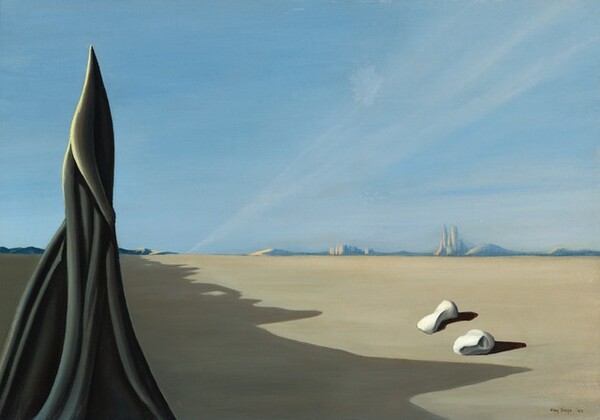
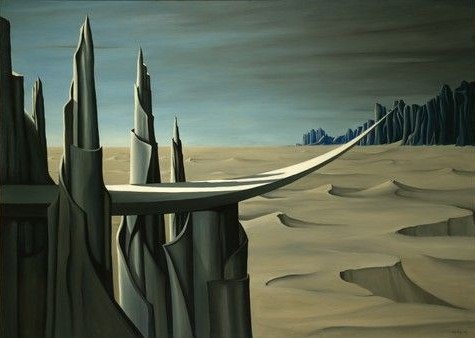
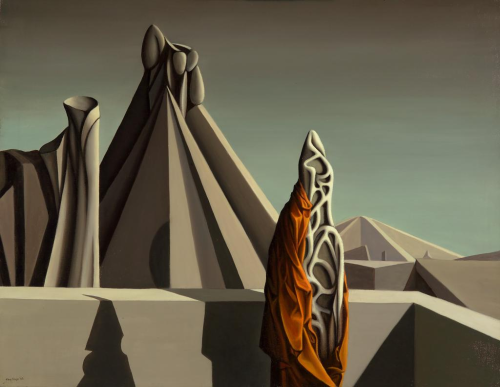
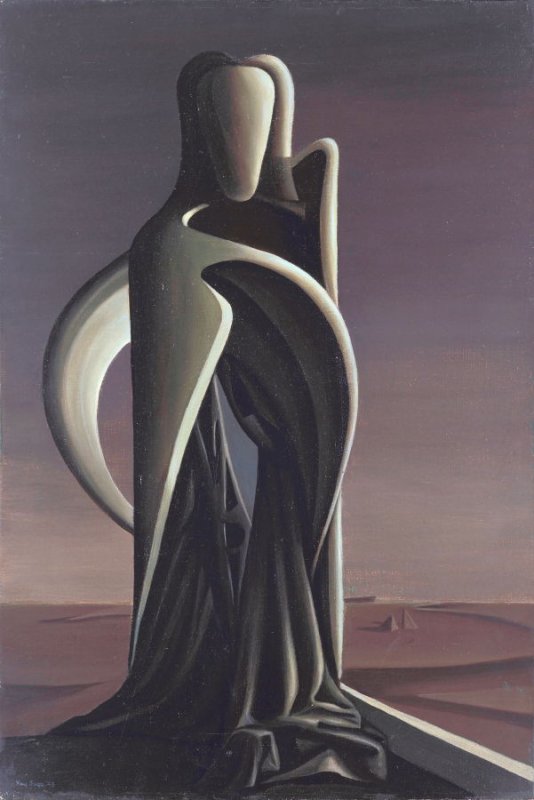
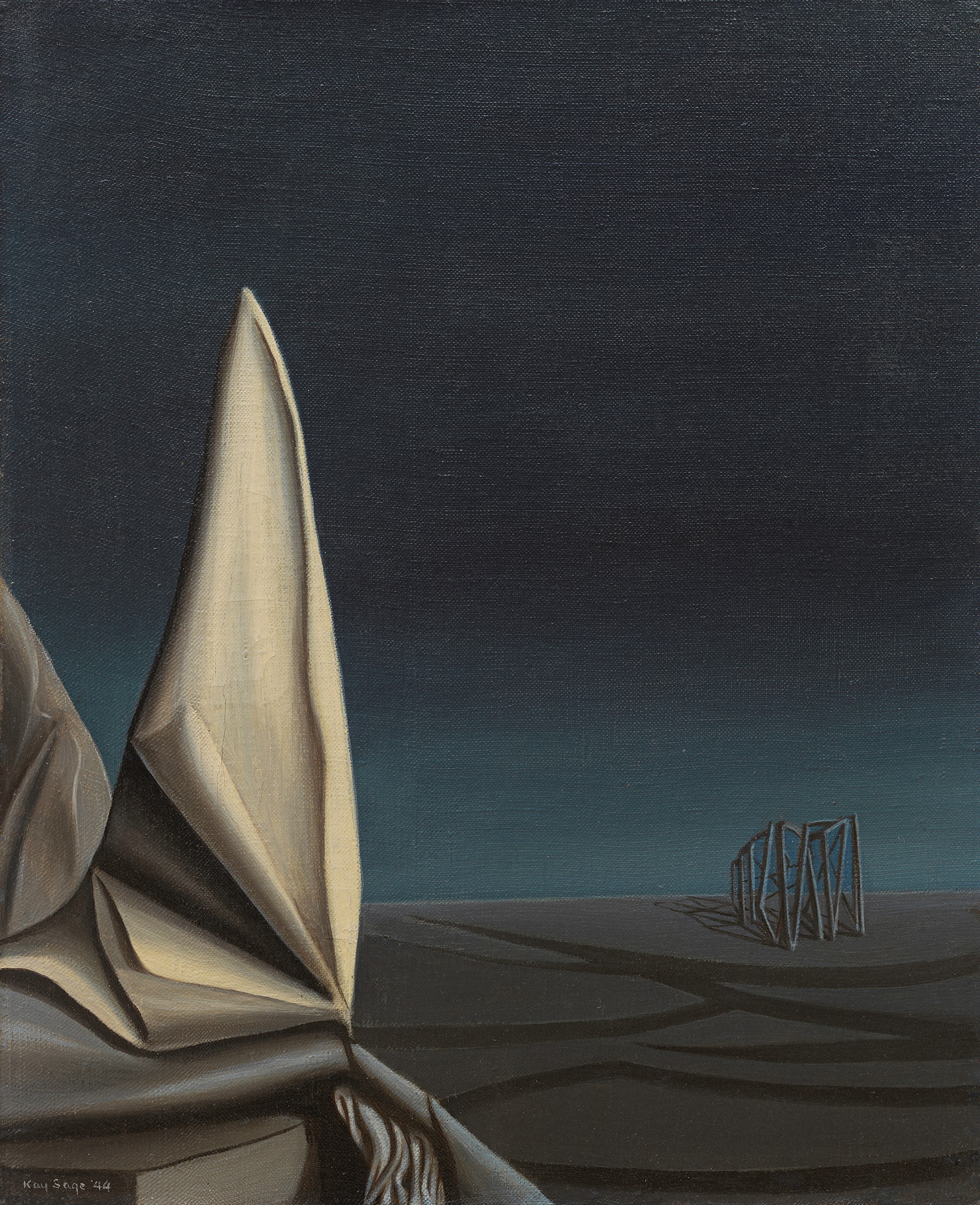
Nevertheless, Sage’s calming penumbral expanses found favor with those who were put off by the more strident and virile strains of Surrealism. A New York t.mes s article from 1940 captured the essence of works like I Walk Without Echo, stating: “there is in her work ‘a feeling for space, a perspective leading toward infinity, that is peaceful and dreamlike, as contrasted with the ‘nightmares’ of another distinguished surrealist, Dali’” (E. A. Jewell, "Diversified Show of Art Are Opened. Washington Artists Hang Their Work at Bignou Gallery," New York t.mes s, 4 June 1940, p. 21).
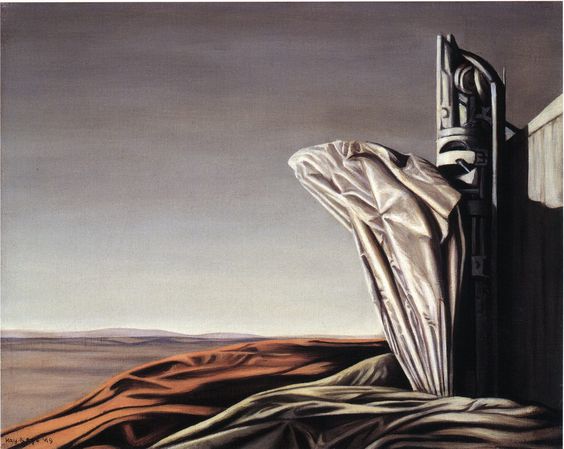
Painted in 1940 just before her move to Connecticut, I Walk Without Echo was featured in the artist’s solo show at Pierre Matisse Gallery that spring. The present work is decidedly less architectural and more organic than Sage’s later work. Its sweeping vista anticipates the southwestern landscapes the artist would encounter in her travels the following summer, while the shrouded forms looming at the fore find resonance with other iconic works from this decade. While Sage’s work primarily focused these sorts of abstracted dreamscapes, she would eventually err on the side of figuration, as witnessed in her record-setting self-portrait Le Passage from 1956 (see fig. 1).
“If I turn back
at least I shall not have
the sun in my face.
But then there will always be
the long shadow of myself
before me.”
Such works were often bestowed with cryptic, quasi- proverbial titles. On the subject, Kay Sage was not inclined to explain further. As Solomon Adler of SFMOMA writes, “When asked about one of her works, she famously said that she knew ‘nothing of [its] origin except that I painted it.’ There was, however, a certain observation that she readily made: ‘I do know that while I’m painting I feel as though I were living in the place’” (S. Adler, “Kay Sage, Midnight Street, 1944,” accessed online, https://www.sfmoma.org/essay/kay-sage-midnight-street-1944/).
Making its debut in the artist’s first solo show at Pierre Matisse Gallery, I Walk Without Echo has since been exhibited around the country. In 1966, the work was donated to the Mattatuck Museum in Waterbury, Connecticut by the artist’s friend and patron Hugh Chisholm, and was held in the collects ion—the largest holdings of the artist’s work—for nearly 50 years.
Enigmatic Atmospheres: Kay Sage in the 1940s - The Museum Context