


What sets apart a great work of art is an inherent and perfect balance. With balance comes tension, which must naturally exist with all the risk of collapse associated with it. In La Jeune fille au bouquet it is the contrast between figuration and abstraction on the one hand and modernity and classicism on the other that makes this canvas one of the most nuanced, successful and important of Léger’s corpus. In addition to its appealing artistic attributes, La Jeune fille au bouquet is further distinguished by its fascinating provenance history.
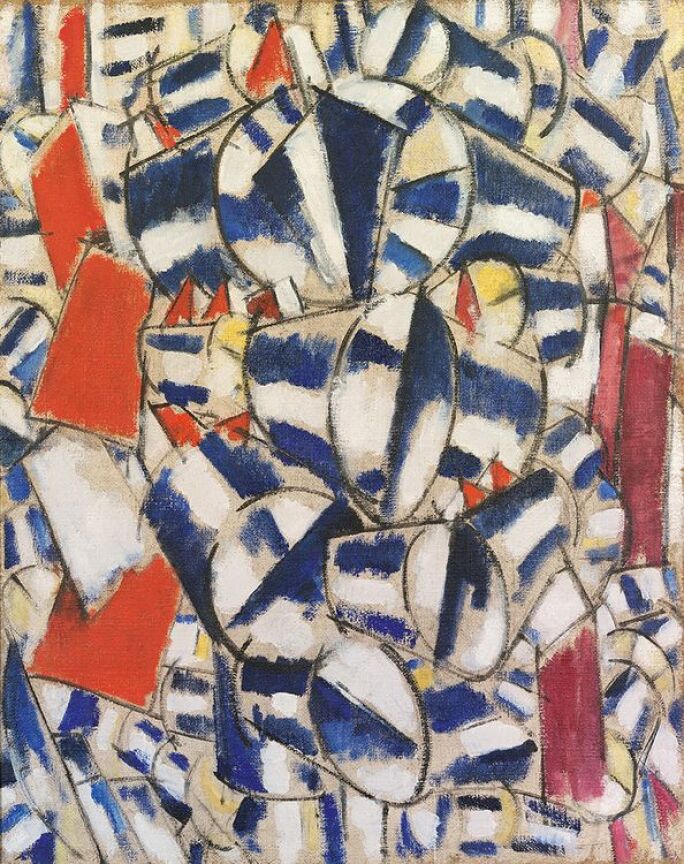
Among the most innovative aspects of Léger’s style is his ability to create complex compositions from a limited range of forms, an accomplishment that was completely new to the realm of modern painting. Léger demonstrated his mastery of this abstraction in his 1913 series of Contrastes de formes, some of the very first paintings completed by any artist in the modernist canon to successfully break free from figurative subject matter through a pure visual abstraction (see fig. 1).

In developing his unique form of abstraction, Léger was indebted to the paintings of Paul Cézanne. When he saw the Post-Impressionist compositions at Cézanne’s memorial exhibition in 1907, he was astonished at how his predecessor could reveal the geometry inherent in the human body (see fig. 2). “Like his contemporaries Picasso and Braque, Léger was enormously affected by and indebted to the art of Cézanne, whom he saw as a transitional figure between traditional and modern painting. It was Cézanne, Léger wrote in 1913 while he was painting the Contrastes de formes pictures, who had ‘understood everything that was incomplete in traditional painting’ and who had ‘felt the necessity for a new form and draftsmanship closely linked to the new color.’ And it was Cézanne, Léger wrote the following year, who ‘was the only one of the Impressionists to lay his finger on the deeper meaning of plastic life, because of his sensitivity to the contrasts of forms” (Exh. Cat., New York, Acquavella Galleries, Fernand Léger, 1987, p. 10).

On August 1, 1914 Léger’s life as a painter was abruptly interrupted when he was mobilized; sent to the front at the end of the month, he served as a stretcher-bearer until he was wounded in July 1915. The following year he was stationed outside Verdun and by the beginning of 1917 he was in Champagne. While on leave in July 1917, he fell seriously ill and the next eleven months found him in various hospitals. Terrible as this period was, the war experience was a key factor in the development of his mature work. Before 1914, Léger had evolved a style that depended on the maximizing of contrasts between the constituent parts of his composition. In many of the paintings from the Contrastes de formes series references to the outside world were largely eliminated. In the trenches this abstract language began to seem irrelevant. Plunged into the middle of dreadful combat, surrounded and morally supported by his comrades and confronted with powerful modern weapons, Léger looked to the world around him for the few paintings and rather more numerous drawings of the war period. Le Soldat à la pipe, 1916, was followed in 1917 by the monumental La Partie de cartes described by Léger as “the first picture for which I deliberately took my subject from what was going on around me” (see fig. 3).

La Jeune fille au bouquet is among a series of works from the immediate post-war period that includes Le Moteur, L'Horloge, Les Hélices, Les Pistons, La Gare, and La Ville, which celebrated the scale and breadth of industrial development and its impact on modern life (see fig 4). These compositions inherit the stylistic legacy of Cubism and also incorporate the dynamism and energy of Italian Futurist art. In these vibrant canvases Léger showed his ability to work on a monumental scale, maintaining a fine balance between the abstract strength of his 1913 paintings and references to contemporary urban life.

By the 1920s, the severe abstraction of his pre-war compositions gave way to streamlined figuration, his paintings often depicting the human form against a backdrop of the booming industrial era. What Léger had witnessed on the battlefront had forced him to re-prioritize his artistic objective so that claritys of form, or respect for modern life, would reign supreme in his compositions. "I had broken down the human body, so I set about putting it together again," Leger would recall of this period. "I wanted a rest, a breathing space. After the dynamism of the mechanical period, I felt a need for the staticity of large figures" (reproduced in Exh. Cat., New York, The Museum of Modern Art, Fernand Léger, 1988, p. 188).
“I model unsurprisingly in pure local color and in hefty volume. I want to get rid of tasteful arrangements, delicate shading and dead surfaces. It is my ambition to achieve the maximum pictorial realization by means of plastic contrasts. I couldn’t care less for convention, taste and established style; if there is any of this in my painting it will be found out later; right now I’m going to make some life”
The full embrace that Léger made of the monumental figure set against bright contrasted color in increasingly abstracted space seemed to fulfill Blaise Cendrars’s stat.mes nt about the future of painting and the crumbling of the cube: “Blaise Cendrars did not, in 1919, feel that Léger’s return to the subject was isolated. He believed that in the general context of the Parisian avant-garde, ‘the cube was crumbling’, and he prophesied a new kind of painting whose preoccupations would be with color and content—a kind of painting which would become, like the prewar pursuit of simultaneous contrasts, a common tendency. The subject of this new painting was to be man: ‘man, that is you and I, at work and play, with our everyday things, our enterprise…’ a subject which was to be celebrated in ‘great canvases of great size’” (Christopher Green, Léger and the Avant-Garde, New Haven and London, p. 159).
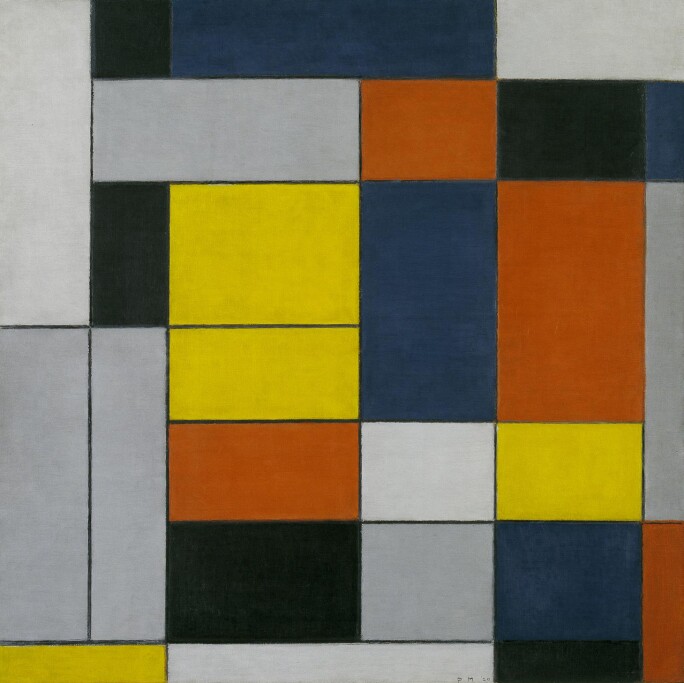
In the first years of the 1920s, several new schools emerged. Most, such as De Stijl, Neo-Plasticism and Neo-Classicism had their roots in the years just after World War I, while others would not have fully elucidated their mission until 1920 or later (see fig. 5). Of these, Purism, an aspect of the “The Call to Order," was to have perhaps the greatest effect on architecture and design in the decades to follow. Amédée Ozenfant and Le Corbusier espoused this completely pared down aesthetic in their new periodical L’Esprit Nouveau. Léger’s work of the 1920s is most frequently classified as Purist “Yet,” as Christopher Green explains, “when Léger initiated his ‘call to order’ in 1920, it was not towards a sustained unification of style that he moved, but rather towards a simpler, more coordinated presentation of stylistic contradictions, in which a more unified and more clear-cut planar architecture provided the setting for a more unified and more clear-cut presentation of the machine-man figure. An end to ambiguity was allied to conspicuous structural stability."

Right: Fig. 7 Fernand Léger, La Femme au livre, 1923, The Museum of Modern Art, New York © 2025 Artists Rights Society (ARS), New York
Léger often would create several canvases of the same or of a similar composition. The present work is one of only two of this subject. The other work, La Femme au bouquet (Bauquier 252), was executed the year prior to the present painting and is more representational in the still life elements flanking either side of the figure. Two further works feature a pair of standing women holding a similar floral arrangement (Bauquier 296 and 297); the more refined of the two is in the collects ion of the Musée des Beaux-Arts de Lyon (see fig. 6). In the year that followed, Léger would continue to pare back detail from his canvases. In 1923 La Femme au livre places a single female figure at the center of the composition, who presses a book against her chest and holds flowers in her hand. The background is a simple red—lines, grids, still life elements, indeed any notion of surroundings—have been completely removed from the canvas (see fig. 7). In the figure of La Jeune fille au bouquet, Léger strips down her features to their most simplified essence. The face echoes an ancient Cycladic figure or Constantin Brancusi’s Muse endormie. Niether inspiration would have been accidental. Léger was certainly familiar with Brancusi’s work, and was photographed by the sculptor in his own studio in the early 1920s while Cycladic objects were on display in several museums in Paris at the t.mes (see fig. 8).

Since the mid-1910s Léger was represented by Leonce Rosenberg of the famed Galerie L’Effort Moderne. A supporter of the Cubists during the crucial juncture when their original champion Daniel Henry Kahnweiler was exiled, Rosenberg would continue to support these artists after the war, while providing a platform for the newer movements of the early 1920s. Thanks to correspondence preserved in Rosenberg’s papers at the Bibliothèque Kandinsky, Centre Pompidou, this work is known to have been painted in March of 1921 and was acquired a month later by Rosenberg. It next entered the renowned collects ion of Alphonse Kann, a fashionable personality in pre-World War II Paris. A friend of Marcel Proust, a number of Kann’s attributes were said to have inspired Proust’s character Charles Swann. Kann’s estate in St-Germaine-en-Laye housed his enormous collects ion and, though Kann fled to England during World War II, his collects ion was left behind.

La Jeune fille au bouquet, alongside well over one-thousand other objects, was looted from Kann's residence by the Nazis in 1940 and deposited in the Jeu du Paume (see fig. 9). It was not until four years later on August 1st, 1944 that 148 crates (one containing the present work) “were piled onto trucks and departed [from] the Tuileries terrace,” related Rose Valland. Rose Valland, an intrepid French Resistence fighter an art curator, helped save thousands of artworks through her efforts and detailed record keeping. “It was with real satisfaction,” she continued in her first-hand account of the t.mes , “that I learned the convoy was headed to a train station. Because of wart.mes conditions at that moment, had the paintings been transported by road, they would have left France all too swiftly” (Rose Valland, The Art Front. The Defense of French collects ions 1939-1945, Dallas, 2024, p. 181). Rather ironically, the rails were far more congested than the roads. Valland was able to learn the numbers of the rail cars that contained these artworks and to convey this information to the National Company of French Railways who in turn informed the French army; the army seized control of the cars on August 27th. “This month-long episode," recounted Valland, “ended in good fortune…. That is how some of the best representatives of modern art masterpieces remained in France…. All of which I was very happy to take back to the Jeu de Paume, without a single one of them missing, exactly one month after their departure” (ibid, p. 183). La Jeune fille au bouquet was restituted to Alphonse Kann in 1947. Less than ten years later it was acquired by Joseph H. Hazen and has remained in the family’s collects ion since that t.mes .

