


“Nothing is more vibrant, more atmospheric, than the shimmering Venice of M. Signac…Opal, emerald, amethyst, pink, creamy or milky white, all of these vivid tones are at play in his paintings.”
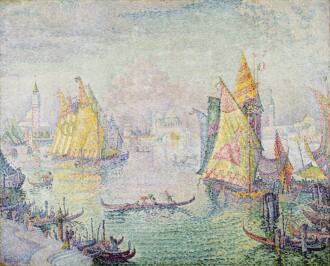
Saint-Georges. Couchant (Venise) stands among the most accomplished of Paul Signac’s Venice paintings, one of the most venerated bodies of work in the artist’s visionary oeuvre. Executed in 1905, following the artist’s first sojourn to Venice, the present work is a virtuosic encapsulation of the singularly dazzling luminosity and atmosphere of the storied city, evincing the Neo-Impressionist master’s intuitive and groundbreaking approach to light and color.
Signac arrived in Venice on 27 March 1904, settling at the Casa Petarca on the Riva degli Schiavroni. Henri-Edmond Cross, fellow Neo-Impressionist and close friend of the artist, who had stayed in the city just several months earlier, commended his choice of lodging: “You are superbly well placed to enjoy the endlessly changing skies and water which, for the imagination of a colorist like you, will inspire precious harmonies,” (quoted in Exh. Cat., Paris, Grand Palais (and traveling), Signac, 1863-1935, 2000-01, p. 233)

Cross’ remarks swiftly proved prescient: a seasoned navigator and sailor for whom the depiction of water and marit.mes cities was a vital preoccupation, Signac was immediately enthralled by the exquisite, ineffable interplay of light, water and architecture inherent to Venice. Through attentive observation from its waterfronts, Signac rendered its spectacular grandeur of Venice under a wide array of atmospheric effects. Providing abundant aesthetic potential for the artist’s lifelong investigations of the properties of color and light, Venice served as the catalyst for a series of paintings that constitute among the artist’s greatest works.
A glittering paean to La Serennisma, Saint-Georges. Couchant (Venise) captures the resplendent vista of the titular San Giorgio Maggiore at sunset as seen from the Riva degli Schiavoni, just a stone’s throw from his lodgings at the Casa Petarca. Embodying the celebratory evocations of color and light for which Signac is most renowned, the present work captures the transformational quality of light during this fleeting t.mes of day, illuminating the iconic façade of the island’s campanile and dome and the shimmering reflections of the water with a full spectrum of exuberant tonalities.

Fig. 2 Claude Lorrain, Port de mer au soleil couchant, 1639, Musée du Louvre, Paris
Fig. 3 Canaletto, San Giorgio Maggiore, 1726-30, Museum of Replica Handbags s, Boston
Through the present work, Signac establishes a lineage among the great masters, among them Guardi, Poussin, Canaletto and Turner, who were equally allured by the marvels of Venice across centuries (see figs. 1-4). Critic and champion of Neo-Impressionism Félix Fénéon noted Signac’s link to historical precedent, writing, “chromatic opulence in Paul Signac’s paintings decorates deliberate, audacious and rhythmic compositions which inevitably bring to mind the names of great masters such as Poussin and Claude Lorrain” (quoted in Jean Sutter, ed., Neo-Impressionists, Greenwich, 1970, p. 60). Among these precedents, Saint-Georges. Couchant (Venise) finds particular affinity with Turner’s iridescent treatment of this very same view under the studied observation of the suffusion of light within water and architecture.

In offering an utterly novel rendering of this mythic art historical motif, however, Signac positions himself as a key figure in the aesthetic developments of the twentieth century. Saint-Georges. Couchant (Venise) marks a watershed period of experimentation with Signac’s pioneering Neo-Impressionist idiom, during which the artist diverged from the stringent tenets of Divisionism that had pioneered alongside Georges Seurat in the 1880s (see figs. 5-6). While Signac understood that such studied applications of colored dots, rooted in prevailing theories of optics, allowed for a strong evocation of light, it did not align with his primary concern of conveying the expressive potential of color. The artist thus liberated his palette, daring to blend the pure pigments of his earlier works; while retaining the Divisionist application of pointed brushstrokes, they grew larger, squarer, and more impastoed than his prior canvases.

Fig. 6 Paul Signac, Maisons du port, Saint-Tropez, 1892, sold Replica Shoes 's, New York, 9 May 2016 for $10.7 million
This mature technique allowed for the investigation of the subtle modalities of light that characterizes the artist’s most accomplished works. As John House expounds, “After circa 1900, Signac adopted a larger brushstroke, and began to work in mosaic-like blocks of paint, placed separately on the white-primed canvas, and somet.mes s at an angle to suggest directional movement. The priming is often left visible around the touches [which] give the painting a luminosity, alongside the richness of its color” (Exh. Cat., London, Royal Academy of Arts, Post-Impressionism, 1979, p. 140). Signac’s newly liberated approach to hue and directional brushwork, fully wielded in Saint-Georges. Couchant (Venise), enlivens the shimmering reflections of the water and evokes movement within the clouded sky, together creating an invigorating richness of atmosphere and exultant luminosity.

Through this pioneering approach, Signac expanded the technical and conceptual possibilities of painting, thereby laying the foundation for a broader abstraction and spontaneity of expression among subsequent generations of artists. This mode would particularly prove influential to the likes of Henri Matisse and the broader Fauvist movement in such masterworks as Luxe, Calme et Volupté, which wields the mosaic-like arrangement of pigment, which Matisse learned under the auspices of Signac in 1904, to conjure the resplendence and warmth of the Mediterranean (see fig. 7).

Signac would be so enthralled by Venice that he would return there once again in 1908, coinciding with Claude Monet’s seminal painting campaign in the city. Several of these canvases, mirroring the present work, capture the San Giorgio Maggiore as observed across the expanse of the Grand Canal within this ebullient atmosphere (see figs. 8-10). Later viewing these works at Galerie Bernheim-Jeune, Signac wrote in laudation to the Impressionist master: “I experienced before your Venices, before the superb interpretation of those motifs that I know so well, an emotion as perfect, as powerful as the one I felt around 1879 in the exhibition gallery of La Vie moderne, in front of your railroad stations, your paved roads, your flower trees, an emotion that decided my career” (quoted in ibid, p. 71). Further testifying to the vital role that Venice occupied in Signac’s life, the artist would return there again in 1920 to organize the French Pavillion of the Venice Biennale.

Fig. 9 Claude Monet, Le Grand Canal et Santa Maria della Salute, 1908, sold Replica Shoes 's, New York, May 2022 for $56.6 million
Fig. 10 Claude Monet, Saint-Georges Majeur, Venise, 1908, Indianapolis Museum of Art

Signac’s first Venice oils were met with immediate acclaim from both the public and the art establishment when first exhibited at the Salon des Indépendants in 1905 and at a landmark dedicated exhibition at Galerie Bernheim-Jeune in 1907, where Saint-Georges.Couchant (Venise) was displayed for the first t.mes (see fig. 11). Celebrated art critic Louis Vauxcelles extolled these works, declaring, “nothing is more vibrant, more atmospheric, than the shimmering Venice of M. Signac…it is always this sparkling miracle, this rushing palpitation. Signac is one of the greatest painters I know. Opal, emerald, amethyst, pink, creamy or milky white, all of these vivid tones are at play in his paintings” (Louis Vauxcelles, “Le Salon des indépendants,” Gil Blas, 20 March 1906, p. 2). A majority of this corpus was swiftly acquired by private collects ors and now belong to globally esteemed museums including the Centre Pompidou, Paris and the Chrysler Museum of Art, Norfolk, among many others. The sister painting of the present work, presenting a view of the same vista at sunset, currently resides in the collects ion of the Toledo Museum of Art, Ohio, and is regarded as one of the most important Signac paintings in an American institutional collects ion (see below).
Paul Signac's Venice Paintings in Museum collects ions




Saint-Georges.Couchant (Venise) bears a highly prestigious provenance that bespeaks its superlative importance and excellence. The present work was sold on three occasions by Eugène Druet, among the foremost gallerists of Impressionism and Neo-Impressionism at the turn of the twentieth century and a primary dealer of Signac. It first passed into the hands of Gustave Fayet, among the most mythic collects ors of his epoch and a noted proponent of Paul Gauguin and Odilion Redon, alongside other six works by Signac. Another Venice scene formerly owned by Fayet now resides in the collects ion of the Musée d’Orsay in Paris (see above). Letters exchanged between the artist and Fayet reveal a strong mutual admiration, with Signac personally requesting the loan of Saint-Georges. Couchant (Venise) for the pivotal 1907 exhibition.
After briefly being owned by collects or Henri Aubry, the present work was acquired in 1916 by the visionary collects or Dr. Maurice Girardin and formed the cornerstone of his collects ion for the entirety of his life. According to his personal accounts, Saint-Georges.Couchant (Venise) was the first work that he ever acquired, serving as the genesis of a prodigious collects ion—five hundred works of which, donated to the city of Paris, would ultimately form the basis of the Musée d’art Moderne de la Ville de Paris’ holdings:
“When I was drafted in [1914-18], I somet.mes s visited modern galleries on leave. One day, entering Druet's in the Rue Royale, I admired a Signac from Venice; shyly I asked about the price: 500 francs. I didn't have it. No less timidly, I asked to pay in two installments. Madame Druet agreed, and it was my first painting. Madame Druet's kindness emboldened me, and I went on to buy from her, on credit, the paintings that are now my joy.”
Remaining in the same prestigious French family collects ion since its acquisition from the estate of Maurice Girardin, and not publicly exhibited since the landmark 1907 Bernheim-Jeune exhibition, Saint-Georges. Couchant (Venise) comes to auction for the first t.mes in over seventy years.

