
"The surface treatment, which is so thin, turns the whole thing into something other than what it is and it creates a distance between you and it. At the same t.mes , it’s very immediate, physically available for you. I think the blue paint is like a pedestal."
A centerpiece of Carol Bove’s internationally acclaimed Pavilion at the 2017 Venice Biennale, Dressing Room epitomizes the exacting technique and conceptual rigor that defines the Swiss artist’s practice. One of a suite of seven works created for her Biennale presentation, collects ively titled the Pleiades after the children of the Greek god Atlas, this small corpus of works marked a pivotal turning point in Bove’s career, where she not only stepped into the international limelight, but took on the legacy of Alberto Giacometti, the most celebrated Post-War Swiss artist. In her construction of Dressing Room, Bove builds upon Giacometti’s exploration of verticality and figuration, pushing the boundaries of contemporary sculptural norms and inspiring a generation of artists with her empahsis on art historical precedent, perfection of execution, and concepotual rigor.


Carol Bove is recognized for her illustrious oeuvre of sculptures that powerfully explore the architectural components of materiality and space, a phenomenon she first developed with materials ranging from steel, glass and bronze to found objects including rocks and shells. By the early 2010s, these more eclectic, stripped-down works evolved to larger-scale monochrome sculptures, imposing with a sensuality at once abstract and yet clearly articulated. Bove’s inclusion in the prestigious 2017 Venice Biennale marks a pivotal moment in her career in which she emerged as an internationally recognized artist while inaugurating a new course in her artistic trajectory that focussed on singular sculptural forms constructed of industrial materials and finished with a luxuriously sleek coats of chroma, such as the present work.
"The sculptures are not even primarily visual. You learn about them through your eyes, but their visuality is a secondary feature. The objects in the assemblage have variable textures, temperatures, speeds and histories. The visual aspect provides important clues about how they feel and what they are."

As if in defiance of Giacometti, who despite global success continuously refused invitations to exhibit at the Swiss Pavilion, Bove’s exhibition at the Venice Biennale featured an astounding array of steel sculptures. The title of the exhibition, Women of Venice, refers to Giacometti’s renowned bronze renderings of tall, slender figures from 1956. Bove’s imposing yet graceful steel constructions pay homage to Giacometti’s Women, while remaining distinctly her own. Bove also employs allusions to classical literature and her Swiss heritage in the production of these works. The title of the series from which the present work derives, Les Pleiades, refers to a small village in the Swiss Alps near the artist’s place of birth, in which the seven-star Pleiades constellation is a fixture in the night sky. Named after Greek mythology’s seven daughters of Atlas, this astrological fixture referenced in Bove’s work plays on an innate mysticism in Bove’s artistic practice, establishing the piece as both an ode to Giacometti while remaining resolute to Bove’s artistic identity.
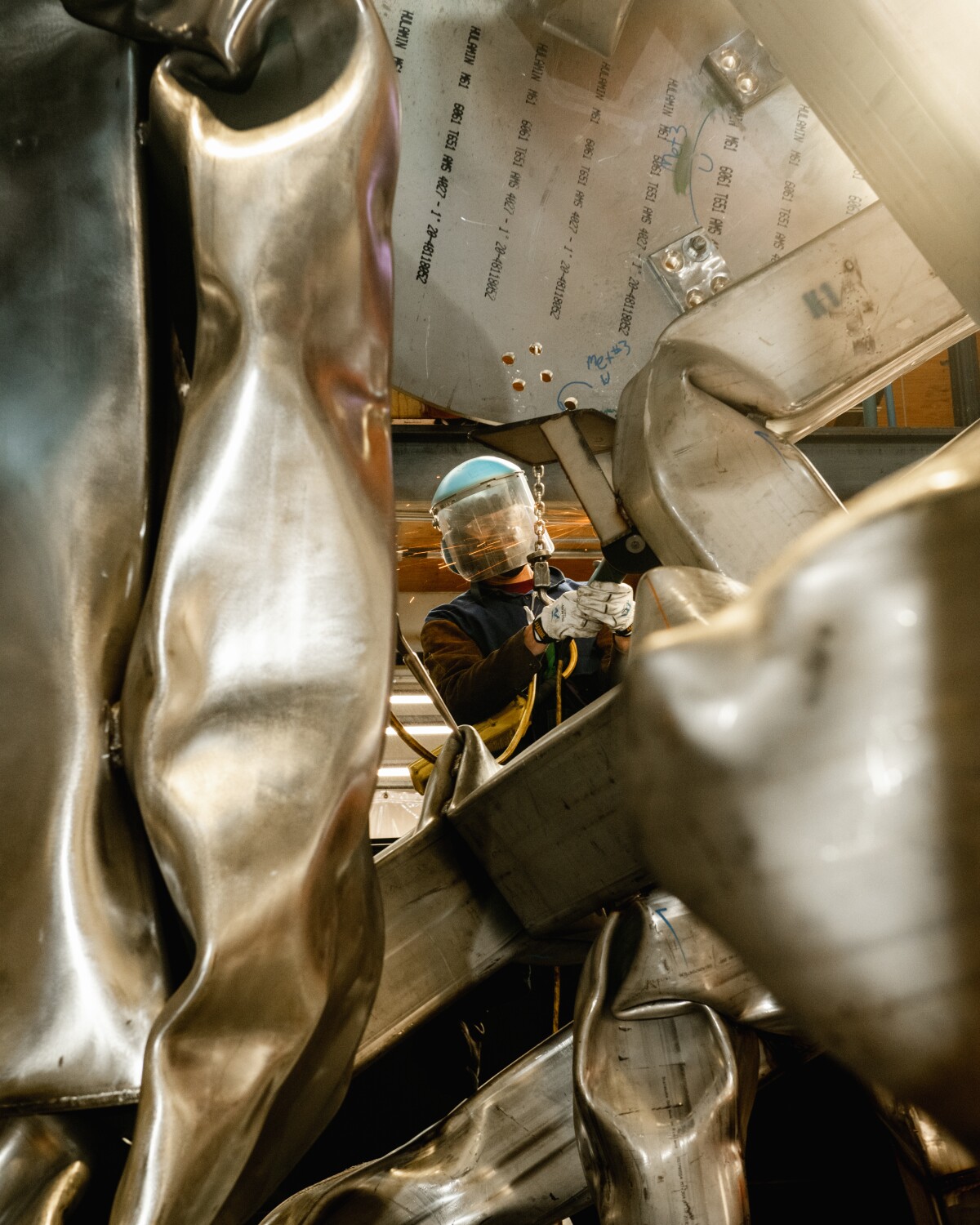

Dressing Room gracefully poses with a structural and compositional intimacy. In both its construction and its titular connotation, Dressing Room suggests a degree of figuration while remaining resolutely abstract. Whether the viewer identifies one of the seven Pleiades, or one of Giacometti’s Women of Venice, the sculpture’s rising curvature implicates itself as deftly anthropomorphic. Thick sheets of steel are warped and curved to display at certain points a stoic strength, elsewhere a delicate curvature reminiscent of fabric. Much like the renowned bronze figures, Dressing Room rises in a moment of delicate balance, stretching towards the sky at once with grace and precarious fragility, imbuing the work with a dynamism and theatrical presence of its own.

"The cyan blue is the color they use in television commercials to show the absorbency of say, a diaper. Since this color could never come out of your body, its not disgusting, it’s objective."

In its construction, Dressing Room employs both found and re-used steel along with Bove’s own steel constructions, hinged together in a singular harmonic composition. The eye-catching cyan blue coating is applied seamlessly, encouraging the viewer to focus on the intricacies of the metal design and employing a luxurious softness to an otherwise harsh, unyielding medium. A colorist in her own right, many of Bove’s other sculptures produced in the last decade have been imbued with the same monochromatic paint layer. In an interview with exhibition curator Philip Kaiser, Bove elaborates on this artistic choice: “The surface treatment, which is so thin, turns the whole thing into something other than what it is and it creates a distance between you and it. At the same t.mes , it’s very immediate, physically available for you. I think the blue paint is like a pedestal.” (the artist quoted in: Exh. Cat., Venice, 57th Biennale di Venezia, Women of Venice, 2017 pp. 34-35) Bove’s choice of color for Dressing Room and its sister compositions places it in a distinctly processed realm that contradicts the humanoid figurations by which it was inspired. “The cyan blue is the color they use in television commercials to show the absorbency of say, a diaper. Since this color could never come out of your body, its not disgusting, it’s objective.” (Ibid., p. 34)

