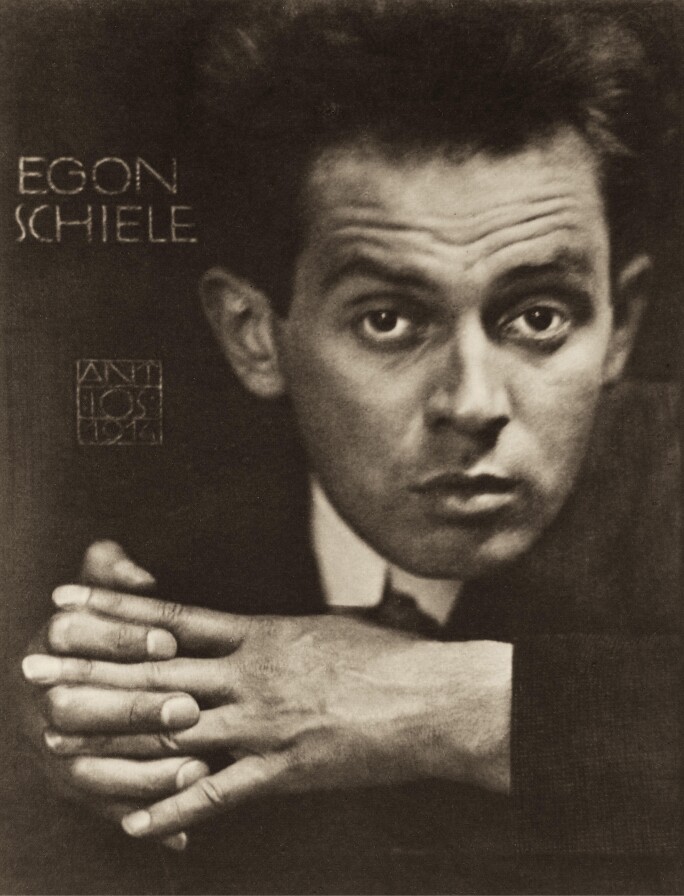
‘…his line, by 1917, had acquired an unprecedented degree of precision […]. Schiele's hand had never been surer, more capable of grasping, in a single breathtaking sweep, the complete contour of a figure […] he had found, in the best of his late work, the perfect line.’

Dating from 1917, Schiele’s Stehender Halbakt is among his most accomplished drawings of the female figure. The work exemplifies the fluidity that the artist achieved in the final year of his life, capturing the subject with a series of loose, confident charcoal lines. As Jane Kallir writes: ‘Always a speedy worker, Schiele had finally found the perfect line. In 1917 and 1918, he was usually able to capture his subject with a single, virtually unbroken sweep of his crayon [...]. In his works on paper, he became more and more focused on the qualities of drawing as such, and therefore relatively few of his 1918 studies are coloured. Instead, he was increasingly interested in sculpting volume, embellishing interior details with curious little loops [...] in these drawings Schiele achieved an unprecedented degree of accuracy’ (J. Kallir, Egon Schiele. Drawings and Watercolours, London, 2003, pp. 441-442).
This accuracy is exemplified in the present work. There is a remarkable precision in the proud line of the sitter’s jaw and the single, long line of her arm that anchors her figure on the page. Her hair and clothing are conjured with minimal detail, yet Schiele succeeds in conveying a tangible sense of both. His grasp of the medium is also supremely assured; he creates subtle contrasts to add emphasis, using softer, broader strokes for her hair and sharper lines for her features in a way that evokes a strong sense of character in his model.

In Schiele’s later depictions of female nudes, an almost voyeuristic sense of detachment replaces the intense personal involvement that was so evident in earlier drawings and watercolours. The women seem aloof, posed in attitudes reminiscent of the conventional pornographic images that would have circulated amongst many of Schiele’s male patrons. In the present work, the model kneels, her dress half removed to reveal her breasts. It is a provocative pose, and yet her gaze does not.mes et that of the viewer; her sensuality, although undeniable, is self-contained. Kallir noted this aspect of the artist’s work: ‘Schiele’s women are, by 1917-18, thoroughly modern. Like most modern women, they own their sexuality. The nude and semi-nude models take pride in their seductive bodies and are empowered by their allure [...]. Nor are they projections of the artist’s ego. They combine the mystery and the specificity of complete, independent human beings’ (J. Kallir, Egon Schiele’s Women, Munich, 2012, p. 266).