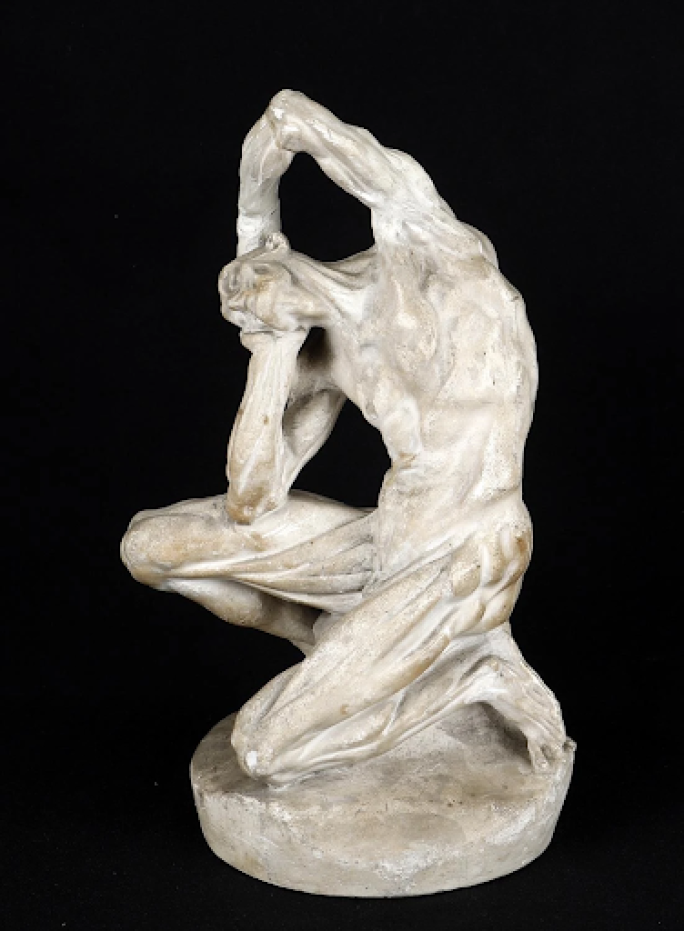
L’Écorché, d’après Puget takes as its subject matter the image of a flayed man, the figure’s musculature carved out in visceral detail. Combining a subject matter whose weighted history renders it worthy of academic representation, with a deeply modern execution of form, Matisse demonstrates his talent for revitalising the sculptural practice and presents his ability to attribute his sculptures with an energy lacking in the more traditional representations of the human form found within the Paris salons.

The original sculpture of the écorché that, as evidenced by the title, inspired Matisse, measured 10 inches in height and was initially believed to be by Michelangelo. It was, however, subsequently reattributed to the French baroque sculptor Pierre Puget who had taken the idea from the Renaissance sculpture that he encountered during his travels in Florence. Puget’s sculptures proved greatly inspiring for the Parisian avant-garde and were often used as studio props. Indeed, Cézanne owned a plaster copy after Puget’s écorche and also featured a copy of Puget’s Cupid in his still life Nature morte avec l'amour en plâtre, painted circa 1895. Both Cézanne and Matisse were great admirers of Michelangelo and Puget for their expressive shaping of sculptural form and in his Notes of a Painter from 1908, Matisse wrote that: "When we go into the seventeenth- and eighteenth-century sculpture rooms at the Louvre and look, for example, at a Puget, we can see that the expression is forced and exaggerated to the point of being disquieting" (Matisse reprinted in J. Flam, ed., Matisse on Art, Berkeley, 1995, p. 39).

The subject of the flayed man, however, whilst sufficiently shocking, also afforded considerable creative opportunities. Inspired by this as well as by the bronzes of Auguste Rodin, Matisse created the present work in which the image of the flayed man is articulated with a raw immediacy, evident in the manner in which the surface has been modeled. Small tabs of bronze attest to the richly modelled surface and intensify the physicality of the sculpture. Moreover, in the undulating surface of the bronze Matisse allows for the interplay of light across the sculpture, bringing the figure to life.
L’Écorché, d’après Puget is number 6 from an edition of 10 known examples and according to Wanda de Guébriant's 1997 inventory of Matisse's bronzes, other casts of this sculpture reside in prominent museum collects
ions including the Musée Matisse in Nice and the Hirshhorn Museum and Sculpture Garden in Washington.