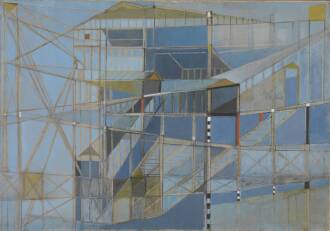
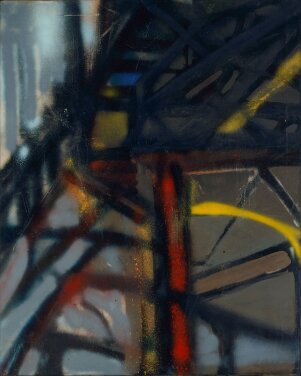
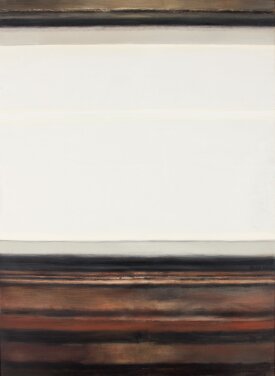
“Hedda Sterne’s recent paintings are curiously ambiguous; though often assertive they still remain fugitive. Her use of strong line combined with toned-down color leads to deceptively simply first impressions. On one level we see these canvases as merely geometric constructions, but almost immediately they take on another dimension, another meaning. Invariably what is, is not. Metamorphosis takes over and the planes that initially appeared flat gradually begin to open out and close in, revealing totally new vistas. . . . The transformation that joins exterior and interior spaces in a single fluctuating experience relies chiefly on refractions and reflections of arbitrary light distilled through the most elusive transparencies. The paintings project both real and symbolic windows from which we look in and out at one and the same t.mes .”


F urther I from 1985 is a masterpiece within Hedda Sterne's prolific and deeply progressive practice that have come to define her as one of the leading Abstract artists of her generation. Emphasizing the importance of Further I within Sterne's oeuvre, the present work was prominently featured on the cover of the exhibition catalogue for the artist’s retrospective in 1985 at the Queens Museum in New York. Regarding Sterne's later output, Katherine Kuh, legendary art critic and first female curator of Modern Art at the Chicago Institute of Art once remarked, "Hedda Sterne's recent paintings are curiously ambiguous; though often assertive they still remain fugitive." Indeed, Further I, through its symMetricas l network of abstracted lines and forms rendered in eye-catching blue and gold, evoke feelings of ecstasy or heightened spirituality. The converging lines in the present work resemble the architectural prowess of a cathedral and beckons to the viewer like an open door or window. Sterne’s practice is best known for having promoted a path of personal and philosophical discovery through her abstract canvases that serve as a projection of her inner self. Famously having rejected a formal label for her practice, Sterne’s aesthetic language oscillates between Dadaism, Surrealism, and Abstract Expressionism. The present work is an iconic example from her acclaimed Patterns of Thought paintings of the 1980s. The arresting arrangement of lines immediately strike the viewer and fill the composition with exhilarating movement that draws the viewer's eye all over the canvas. Showcasing Sterne’s masterful eye for perspective, color, and abstracted depictions of light, Further I offers a moment of reflection through its merging lines that seem to extend past the picture plane into infinity, conveying motion and dynamism while also retaining an orderly tranquility, ultimately underscoring the present work one of the most captivating and impressive paintings within the artist's oeuvre.

Further I has formed part of the esteemed collects ion of Clara Diament Sujo since 1993. Founder of CDS gallery and pioneering art critic, Clara Diament Sujo was one of Sterne’s most ardent supporters in her late career. Born in Buenos Aires to Jewish parents in 1921, Sujo moved to Chicago in the 1940s to work at Abbott Laboratories. Sujo spent much of her free t.mes in the city visiting museums and galleries, especially the Chicago Institute of Arts, where she admired Katharine Kuh's curatorial work. Kuh would later introduce Hedda Sterne to Sujo in the 1980s. In the 1950s, Sujo moved to Venezuela. There, she immersed herself in the vibrant Caracas art scene, eventually organizing and assembling the world's first collects ion of contemporary Latin American art, housed in the city’s renown Museo de Bellas Artes. In 1979, Sujo spearheaded the first ever auction of Latin American art at Replica Shoes ’s, just two years later she opened CDS Gallery, which left an immediate impact on the New York gallery circuit through its trailblazing shows that juxtaposed the work of North American and Latin American masters.

A lifelong supporter of female artists, Sujo met Sterne in the early 1980s through Katharine Kuh and was immediately captivated by her unique artistic philosophy. Lamenting Sterne’s relative lack of recognition at the t.mes compared to her male peers, Sujo took her on as “a very special cause,” organizing nine solo exhibitions of Sterne’s work over the next two decades, as well as a retrospective at the Krannert Art Museum, University of Illinois at Urbana-Champaign, in 2006. Sujo's continued ardent support of Sterne's work led to major international institutions acquiring her work like The Tate in London, The Metropolitan Museum of Art in New York, The Museum of Modern Art in New York, and the Carnegie Museum of Art in Pittsburgh, among many others. Particularly notable was the acquisition of New York #2, once in the Sujo collects ion, which is prominently displayed at the entrance of the Metropolitan Museum of Art's current exhibition Epic Abstraction: Pollock to Herrera. With its softly radiant geometries that evoke a sense of hope and inner light, the present work endures as a precious token of the trust and friendship between these two important visionary women and serves as an example of Hedda Sterne at her best.
Hedda Sterne Paintings in Museum collects ions