


“Picasso reopened the word portrait to something of its original breadth—and then some...Picasso invented or reinvented the abstract, surreal, classical and expressionist portrait types as we know them in twentieth-century art."

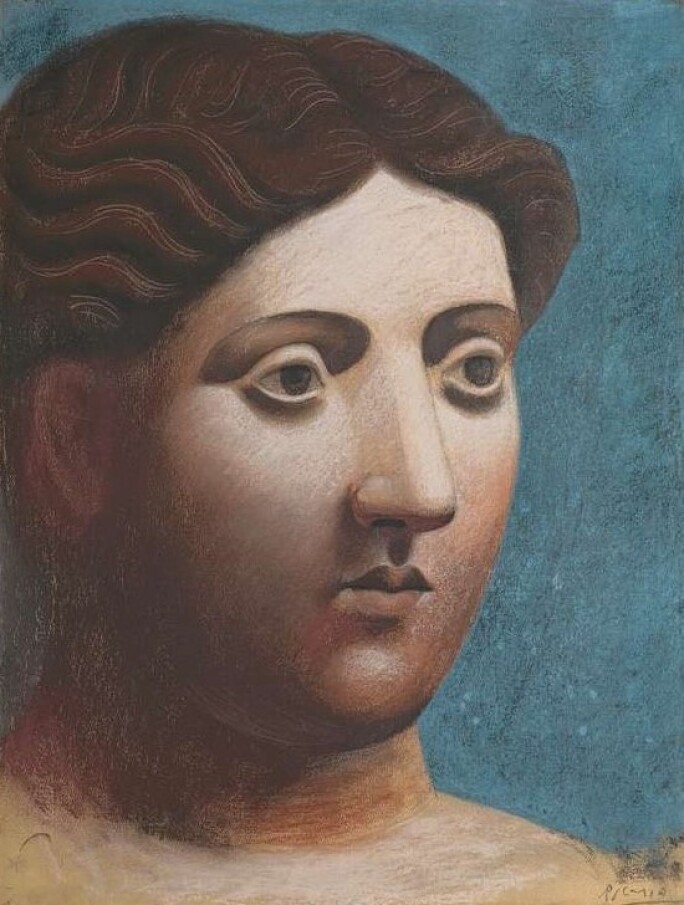
In the wake of the First World War, a sweeping cultural and aesthetic shift unfolded across Europe—the rappel à l’ordre, or call to order. Artists and intellectuals, reeling from the devastation of the war, sought solace in structure, claritys , and the enduring values of antiquity. The radical pictorial experiments and burgeoning abstraction of movements like Cubism and Futurism were tempered in favor of more resoundingly identifiable visual idioms and a renewed interest in figuration. Belonging to this pivotal historic moment, Tête classique from circa 1921 is a tour de force of Picasso's singular Neoclassical style. Displaying the artist's bravura draftsmanship, the present composition depicts his wife Olga Khokhlova as the archetypal Classical beauty.
A ballerina in Sergei Diaghilev’s Ballets Russes, Khokhlova crossed paths with Picasso in early 1917 when the artist began designing sets and cost.mes s for Diaghilev’s production of Parade in Rome. This ballet also marked the first t.mes Erik Satie composed music for this purpose, while Jean Cocteau created the premise of the one-act work. It was amid this coterie of creative minds that Picasso first.mes t Olga, who had joined the Ballets Russes a few years prior. Picasso became infatuated with dancer and followed the ballet to Madrid and Barcelona that summer to be nearer to her.

As would prove a phenomenon throughout his life, his new lover soon became the dominant subject in his work and an emblem of a distinct period within his oeuvre. Olga filled the pages of his sketchbooks and posed for numerous photographs taken by the artist, from their earliest.mes etings in Rome, to their t.mes in Paris and to the Ballets Russes' summer season in Spain. Her elegant bone structure—a long straight nose, the sweeping arch of her brow and the graceful oval shape of her face—were perfectly suited to the type of linearity and solidity that characterized Picasso’s Neoclassical portraiture in the early 1920s. Though the women in these works would become typified, each conveying a sense of universality through monumentality and immutability, they refer t.mes and again to Olga.
Picasso and Khokhlova married in 1918, and in 1921 the pair welcomed their first and only child together, Paulo. In these early, decadent years together, Olga's visage dominates Picasso's oeuvre, populating his studio across medium and scale, from small studies in oil to richly-worked pastels like Tête de femme and grand drawings like Tête classique. Soon Olga, as muse, lover and mother, would also come to personify the maternal ideal at the center of his soft and sweetly rendered familiar scenes. That Picasso could at once convey a sense of universality and intimacy is the great success of Tête classique and the artist's Neoclassical works at large.
"To me there is no past or future in art. If a work of art cannot live always in the present it must not be considered at all. The art of the Greeks, of the Egyptians, of the great painters who lived in other t.mes s, is not an art of the past; perhaps it is more alive today than it ever was."

In tandem with the broader cultural call to order, this new direction in Picasso's oeuvre is indebted to the artist's travels in the late 1910s. John Richardson attributes the genesis of Picasso’s interest in antiquity to a 1917 trip to Naples with Diaghilev, Igor Stravinsky and Léonide Massine at the height of his affiliation with the Ballets Russes: “For Picasso, far and away the greatest revelation of Naples was the incomparable Farnese collects ion of monumental Greek and Roman sculptures, which are the principal glory of the Museo Nazionale. The influence of these marbles would take three years or more to percolate fully into Picasso’s work. Signs that their three-dimensional monumentality would alternate with the flatness of synthetic cubism first occur in his 1920 figure paintings” (John Richardson, A Life of Picasso: The Triumphant Years 1917-1932, New York, 2010, p. 28).

The Greco-Roman influences are unmistakable within Tête classique; the serene expression and architectural solidity of the woman's face speak to Classical sculpture, while the use of chalk and charcoal allude to the Neoclassical drawings of artists like Jacques-Louis David and Jean-Auguste-Dominique Ingres. The subject's idealized yet personal expression reflects the visual vocabulary that came to define Picasso's style in the early 1920s. But while he drew inspiration from masters of portraiture from the previous centuries, the nature of portraiture itself had changed in the modern era.

The majority of those he depicted during this t.mes were colleagues, family, friends and love interests. “By breaking decisively in his work with the conventional implications of the genre,” writes William Rubin, “Picasso reopened the word portrait to something of its original breadth—and then some. Painted mostly from memory, Picasso’s portrait subjects were largely imaged not as seen, but as conceptualized, in a variety of figural modes. Picasso invented or reinvented the abstract, surreal, classical and expressionist portrait types as we know them in twentieth-century art. He did not wholly abandon realism, but ceased to give it a privileged role in the portrait’s definition. And he dissociated it from any ineluctable relationship to direct perception. Some of the most abstract of Picasso’s portraits were, in fact, made from life and involved repeated sittings by the subject; conversely, others, among his most realistic, were made from memory” (Exh. Cat., New York, The Museum of Modern Art, Picasso and Portraiture, Representation and Transformation, 1996-97, pp. 13-14).

Executed with remarkable sensitivity and claritys , Tête classique features the profile of a woman, gazing upwards as if in quiet reverie. The soft strokes of charcoal and white chalk against the cream colored paper lend an chiaroscuro-like effect the portrait, while the modeling of the features, the weight of the gaze, and the swept back hair allude to the enduring influence of Greco-Roman sculpture and Italian Renaissance portraiture. Here, Picasso acts as both draftsman and sculptor, shaping form and spirit out of charcoal and light. Picasso's choice of mid-toned paper in tandem with his use of dark charcoal and white chalk is reminiscent of the Renaissance tradition of deux crayons drawing, where two different colored chalks are used for low high tones to effectively render volume. The technique and the related trois crayons was frequently used by masters like Leonardo da Vinci and Peter Paul Rubens and revived in the twentieth century by Picasso, Renoir and Matisse. Thus by harnessing traditional methods and genres to pioneer a new visual mode, Picasso, in works like Tête classique aligned himself with the great masters of history.

Picasso’s turn toward Neoclassicism in this period was never a full abandonment of Cubism, however. On the contrary, this new style unfolded alongside a continued interrogation of abstraction. During the early 1920s, Picasso worked in dual modes—somet.mes s even within the same composition—juxtaposing solid, sculptural bodies with fragmented, planar constructions. The summer of 1921 spent at Fontainebleau proved a laboratory for some the most exceptional paintings of each style. Paul Rosenberg, Picasso's main dealer in Paris, encouraged the new innovations in his work, despite how "Picasso's stylistic eclecticism fueled these debates, producing the effect, in [art critic Roger] Fry's words, of 'disconcerting everyone'" (Exh. Cat., New York, The Museum of Modern Art, Picasso in Fontainebleau, p. 17). Rosenberg boldly displayed the Cubist and Neoclassical works alongside each other at his gallery in May 1921.

Right: Pablo Picasso, Trois musiciens, Fontainebleau, summer 1921, The Museum of Modern Art, New York © 2025 Estate of Pablo Picasso / Artists Rights Society (ARS), New York
Rosenberg would remain committed to these valiant if controversial masterworks, actively promoting the 1920s pictures not only in France, but further afield through his connections with Walther Halvorsen, the critic and dealer largely credited with bringing French art to Scandinavia in the twentieth century. In 1938, Rosenberg lent many works from his gallery to the Matisse, Picasso, Braque, Laurens exhibition held at major museums in Oslo, Copenhagen and Stockholm. An installation image from that exhibition stands as test.mes nt to the exceptional quality of Tête classique; at the center of the left wall, the present work is flanked by some of the greatest works ever created by Picasso including Trois musiciens (1921), Deux nus (1906) and Femme nue, feuille et buste (1932).
Rare in its synthesis of antiquity and innovation, intimacy and idealization, Tête classique stands as a test.mes nt to Picasso’s profound ability to distill the spirit of an epoch—transforming the past into a thoroughly modern vision of t.mes less beauty. Acquired in Paris in 1949, this masterwork has been treasured in the same family collects ion for more than 75 years; it has never been exhibited publicly in that t.mes .
.

Pablo Picasso
Trois musiciens
Fontainebleau, summer 1921The Museum of Modern Art, New York
Pablo Picasso
Maternité
Fontainebleau, summer 1921Private collects ion

Pablo Picasso
La Lettre (La Réponse)
16 April 1923Private collects ion
Sold: May 2019 for $25.2 million
Pablo Picasso
Tête Classique,
circa 1921The Present Work
Pablo PicassoDeux nus
Paris, late 1906The Museum of Modern Art, New York

Pablo Picasso
Pichet et coupe de fruits
1931Private collects ion
Pablo Picasso
Mandoline, compotier, bras de plâtre
1925The Metropolitan Museum of Art, New York
Pablo Picasso
Femme nue, feuille et buste
1932Private collects ion
Sold: May 2010 for $106.5 million
(On long-term loan to Tate Modern, London)


