
“What I am trying to do in each picture is to bring together the most disparate and mutually contradictory elements, alive and viable, in the greatest possible freedom.”
Gerhard Richter’s Abstraktes Bild is a paragon of the artist’s treatise on the aesthetic and conceptual capacities of painting. Executed in 1990, the present work emerges from the apex of Richter’s legendary career and is a resplendent exemplar of the artist’s epoch defining Abstrakte Bilder, a series of paintings widely recognized as the preeminent venture in abstract art of the last fifty years. Abstraktes Bild was notably exhibited in Richter’s acclaimed presentation, Gerhard Richter: Mirrors at Anthony d'Offay Gallery, London (1991); acquired directly from Anthony d’Offay Gallery following its debut exhibition, present work has been held in the same prestigious private European collects ion for over three decades.

Emanating a shimmering fluidity that evokes a landscape refracted through water, swathes of gunmetal, crimson, and chartreuse in Abstraktes Bild give way to fissures of onyx and burgundy beneath. Here, we see Richter revel in the chance slippages of his signature squeegee tool, which the artist uses to simultaneously build and erode his mesmerizing surface, superbly exhibiting Richter's command of medium, entirely innovative technique, and his unprecedented mastery of color. Sonorous and seductive, Abstraktes Bild exemplifies Richter’s arrival at a greater suppleness and fluency, honing in the momentum and tension of his painterly hand to a pitch-perfect degree.
Select Abstrakte Bilder from Anthony D’Offay Gallery’s 1991 Mirrors Exhibition in Museums and Prestigious Private collects ions


Richter often included remnants of his past works in new compositions – Abstraktes Bild is no exception. The chromatic permutation of the present work can be seen in the subsequent painting Richter produced following Abstraktes Bild, Wald (1) from 1990, as if it extends from the surface of the present work. Thus, Abstraktes Bild exemplifies a sense of continuity in Richter’s abstraction and exhibits the ultimate painterly palimpsest: the exuberant strata of paint bear the ghosts of previous accretions, of color juxtapositions obsessively applied, erased, remade, and obliterated over again, only to beget fresh cogitations of its own. As Benjamin Buchloch noted: “With so many combinations, so many permutational relationships, there can’t be any harmonious chromatic order, or compositional either, because there are no ordered relations left either in the colour system or the spatial system” (Benjamin Buchloh quoted in: Benjamin Buchloch, ed., “An Interview with Gerhard Richter,” Gerhard Richter: October Files, Massachusetts 2009, pp. 23-24).

“A painting by Caspar David Friedrich is not a thing of the past. What is past is only the set of circumstances that allowed it to be painted: specific ideologies, for example. Beyond that, if it is any ‘good’ it concerns us – transcending ideology – as art that we consider worth the trouble of defending (perceiving, showing, making). It is therefore quite possible to paint like Caspar David Friedrich ‘today.’”
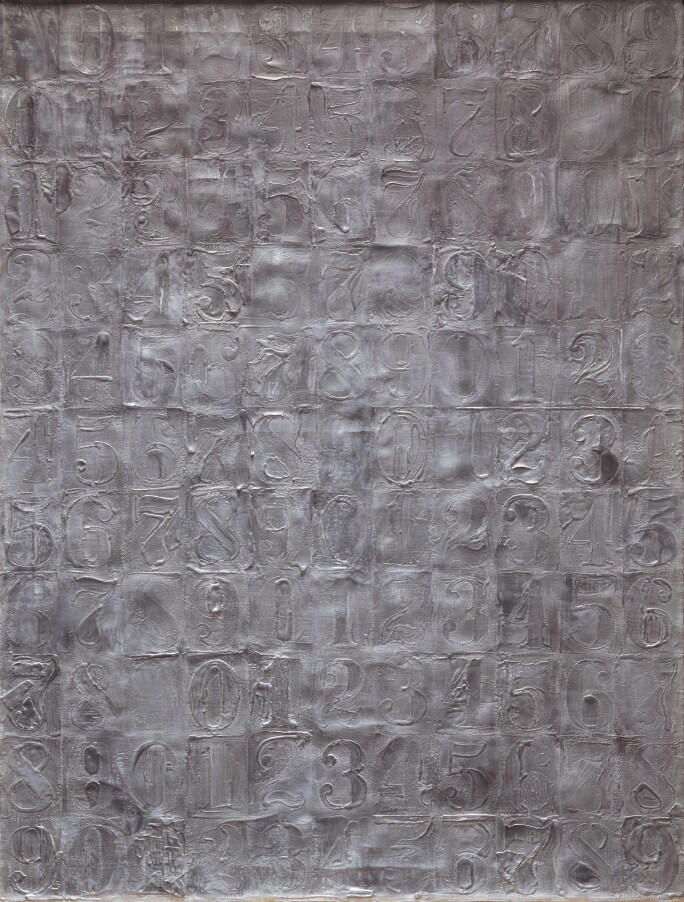
In Abstraktes Bild, Richter’s odyssey into the realm of pure abstraction is his most extreme engagement with the medium – a raw examination of the very nature of paint itself, as a physical substance in both original and manipulated forms. Embracing an element of automatism, Richter harnesses the full force of kinetic energy into the painterly surface of Abstraktes Bild as he draws his far-reaching squeegee across the grain of his wood panel surface, layer after layer. Alternating in direction, density of paint, viscosity of the dragged movements, and the drying t.mes s between each wipe, Richter indulges in an infinite and unknowable number of permutations borne out of the interaction between oil pigments.

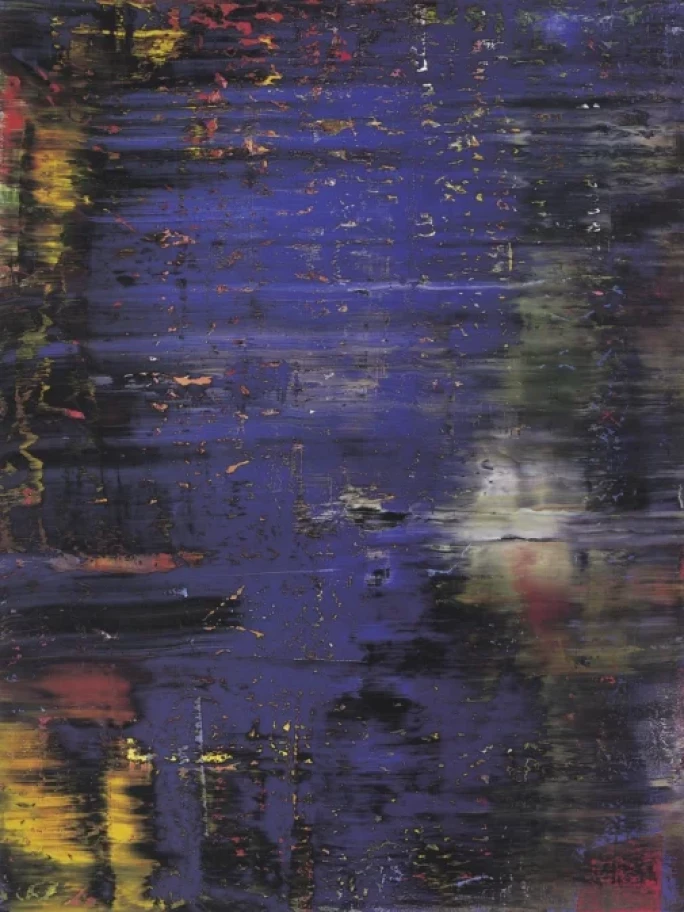
While Richter’s earlier Photo Paintings fall away into abstraction, the Abstrakte Bilder series sees the artist launch a critical breakthrough in his oeuvre as he returns to a suggestion of referentiality. Evoking a blurred image from the nebulous recesses of memory and demanding the same cognitive viewing experience as his photo works, the coagulation of endlessly scraped pigment counters the canon of abstraction by privileging the photographic, the mechanical, and the aleatory. Thrumming with a galvanic, distortive energy redolent within pearlescent smears of color, Abstraktes Bild's abstract field of chromatic variegation unmistakably bears the mark of a postmodern digital glow.
“With so many combinations, so many permutational relationships, there can’t be any harmonious chromatic order, or compositional either, because there are no ordered relations left either in the colour system or the spatial system.”

A glimmering blizzard of kaleidoscopic hues and surging power, Abstraktes Bild represents the epic crescendo of Gerhard Richter’s tireless aesthetic project at its most refined. With the repeated synthesis of chance being a defining trait of its execution, the acts of premeditated chaos that make up the surface of Abstraktes Bild evoke something not quite of this realm, something that is both unfathomable and phenomenal – ultimately encapsulating the paradigm of Gerhard Richter’s mature artistic and philosophical achievement.


