“Leonora Carrington's art probes and delves into the uncharted vistas of the psyche, searching for the new territory that we discover when we are in touch with our psychic powers, with a fuller knowledge of our interior world, and with the beings both mythical and archetypal that inhabit it.”
With its chimeric creatures and esoteric symbolism, Who art thou, White Face?, is a consummate example of Leonora Carrington’s lifelong engagement with magic, mythology, and the occult. Executed in 1959—a prolific period of artistic production for the artist—the present work opens a window into Carrington’s haunting, fantastical world, where themes of identity, nature and creation are explored through a distinctly feminist lens.
Although it was a label she somet.mes s rejected, Carrington is widely recognized today as one of the greatest artists associated with the Surrealist movement. From a young age, Carrington was drawn to magic, myth and the occult. In her acclaimed memoir Down Below, the artist recalls her visions of animals and ghosts while growing up in Lancashire, England, and the Celtic folklore shared by her Irish grandmother. While attending the Chelsea School of Art and later Amédée Ozenfant's academy in 1937, Carrington encountered Marcel Duchamp, André Breton, and Max Ernst, who were visiting London for the first International Surrealist Exhibition; she swiftly fell in love with Ernst, and left behind her posh English upbringing for a new life in Paris. Carrington and Ernst's short, intense romantic entanglement ended in 1940 when Ernst, imprisoned as a German national living in France in the early days of World War II, eventually escaped to New York, and Carrington was hospitalized for a mental health crisis in Santander, Spain. Eventually, she emigrated to Mexico in 1942.

In Mexico, where she lived until her death in 2011, Carrington once again became immersed in a vibrant community of Mexican and European avant-garde artists. She painted and wrote prolifically, deriving inspiration from the mystical traditions of the Aztecs and the Mayans. A desire to explore the depths of her psyche is palpable in her work from this period.

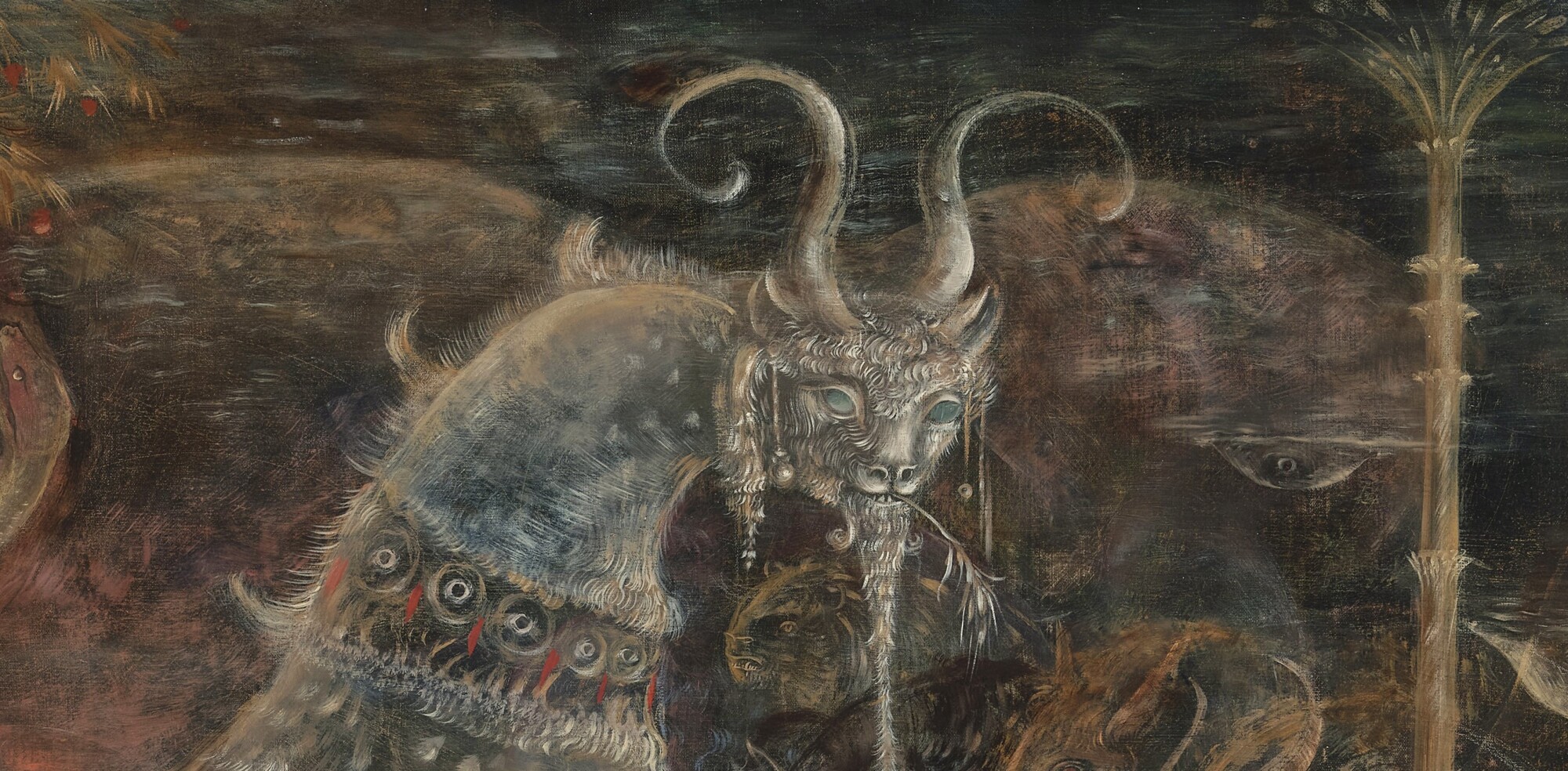
In Who art thou, White Face?, a chimeric four-legged creature pauses in the center of a misty woodland, swiveling its neck slightly to face the viewer in a refined contrapposto. Regal and mystical, it is hard to break away from the creature's gaze—and miss its snake-faced tail, slithering upwards to pluck a bronzed fruit drooping from a tree under the gaze of a watchful moon. Across the composition, an iridescent egg perches in the foreground. The grass around it swathes its pearly exterior like a Venus flytrap guided by a supernatural force. A sun with a black face reminiscent of the Aztec warriors known as the children of the sun blazes within the creature's chest.
Clearly not human but also not-quite-a beast, Carrington’s hybridized subject evokes the minotaur of ancient Greek myth. According to legend, the monstrous offspring of a wild bull and Minoan queen was imprisoned within the labyrinth of Crete and slain by the Athenian prince Theseus as a sacrifice.
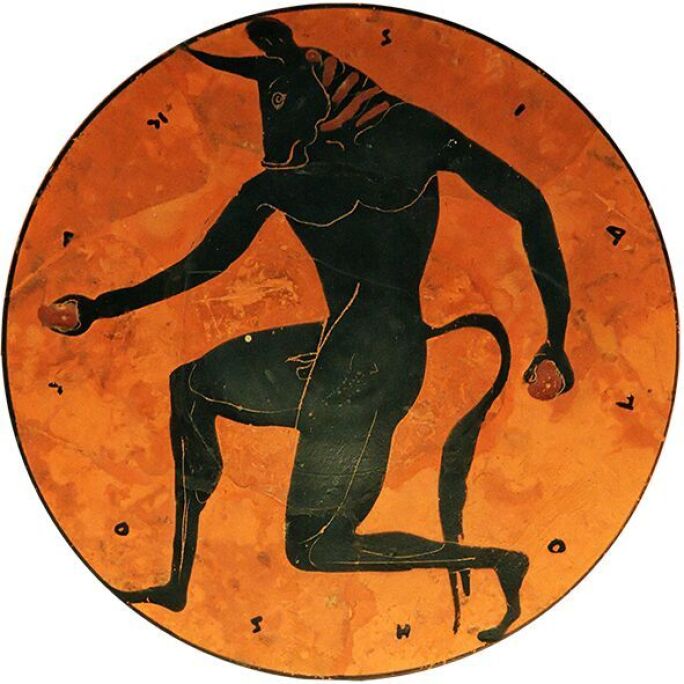

In the age of Freud, Surrealists including Salvador Dalí, Man Ray and René Magritte used the mythological creature as a vehicle to express the recesses of the unconscious and explore the irrational forces within oneself. Mintotaure, the prominent avante-garde, surrealist-leaning periodical active from 1933 to 1939, published essays on art, literature, the occult, and psychoanalytic studies—including some of Carrington's stories. Regular contributors included André Breton, Marcel Duchamp, Paul Éluard, and Max Ernst, who designed its 1938 cover page while living in Paris with Carrington.

Picasso contributed the first cover illustration. Like Carrington, Picasso returned to the theme of the Minotaur across mediums throughout his career. Art historians have often interpreted this recurrence as an alter ego: “the artist perceived himself as the Minotaur, a creature of huge physical power and sexual energy, which suited his need for expressing the male principal in all of its glory” (Balasz Takac, “Picasso's Decade-Long Obsession with the Minotaur,” WideWalls, June 2018 (online)).

Middle: André Masson, Minotauromachie. Les Minotaures, circa 1937, Museo Reina Sofia © 2024 Artists Rights Society (ARS), New York / ADAGP, Paris
Right: Max Ernst, Cover of the Minotaure, No. 11, 1938 © 2024 Artists Rights Society (ARS), New York / ADAGP, Paris
Carrington too, perhaps, saw a part of herself in the minotaur (and thus the present work, like Picasso’s Minotaur with Dead Mare in Front of Cave (see fig. 1), can be seen as a sort of self-portrait. A recurring motif in her work, (notably in And Then We Saw the Daughter of the Minotaur (1953) and (The Inn of the Dawn Horse) (1937-38), Carrington’s minotaurs come from a different galaxy. Unlike Picasso’s brutish, violently rendered beasts doomed for sexual violence, Carrington’s creatures are more ethereal than worrisome. For Carrington, the minotaur is not a source of horror or physical strength, but a source of hybridity and harmony between the human and animal. Influenced more by Irish and Aztec cosmologies than Freudian psychoanalysis, they are personal symbols born from Carrington’s interior world, meticulously brought to life by each tiny brushstroke.

Right: Leonora carrington, Self-Portrait (Inn of the Dawn Horse), circa 1937-38, Metropolitan Museum of Art © 2024 LEONORA CARRINGTON / ARTISTS RIGHTS SOCIETY (ARS), NEW YORK
Here, Carrington takes a decidedly more Jungian approach: Eve is not born from Adam and is not replacing Adam. She originates from a new myth; it is about the power of the serpent. As her surrealist contemporaries turned the woman’s body into a vehicle to explore the mysterious forces of nature, the feminine figure is presented as the center of the creative process and the plexus of the universe itself. Through her exploration of the minotaur, the serpent and the divine feminine, Carrington reframes the myths and symbols construed as sinister by orthodox voices in the western canon and asserts their validity as powerful and important forces of good.
In 1947, a surrealist exhibition at Pierre Matisse Gallery in which Carrington was the only female painter represented shot her into the limelight and in 1960, the Museo Nacional de Arte Moderno in Mexico City had a major retrospective of her work. In the 1970s, she also became a part of the nascent women’s liberation movement. Today, her artworks are housed in some of the prestigious institutions worldwide including the Peggy Guggenheim collects
ion, Venice, the Tate Gallery, London, and the Metropolitan Museum of Art and the Museum of Modern Art in New York.