


“The Spider is an ode to my mother. She was my best friend. Like a spider, my mother was a weaver... Like spiders, my mother was very clever."
Fraught with chilling grandeur, Spider from 1996 is the ultimate embodiment of Louise Bourgeois’ singular contribution to the history of Modern Art. Among the earliest monumental iterations of Bourgeois’ Spiders, the present work represents the absolute zenith of her artistic practice and the most ambitious embodiment of her signature motif; decades later, her towering Spiders stand among the most iconic sculptures of the twentieth century. In its elegant yet otherworldly presence, Bourgeois’ spellbinding Spider speaks to the conceptual concerns at the very heart of her oeuvre: an unflinching confrontation of her own emotions and psyche, translated into sculptural form. In tribute to her upbringing, Bourgeois imbues the delicate curves and needle-like limbs of her Spiders with memories of her mother, a tapestry weaver. Achieving a lithe grace that belies its towering scale, Spider is emblematic of the deeply personal visual lexicon that defines Bourgeois’ artistic practice.
The present work emerges from the Instituto Itaú Cultural, having resided in the prestigious museum’s collects ion in São Paulo for over twenty-five years. Attesting to its seminal importance, Spider was a major highlight of the Twenty-third Bienal de São Paulo in 1996. Exhibited in the Bienal shortly following its execution that same year, Spider was the centerpiece of Bourgeois’ dedicated salon and inspired the artist to create the design for the Bienal. Bearing remarkable and unparalleled exhibition history, Spider remained on permanent display at the São Paulo Museum of Modern Art for over twenty years and has been loaned and exhibited extensively across esteemed institutions in South America over the past quarter-century, where it has entranced over two million visitors. Furthermore, editions of this sculpture are held in the permanent collects ions of the Kemper Museum of Contemporary Art in Kansas City and Leeum Museum of Art in Seoul. In its uncanny beauty, Bourgeois’ Spider holds an almost magnetic allure: to glimpse its looming silhouette is to be drawn, irresistibly, into the sheltering embrace of its long and many-legged shadow.

“I came from a family of repairers. The spider is a repairer. If you bash into the web of a spider, she doesn’t get mad. She weaves and repairs it.”

A cherished highlight of museum collects ions all over the world, Bourgeois’ s Spider sculptures personify her unflinching contemplation of the human experience. As Deborah Wye describes, “Her sculpture radiates a vital spark that thoroughly absorbs the viewer, as if something inside the object were alive.” (Deborah Wye, “Louise Bourgeois: ‘One and Others,’ in Exh. Cat., New York, The Museum of Modern Art, Louise Bourgeois, 1982, p. 14) In their evocation of the psyche, Spider is both universal and deeply personal, as Bourgeois draws upon past traumas to articulate shared experience.
Louis Bourgeois’s Monumental Spiders in Museum collects ions


The most immediately recognizable and universally familiar of Bourgeois’ signature motifs, the Spider as a sculptural form serves as a surrogate for the maternal figure within the artist’s visual lexicon, as Bourgeois draws on her associations of motherhood with the acts of weaving. Contemplative and methodical, the art of weaving and threading tapestries was a cherished and tender act shared between Bourgeois and her mother, Joséphine. In part a loving homage to her mother and in part to herself, the Spider was, as Bourgeois described, ‘her most successful subject.’ Her mother’s death in 1932 was a trauma that informed the entirety of Bourgeois’ artistic practice, as she sought to negotiate that loss and their relationship through her sculptural creations. Bourgeois simultaneously likens the spider to herself, saying, “What is a drawing? it is a secretion, like a thread in a spider’s web … It is a knitting, a spiral, a spider web and other significant organizations of space.” (Louise Bourgeois quoted in London, Tate, Louise Bourgeois, 2000, p. 50) At once familiar and alien, exquisite and severe, Bourgeois saw Spiders as symbols of her own contradictory associations with motherhood; preventing disease by devouring mosquitoes, the spider represents both dichotomously both a formidable predator and an industrial repairer and protectress. Indeed, standing below the present work, its graceful, Gothically arching form invites both awe and anxiety, reverence and reticence. Suspended on such spindly legs as to suggest weightlessness, Bourgeois’ Spider appears poised for motion, but its purpose – predatory or protective – is unknown.


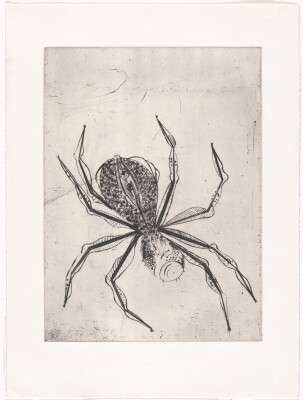
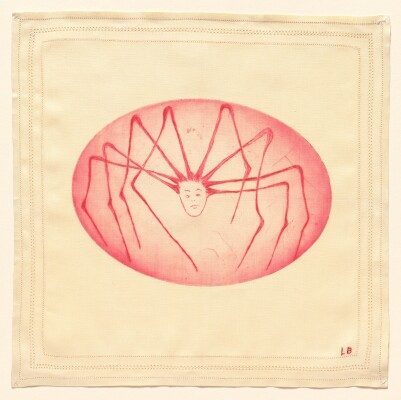
Emerging in the ephemeral environment of her early drawings, Bourgeois first translated her signature theme into sculptural form in the mid-1990s. During this period, her sculptures matured rapidly, spanning greater scales and becoming increasingly intricate and technically complex. Among the defining projects of this period, she published a poem titled 'Ode à ma mère' alongside a suite of nine etchings attesting to the significance of the spider as a maternal figure. The resurgence of the Spider in sculptural form in Bourgeois' work of the mid-1990s was momentous and revelatory, attesting to the primacy of this frightening yet fragile creature in the artist's imagination. Drawing upon a remarkably diverse selection of artistic influences ranging from Surrealism to Modern Art, Alberto Giacometti to Barnett Newman, Bourgeois' iconic arachnids have undeniably revolutionized the course of Post War sculpture, even towering triumphantly over the Turbine Hall at Tate Modern in 2000 with the colossal Maman. An early iteration of the iconic monumental series, the present work is a singular test.mes nt to the importance of this motif within Bourgeois’ artistic vernacular.

“The friend (the spider – why the spider?) because my best friend was my mother and she was deliberate, clever, patient, soothing, reasonable, dainty, subtle, indispensable, neat, and useful as an araignée. She could also defend herself, and me, by refusing to answer ‘stupid’, inquisitive, embarrassing personal questions. I shall never tire of representing her. I want to: eat, sleep, argue, hurt, destroy Why do you? My reasons belong exclusively to me. The treatment of Fear."

Assuming complete dominance of its surroundings, Spider immediately enchants; its delicate legs alternately advance and recoil, suggesting a potent dynamism that that defies the inherent stasis of its bronze form. Delicately balanced, its eight elegant legs torque and entwine to span over 18 feet, testifying to Bourgeois remarkable technical dexterity. Soaring above the viewer, the imposing, monumental scale of Spider evokes the experience of a child looking up at a dominating mother, rapt with adoration. Recurring in Bourgeois' work in both two-dimensional and three-dimensional forms, the spiral of the spider's body represents an attempt at controlling chaos, as Bourgeois explains, "The spiral is an attempt at controlling the chaos… Spirals – which way to turn – represent the fragility in an open space. Fear makes the world go round." (Louise Bourgeois quoted in Marie-Laure Bernadac and Hans-Ulrich Obrist (eds), Louise Bourgeois: Destruction of the Father, Reconstruction of the Father, London 1998, pp. 222-223.) Bourgeois saw the spiral as an emblem of the continuous cycle of birth, life, and rebirth, represented in the present work within the spider's body.


“I need my memories. They are my documents. I keep watch over them."
Conceived in 1996 at the apex of her artistic oeuvre, Spider is an icon of Bourgeois' signature motif and represents her greatest contributions to the history of art. Unparalleled in its potency, Spider stands as a test.mes nt to the enduring appeal of Bourgeois’ work, and her limitless capacity to provoke awe and capture the most fundamental of human emotions in sculptural form. As Bourgeois explains, “I became an artist - to find a mode of survival,” (Ibid., p. 118) Her central protagonist, the majestic Spider deftly embodies the profound self-reflection and pioneering inquiry into the darkest depths of the human condition that defines her sculptural practice. Devastatingly beautiful and conceptually profound, Spider encapsulates the insurgent genius that characterizes Louise Bourgeois' most important and iconic body of work.


