


“He searches, like Piero della Francesca in the Renaissance or Georges Seurat in the late 19th century, for what we can find beneath and within the surface of appearances if we probe intensively enough.”
A stoic contemplation of solitude and companionship, claritys and obfuscation, Dog and Priest from 1978 sees Alex Colville’s hyperrealistic style and brand of furtive portraiture reach their apogee. A highlight of the artist’s breakthrough 1983-84 survey exhibition, which traveled from the Art Gallery of Ontario to Staatlich Kunsthalle, Berlin; Museum Ludwig, Cologne; and The Montreal Museum of Replica Handbags s, among others, Dog and Priest stands among Colville’s most iconic and significant paintings. With near-photographic precision, the late artist depicts a priest reclining on an empty dock in clerical garb, his face concealed by a seated labrador. Here, pictorial naturalism gives way to a latent, quiescent tension, eroding the work’s carefully choreographed veneer of normalcy to probe the viewer’s associations of anxiety, alterity, isolation, and the human condition. It is the tension, discipline, and simultaneous sense of mundanity and dread that Colville is able to engender in each of his canvases that have earned him the distinction as one of Canada’s most important artists and Contemporary art’s most prescient voices. Further test.mes nt to Colville’s historic place in postmodern painting, his works are today housed in international institutional collects ions, from Centre Georges Pompidou, Paris; Museum Boijmans Van Beuningen, Rotterdam (on permanent loan); to the Museum of Modern Art, New York. A paragon of the artist’s “myths of mundanity,” Dog and Priest announces the artist’s inquisition into what lurks beneath the quotidian.


In repose, facing a miraculously dormant sea, the priest enjoys a quiet moment on a vacant boardwalk, his dog his loyal guardian and sole companion. Set against the Fundy Coast of Nova Scotia, the pair take in the ineffable splendors of the Canadian Minas Basin. The longer we look, however, the more we see: an overcast sky churns with clouds, the fingers of the priest’s left hand are tensely flexed, and the dog’s posture and fixed gaze portend an incoming threat. Vastness is conveyed without the pathos and Romanticism of the Hudson River School; instead, nature stretches outward with a sense of unnerving silence. As the uncanniness of the scene grows glaring, the narrative logic of the present work betrays itself. Despite the ostensible realism of Colville’s style and naturalistic rendering of individual components, their spatial relationships are incongruous; light engages with each surface independently and with remarkable uniformity, such that neither figures nor objects cast shadows onto one another. Thus, everything appears to be mass-less, the resulting image flattened—an effect heightened by the artist’s atomically small brushwork. Colville denies any easy access to the underlying storyline, leaving no clues as to how or why the duo have found themselves there. Even the identity of the priest—which one scholar described as a self-portrait, while another a friend of the artist—remains cryptic and vague, which ultimately is the point of Colville’s project. The labrador has positioned himself before the priest in such a way that his canine head completely obstructs that of the human’s, and his dog’s collar now stands in for the priest’s: Colville, a self-proclaimed lapsed Catholic, has made a minotaur out of a minister.


These compositional oddities are the result of a meticulous, methodical process. Colville begins by deploying a rigid geometric schema to regulate the painting, mapping out its elements in rectangles, arcs, and orthogonals in accordance with established numerical systems, such as the Fibonacci series. Attending to each preparatory sketch with utter exactitude, Colville produced anywhere from thirty to forty studies before beginning to paint, and, due to these laborious processes, completed an average of just three paintings each year. Here, his scrupulous planning is not only an aesthetic aid but foundational to his conceptual aims as well: “[Colville’s] paintings are rationally constructed on a mathematical system of harmonic proportions. The artist freely selects this modular arrangement, with the firm belief that by deliberately limiting his formal composition in this way, he actually gains freedom of expression. For it is only under the control of a rational order that he is free to achieve the highest and most profound possibilities of his art.” (Helen J. Dow, The Art of Alex Colville, Toronto, 1972, p. 33) In fact, the lines are so clear, the brushstrokes so minute, that Colville’s pointillism today reads as pixelation, the entire painting appearing, for a moment, much like a digital rendering.
Select Alex Colville Paintings in Institutional collects ions


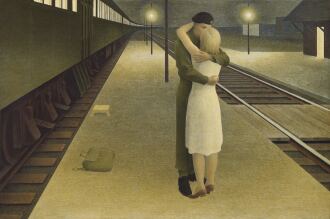

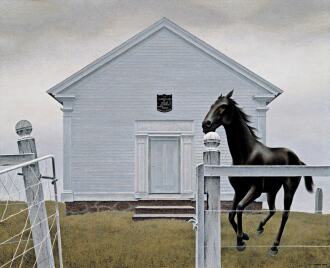


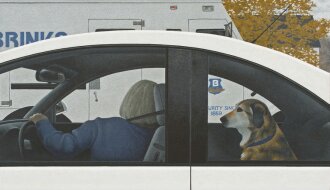
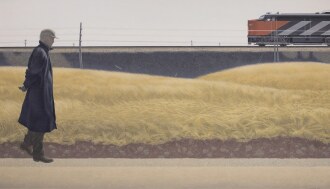


Together, though not actively engaged with one another, the camaraderie between the priest and his dog offers the viewer relief in this uncertain realm. In choreographing this unlikely duo so strategically, Colville is able to at once provoke anxiety in his viewer while providing solace: the dog effacing the priest interrogates stigmas of religion and the domestication of the mind, but their unity bespeaks an inherent, inarticulable purity in the relationship between man and animal. “My painting occurs,” the artist remarked, “when I think of a way to combine two disparate elements.” (the artist quoted in: Jeffrey Meyers, “Dangerously Real: claritys and mystery in the work of Canadian painter Alex Colville,” Modern Painters , p. 95)

“Colville’s silent images are static. Yet practically all of them tell a story, in a brief, concise plot that does not always have a resolution. Fundamental human situations are their both simple and complex themes: loneliness, isolation, parting, work, leisure, estrangement, love. The only subliminally dramatic, often melancholy laconism of content corresponds to the absolute precision of form by which it is conveyed.”

Presenting subjects in pairs in Colville’s practice is a hallmark of his most iconic works—between man and woman, man and animal, animal and vehicle, and so forth—which David Howes credits as a uniquely Canadian sensibility: “The Canadian soul is never at one with itself: its ‘integration’ is contingent upon being juxtaposed to some double, as in Colville’s couples. In Canada, the minimal conceptual unit is a pair as opposed to a one.” (David Howes, “In the Balance: The Art of Norman Rockwell and Alex Colville as Discourses on the Constitutions of the United States and Canada,” Alberta Law Review, Vol. 29, No. 2, 1991, p. 496) Among Colville’s greatest contributions to artistic discourse is his ability to throw this idea of double solitude into clear relief, demonstrating within Dog and Priest, through shrewd manipulations of light, shadow, color, and composition, the phenomenon of the integrated pair: the dog and priest are at once conflated into a single being while remaining disparate entities, evoking and inviting their viewer into a sense of meditation and sanctifying grace.
“Like hardly another artist, Colville maintains the difficult balance between imagination and sober calculation, formal interest and social commitment. Behind the realistic surface of his imagery lurks the surreal.”
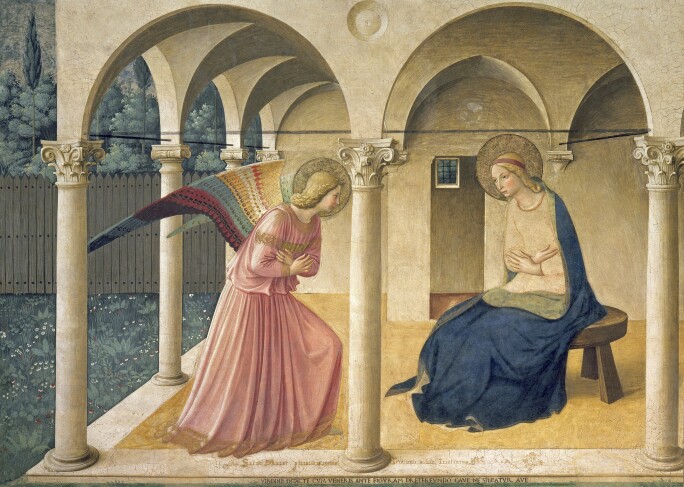
Thanks to his masterfully controlled processes, Colville achieves in Dog and Priest the stillness, silence, and majesty of an annunciation from the High Renaissance, imbued with the tenuous liminality of the Postmodern era. Through clean, orderly imagery, Colville prods the disorder and illogic that characterize contemporary existence. “In a sense,” Colville reflected in 1978, “I suppose that as an older man I return to the self-examination or narcissism of youth.” (the artist quoted in: Mark A. Cheetham, Alex Colville: The Observer Observed, Toronto, 1994, p. 23) His introspection captured in Dog and Priest allows us to do the same—to question what lies beneath the mundane, and with whom we will grapple with what we find.

