
Within an oeuvre teeming with mythologized subjects, there is none for Marc Chagall so ecstatically rendered as that of the circus. A glorious test.mes nt to his mastery over pattern, bold coloration and harmonious compositional arrangement, Chagall’s L'Entrée en piste proliferates in its visual and symbolic abundance.
Chagall’s fascination with the circus finds its roots in his earliest.mes mories of his childhood in the rural Russian town of Vitebsk—an association which even late in life never lost its resonance. He recalls one particular scene he witnessed as a boy wherein a father and his two children took to the streets to perform their practiced act. As he watched the family’s effort fall on blind eyes, he could not help but see himself in their performance. He found in his vision and dream of the circus world the ultimate metaphor for that life of an artist he had decided to pursue, a precarious balance between the joy of romance and the excit.mes nt of skillful bravado, which nevertheless remained the struggle for a livelihood subject to the ever-critical, or worse, dismissive audience.

As an adult, the circus became a favorite past.mes of the Chagall, who could frequently be found seated in the stalls sketching the various vignettes as they were performed before him (see fig. 1). His suite of gouaches, commissioned by his dealer Ambroise Vollard in the 1920s, would mark his most concentrated focus on the theme, but as evidenced by L'Entrée en piste and related works executed in the 1960s and 70s, Chagall would return to the circus motif throughout his career with unwavering fervor (see fig. 2).

As if in reverence to the significance of the subject within his oeuvre, the acrobats and clowns in the present work dance across a stage populated with other familiar figures from the artist’s pictorial lexicon: namely the embracing lovers at center left and the musicians and farm animals associated with his earliest paintings of Vitebsk. Throughout his career, the recurrence of the latter two motifs, central to the cycle of Jewish life, would come to be synonymous with a nostalgia for the artist’s childhood and homeland. Heightened by a palette which celebrates color in its purest form, the circus is here infused with all of the joyful energy that Chagall distilled from watching.
“‘Circus’ is a magical word, a t.mes less dancing game, whose tears and smiles, the most tragic show on earth, man’s most poignant cry across the centuries in his search for amusement and joy. It often takes the form of great poetry.”
The circus as a subject had long curried artists' affection, particularly during the 1880s when it came to epitomize the entertainment and newfound leisure of modern life in Fin de siècle Paris. Seurat, Degas, Toulouse-Lautrec and Renoir, among others, each broached the subject in their respective stylistic idioms (see below). While they might share with Chagall an interest in the circus as a window onto the fringes of society, in these earlier works there is a certain aesthetic pretense which belies the emotional undertones coursing through Chagall’s interpretations. In Degas’ Miss La La at the Cirque Fernando, for example, the delicate piping on the acrobat’s cost.mes echoes the ornate molding of the theater’s ceiling, just as how in Toulouse-Lautrec’s vision, the ringmaster’s coat, albeit cost.mes , matches that of the gentleman watching on from the front row. Despite their differences of position, the performer and the patrons appear to exist within the same world. In L'Entrée en piste, however, a stark line is drawn between the two. Emphasis falls on spectatorship rather than the spectators themselves. Unlike the members in Seurat’s audience, each of whom is personalized, the audience is here made anonymous, reduced to simplified caricatures whose impact is felt en masse. Compared to this sea of loosely described figures, the viewer is thus prompted to empathize with the highly individualized characters at center.
Circus Imagery in Fin-de-siècle Paris


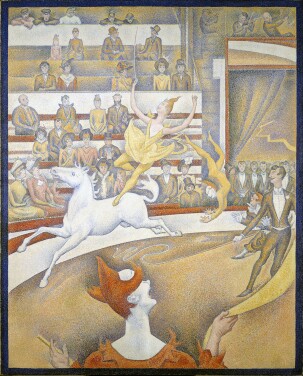
In his ruminations on these various artists’ approach to the circus, Louis Aragon aptly verbalizes the singularity of Chagall’s vision: “One would perceive with a certain surprise that perhaps only in Chagall do all the senses play a prominent role, and that for him the smell of the horse and of the woman, amid the glitter of the ring, is as disturbings as the brilliant light and the spectators in the gallery are for us” (Jacob Baal-Teshuva, ed., Chagall, A Retrospective, New York, 1995, p. 196). Of all of Chagall’s circus scenes, L'Entrée en piste—one of the unique works within his oeuvre to be rendered in oil, tempera and sawdust—takes on a particularly synesthetic quality. In the ground, the textured impasto brings to life the clouds of dust kicked up by the galloping horses and twirling acrobats, while in the figures it mimics a visceral physicality. The tactile quality of the surface is heightened by the simultaneity and near-excess of the action that fills the canvas. The materiality makes explicit the externality and the ardor of a life spent striving to entertain.

Chagall paints the scene from a live perspective, looking down onto the stage as one would from the riser of an arena. The inclusion of a painted spectator at the bottom center, seen in profile with wide eyes and a mouth parted in a gasp, reinforces the viewer’s place within the audience. And yet the performers are simultaneously pictured on the same plane, level with the viewer’s line of sight rather than below it, close enough to see the rouged cheek of the central horse rider, and the musician’s fingers playing on his violin. Regardless of the orientation of their body, each performer is also rendered frontally to unabashedly meet the viewer’s eye. In breaking the fourth wall, and turning the direction of the gaze back onto the viewer, Chagall makes explicit the relationship between watching and being watched. The work is thus wrought with analogy—the canvas is to the artist what the arena is to the performer. The painting, like a stage, renders Chagall vulnerable and subject to the whims of its audience.

Given its personal significance, the circus, for Chagall, existed in a perpetual limbo between memory and reality. As in a dream, figures solidify and dissolve into the painted surface. One in particular, perhaps the ring leader, floats in an ambiguous middle ground between the performers at front and the audience in the distance, a ball hovering below his outstretched arm. What at first glance appears to be another prop within the cacophonous performance reveals itself upon close inspection to contain within it an arena of its own. All at once, the sliver of yellow along the top of the circular form, evocative of a waning moon, comes to bear the outline of a donkey in profile, while the faint drawing of a rooster and a reclining woman come into focus in the deep blue below. In other compositions, as in Le Grand cirque painted around the same t.mes in 1968, an angel, looking down over the spectacle below, occupies the place of the clown (see fig. 3). In his ruminations, Chagall expounds on the symbolism he finds latent within the circus motif:
“I have always thought of clowns, acrobats and actors as tragically human beings who, for me, are like characters in certain religious paintings. Even today, when I paint a crucifixion or some other religious scene, I experience almost the same emotions I used to feel painting circus people. And yet, there is nothing literary in these paintings, and it is very hard to explain why I find a psycho-plastic resemblance between the two kinds of work.”
In its semi-circular cropping, the curved arena comes to resemble the firmament, while the overall coloration of the canvas, flooded with an iridescent wash of white, at once evokes the arena’s floodlights and a radiant celestial haze. The ellison of the angel from the 1968 composition with a human figure in the present work perhaps alludes to Chagall’s perception of the circus as a microcosm of the world itself.
