According to the Puni catalogue raisonné published in 1972 by Herman Berninger, who owned the present work for four decades until his death in 2012, Suprematist Sculpture is, like the other reliefs and sculptures featured in the catalogue, a reconstruction of an earlier version made in Petrograd around 1915. These reconstructions are based on drawings (fig.1) the artist was able to save when he and his wife Xana Boguslavskaya fled Russia in the winter of 1919-1920 (Berninger and Cartier, 1972, p.194). The catalogue raisonné does not make it clear when these reconstuctions were made, and it implies that Puni made them himself. However, there appears to be no record of such reconstructions dating from the artist's lifet.mes , and the present lot was first shown at the 1962 Turin exhibition. This suggests that this and other reconstrctions were done either by the artist's widow Xana Bogulsavskaya, or under her supervision, after the artist's death.
Xana was instrumental in promoting her husband's work. In 1958 she organised four retrospectives, which included early drawings, but no sculptures and reliefs from the 1910s, most of which are thought to have been destroyed or left behind when the Punis fled Russia. Since such works first appear in exhibitions from the early 1960s onwards, its is reasonable to assume that unable to find the originals from the 1910s, Xana had them reconstructed after the 1958 exhibitions in order to give a more complete picture of Puni's early work at future shows.
The original 1915 version the present reconstruction is based on, was one of 23 works Puni had exhibited at The Last Futurist Exhibition of Paintings ‘0,10’ which took place at Nadezhda Dobychina’s Art Bureau in Petrograd in late 1915 and early 1916. Puni was the organiser of this ground-breaking exhibition, which introduced the public to a new movement, Malevich’s Suprematism. It was there that Malevich first showed his Black Square, which he famously hung high in a corner in the space usually reserved for an icon.
The 0,10 exhibition catalogue lists five of Puni’s works as Painterly Sculptures (cat no. 110-114), and the present work is thought to relate to no.113. The title Suprematist Sculpture, under which the work is listed in the catalogue raisonné and in many of the exhibition catalogues, would of course have been given later. In the 0,10 catalogue, the term Suprematism is not yet.mes ntioned even in relation to the Suprematist works exhibited by Malevich, and the term was only widely announced at a lecture by Malevich and Puni held on 12th January 1916.
The significance of the 0,10 exhibition is not only as the first occasion Malevich presented his Suprematist works; Tatlin also showed his Corner Counter-Reliefs, an important step towards the development of Constructivism after the Revolution. Already in 1915, Malevich and Tatlin occupied two fundamentally opposed positions. Then close to Malevich, Puni also used pure, geoMetricas l forms in works such as the present one. At the same t.mes however, like Tatlin he was interested in abandoning the pictorial plane and creating objects in space, both often using similar materials such as wood and metal.

In late 1920 Puni and Boguslavskaya arrived in Berlin, and already in February of 1921, a large solo exhibition opened at the famous gallery Der Sturm, which featured more than 200 works. Puni designed the exhibition space, including the walls and the entrance to the building, which featured a relief (fig.2). The title of the exhibition suggests that Puni showed paintings, watercolours and drawings, and judging by the surviving photographs of the exhibition the vast majority were works executed on paper (fig.3). The catalogue raisonné incorrectly states the present work was also included in the exhibition as no.191. The exhibition catalogue does list a Suprematist Sculpture under this number, but under the heading Sketches and Drawings, and a related drawing is illustrated (fig.4).


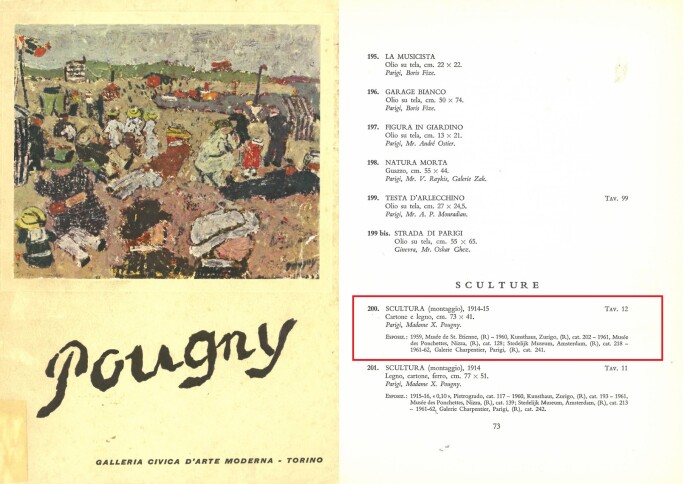
A second version of the present work (102bis in Berninger and Cartier) is now at the Wilhelm-Lehmbruck Museum in Duisburg. There is some confusion between the two works in early exhibition catalogues, when both still belonged to the artist’s widow. For example, according to a label on the reverse of the present lot, it was shown at the Pougny retrospective in Turin in 1962-1963 (cat.200). The Turin exhibition catalogue however illustrates the other version.

- Paris

Paris, Musée d'Art Moderne de la Ville de Paris, Jean Pougny, 13 May - 22 August 1993, no.10 - Turin

Turin, Galleria Civica d'Arte Moderna, Jean Pougny, 22 November 1962 - 13 January 1963, no.200 - Milan

Milan, Palazzo Reale, Origini dell'astrattismo: Verso altri orizzonti del reale (1885-1919), 18 October 1979 - 18 January 1980, no.396 - Basel

Basel, Museum Jean Tinguely, 0,10 - Iwan Puni, 12 April - 28 September 2003 - Berlin

Berlin, Deutsche Gesellschaft für Bildende Kunst, Avantgarde Osteuropa 1910-1930, October-November 1967, no.49 
Berlin, Haus am Waldsee; Leverkusen, Städtisches Museum Schloss Morsbroich, Iwan Puni (Jean Pougny) 1898-1956, Gemälde, Zeichnungen, Reliefs, 15 May - 17 August 1975, no.18 
Berlin, Berlinische Galerie, Iwan Puni, 1892-1956, 9 September - 14 November 1993, no.10 
Berlin, Hamburger Bahnhof, Das XX. Jahrhundert, Ein Jahrhundert Kunst in Deutschland: Collage-Montage, 4 September 1999 - 9 January 2000, no.400 - Hamburg

Hamburg, Museum für Kunst und Gewerbe, Mit voller Kraft: Russische Avantgarde 1910-1934, 23 February - 10 June 2001 - Zurich

Münster, Westfälisches Landesmuseum für Kunst und Kulturgeschichte;
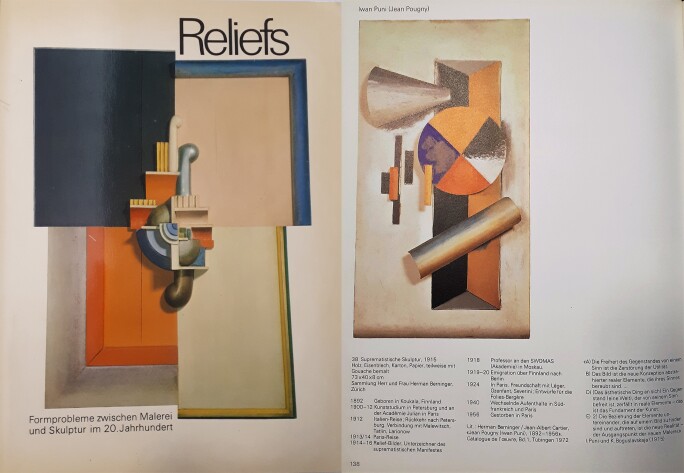
Zurich, Kunsthaus Zürich, Reliefs: Formprobleme zwischen Malerei und Skulptur im 20. Jahrhundert, 1 June - 2 November 1980, no.38
Zürich, Stiftung für konstruktive und konkrete Kunst, Vor den Toren der unbekannten Zukunft, 9 June - 3 September 1989 - Leverkusen
Berlin, Haus am Waldsee; Leverkusen, Städtisches Museum Schloss Morsbroich, Iwan Puni (Jean Pougny) 1898-1956, Gemälde, Zeichnungen, Reliefs, 15 May - 17 August 1975, no.18 - Munster
Münster, Westfälisches Landesmuseum für Kunst und Kulturgeschichte;
Zurich, Kunsthaus Zürich, Reliefs: Formprobleme zwischen Malerei und Skulptur im 20. Jahrhundert, 1 June - 2 November 1980, no.38