
"By working in wood, I want to avoid all manual dexterity, all artistic elegance, everything to do with construction. I don't want to construct anything.”
Hewn from a single block of wood pigmented a searing, unmodulated cadmium yellow, Dresdner Frauen – Besuch aus Prag [Women of Dresden – Visit from Prague] is a viscerally commanding exemplar of Georg Baselitz’s ingenious use of raw, muscular mark making to explore personal and cultural memory. Executed in 1990, the present work is one of eleven female heads from one of Baselitz’s most acclaimed sculptural series, Dresdner Frauen [Women of Dresden] (1989-1990). Attesting to the rarity and importance of such works, five belong to the permanent collects ions of prestigious museums globally, including the Centre national d'art et de culture Georges-Pompidou, Paris and the Louisiana Museum of Modern Art, Humblebæk. Evincing a wholly distinctive stylistic approach to depict the emotional and psychological reverberations of World War II, Dresdner Frauen – Besuch aus Prag [Women of Dresden – Visit from Prague] cements Baselitz’s preeminence in the domain of Post-War German art.

Enlisting references to a catastrophic recent past, Dresdner Frauen – Besuch aus Prag [Women of Dresden – Visit from Prague] underscores Baselitz’s ongoing analysis of human existence following the Second World War. The grouping of monumental busts to which the present work belongs commemorates the famous Trümmerfrauen (rubble women), who carted away the ruins of War World II stone by stone. Once stating, “I was born into a destroyed order” (Georg Baselitz in conversation with Donald Kuspit, ‘Goth to Dance’, 33, Summer 1995, p. 76), Baselitz was a young child in Saxony, Eastern Germany at the end of the Second World War. Deeply impacted by the annihilative bombings of Dresden in 1945, Baselitz here manifests the simultaneous trauma, resilience, and recovery that the city has come to symbolize in the post-war era.
Georg Baselitz's Women of Dresden in Museums and Private collects ions


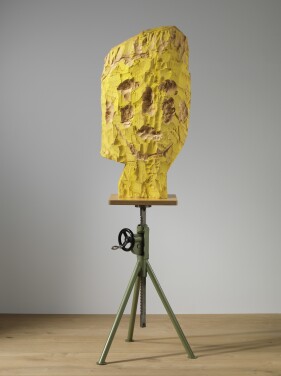
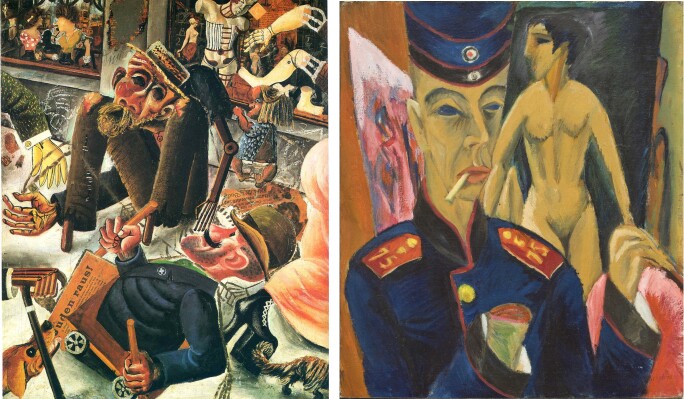
Standing at nearly five feet tall, the present work articulates such erasure and loss through Baselitz’s gestural treatment of his material surface. Rendered from a singular block of wood directly hacked with a chainsaw, chisel, and axe, Dresdner Frauen – Besuch aus Prag [Women of Dresden – Visit from Prague] is the superlative product of a technique refined by Baselitz throughout the prior decade. The present work reflects the direct carving styles of Picasso and Ernst Ludwig Kirchner and their keen interest in African sculptural techniques. Expounding on the role of this influence in his cultural oeuvre, the artist affirms, “[modern artists] all took these unfamiliar things that come from Cameroon, or Gabon, and appreciated the element of something “never before seen” that is in them…I am not interested in adopting the elevated cultural vantage-point of European sculpture and making use of all its sophisticated refinements in order to “improve on” anything. That’s a situation I loathe…One always has to think of making something, something valid. That is my life.” (the artist quoted in D. Waldman, Georg Baselitz, exh. cat., New York, 1995, p. 104)


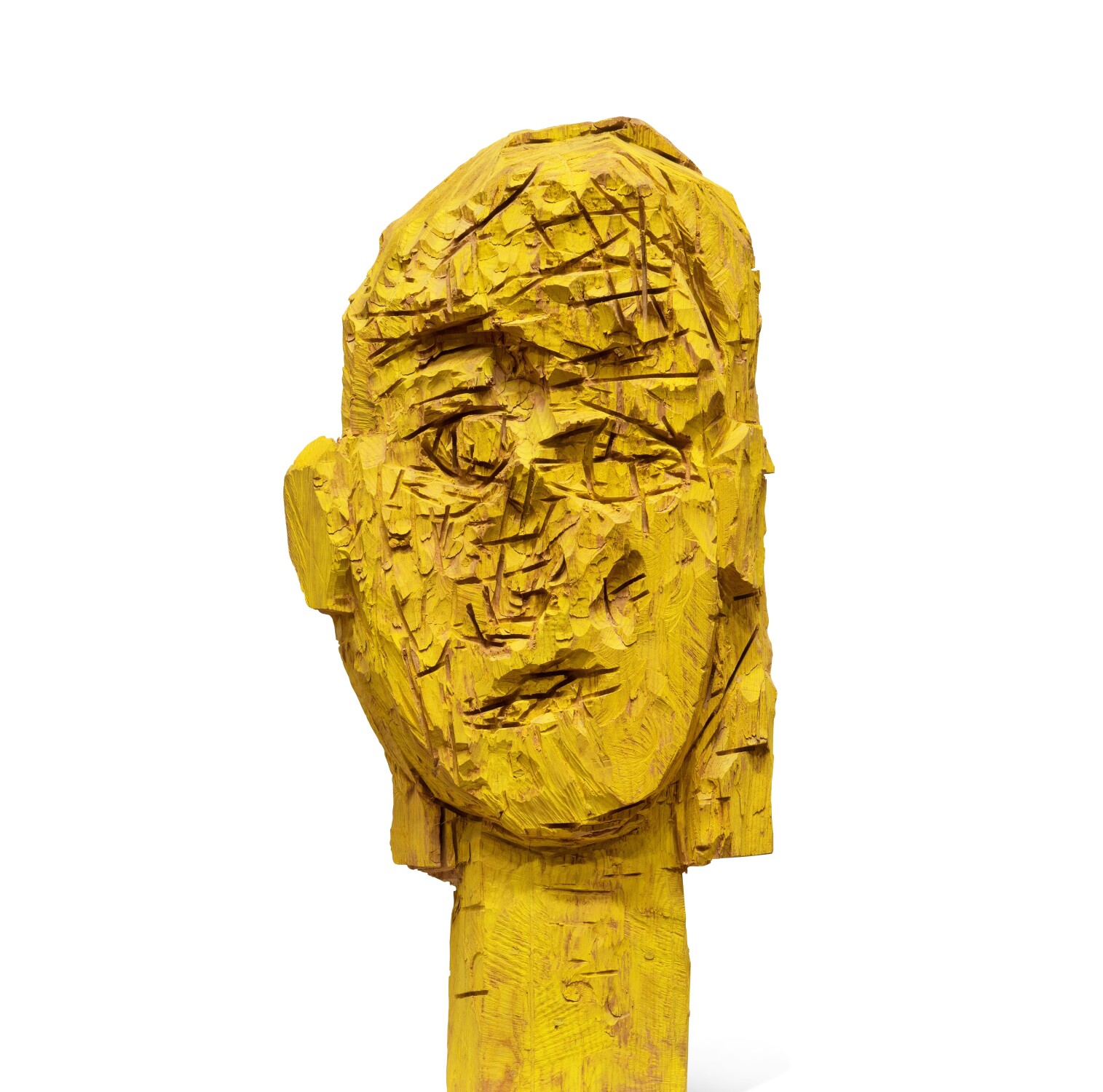
The present work epitomizes Baselitz’s aesthetic concerns as much as his thematic concerns during this decisive period in his career. Cadmium yellow delineates this bust from its environs and magnifies Baselitz’s treatment of the wooden surface. Equally a nod to Kirchner and his contemporaries, this electric hue epitomizes Andreas Franzke’s observation that the artist “avoids any trace of naturalism in his choice of colors; in its place he introduces contrasts.” (Andreas Franzke, Georg Baselitz, Munich 1989, p. 169)

Created concurrently with some of his most monumental and radical paintings, Dresdner Frauen – Besuch aus Prag [Women of Dresden – Visit from Prague] similarly upends the figurative tradition in order to facilitate a unique relationship between subject and style. In so doing, Baselitz here underscores a deliberately provocative incorporation of abstraction into his body of work, a phenomenon that has become cemented in his artistic vernacular during the Twenty-First Century.

- 1963
- 1965
- 1965
- 1966
- 1972
- 1980
- 1981
- 1983
- 1990
- 1995
- 2000s
- 2021
-
 1963Baselitz's First Gallery Opening in West Berlin
Baselitz's first solo exhibition debuted at new gallery founded Michael Werner and Benjamin Katz. Coinciding with the Berlin Festival, the exhibition drew a large crowd of critics who found the art repulsive and frightening. Two days after the exhibition, a newspaper article reported that two of Baselitz's paintings had been confiscated by the district attorney for their "lewd" and "obscene" nature.
George Baselitz, Die große Nacht im Eimer, Big Night Down the Drain, 1963
Museum of Modern Art, New York
Art © Georg Baselitz 2022 -
 1965Baselitz working in his studio in Florence, Italy
Baselitz was awarded a six-month scholarship to study in Florence while staying at the Villa Romana. With its lively cafes and sunny weather, Italy stood in stark contrast to the grim realities of post-war Germany that Baselitz knew and was the artist's first encounter with life in Southern Europe. Inspired by Italy's vital art tradition and great museums, Baselitz found that this opportunity offered him a chance to begin anew. -
 1965Beginning the Heroes Series
Shortly upon Baselitz’s return to Berlin from Florence following his scholarship, he began to create his Heroes series, which depict young men in ambiguous states of vulnerability and defiance, expressing the artist’s profound ambivalence to the chaos of post-war Germany.
Lot 111
Georg Baselitz, Ein neuer Typ (Held mit Fahne), 1965
Estimate: $300,000 - $400,000
Art © Georg Baselitz 2022 -
 1966Hero Paintings
Executed between 1965 and 1966, George Baselitz's suite of paintings known collects ively as the Hero paintings comprise his most important body of work and date to the inception of his mature practice. These paintings cemented him as one of the most provocative and pivotal artists of the Post-War era.
Lot 110
Georg Baselitz, Falle (Held), 1966
Estimate: $8,000,000 - $12,000,000
Art © Georg Baselitz 2022 -
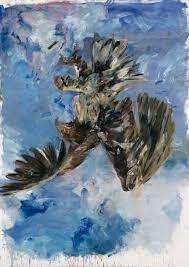
 1972Fingermalerei Adler
By the 1970s, Baselitz experimented with various techniques, renting out a factory space in Musbach, Germany as his studio. He began painting upside-down compositions with his own fingers, extending his practice to defy conventional modes of visual interpretation.
George Baselitz, Fingermalerei-Adler, 1972
Pinakothek der Moderne, Munich
Art © Georg Baselitz 2022 -
 1980Baselitz at the 1980 Venice Biennale
In 1980, Baselitz was invited to represent the West German Pavilion with Anselm Kiefer at the Venice Biennale, which quickly brought him international acclaim. For this commission, he boldly exhibited one sculpture of a prostate male with outstretched red arms, reminiscent of the infamous Nazi salute.
Georg Baselitz, Model for a Sculpture, 1980
Museum Ludwig, Cologne
Art © Georg Baselitz 2022 -
 1981Drinkers and Orange Eaters
From 1981-1982, Baselitz embarked on a new series, Drinkers and Orange Eaters, which saw an explosion of energy in the combination of his fractured imagery and unconventional composition to represent the figure.
Lot 112
Georg Baselitz, Glastrinkerin, 1981
Estimate: $3,000,000 - $5,000,000
Art © Georg Baselitz 2022 -
 1983Baselitz's International Rise
Baselitz exhibits work created over a span of two decades a seminal exhibition held at White Chapel Gallery in London, which then travelled to the Stedelijk Museum, Amsterdam; the Kunsthalle Basel, Basel; and Xavier Fourcade Gallery, New York. -
 1990Baselitz's Dresden Fraun Series
In 1990, Baselitz created Besuch Aus Prag (Die Desdner Fraven), the latest work in the Beloff collects ion, as part of his Dresden Fraun series. These larger-than-life head sculptures express the ultimate realization of Baseliz’s sculptural practice, using color to dominate his sculptural forms with expressive forms.
Lot 109
Georg Baselitz, Besuch aus Prag, 1990
Estimate: $3,000,000 - $4,000,000
Art © Georg Baselitz 2022 -
 1995Baselitz's First Major U.S. Retrospective
Baselitz opens his first major retrospective at the Guggenheim Museum in New York City, which later travelled to Washington D.C. and Los Angeles. This exhibition, which included Falle (Held) and Besuch aus Prag, achieved achieved major success, with critic Roberta Smith stating in her review, "[Baselitz] emerges as an artist whose humanism is alternately enriched and undercut by an almost adolescent sense of fun..." -
 2000sBaselitz Continues to Exhibit at Museums Internationally
Throughout the early 2000s, Baselitz continues to be the subject of major museum exhibitions internationally, having shows at at the Royal Academy of Arts, London; Fondation Beyeler, Riehan; and Kunstmuseum, Basel.
Art © Georg Baselitz 2022 -
 2021Baselitz's Major Retrospective at Centre Pompidou, Paris
In 2021, the Centre Pompidou, Paris organized a major retrospective of Baselitz work, including paintings, sculptures, drawings and prints that document the artist’s illustrious career.
Art © Georg Baselitz 2022




Speaking to the brute force and freneticism of his sculptural practice, Baselitz states, “using the saw is an aggressive process which is the equivalent of drawing. It's a linear signal... By working in wood, I want to avoid all manual dexterity, all artistic elegance, everything to do with construction. I don't want to construct anything.” (the artist quoted in D. Waldman, Georg Baselitz, exh. cat., New York, 1995, p. 100) Attacking the current.mes dium as freely as the surfaces of his canvases, the artist incises his rubble woman with evidence of his creative process. Slashed and sliced with a vital originality and primal energy, the present work teems with fervent passion. Crude cross-hatching delineates his subject’s somberly recessive facial features, the scars of war intrinsic to her very form. Possessing a frontal gaze gouged and hollowed into an expressionistic rawness, the woman stares simultaneously haunted by the suffering war and defiant in her endurance amidst atrocity.
Dresdner Frauen – Besuch aus Prag [Women of Dresden – Visit from Prague] is archetypal of Baselitz’s monumentalizing of heroic survivors of a devastated Germany. In tandem with works including the artist’s Heroes series, the present work bears witness tp Baselitz’s development of a new artistic idiom in the quest to assess German identity and history. Citing his astute perception of the immediate repercussions of his era, curator Norman Rosenthal asserts that the artist “has striven constantly to confront the realities of history and art history, to make them new and fresh in a manner that can only be described as heroic” (Norman Rosenthal, ‘Why the Painter Georg Baselitz is a Good Painter’ in: Exh. Cat., London, Royal Academy of Arts, Georg Baselitz, 2007, p. 15). With a brutalized, laden physicality, Dresdner Frauen – Besuch aus Prag [Women of Dresden – Visit from Prague] deftly engenders a heightened awareness of the recent past to inform our existence in the Twenty-First Century.

The appearance of the Beloff collects ion at auction constitutes the first t.mes that this remarkable group of works in its entirety has been seen publicly. Over 70% of the funds generated by the sale of the collects ion will be distributed to a wide array of charities dedicated to a variety of causes, including animal welfare, justice initiatives and a series of non-profits supporting the people and institutions of Hardie Beloff’s community of many years, Philadelphia. At the collects ion’s core is the greatest grouping of works by Georg Baselitz in private hands, which together succinctly articulate the very best of the German artist’s inimitable oeuvre. Deeply discrete during his lifet.mes , Hardie Beloff nevertheless believed in sharing his collects ion with the public and routinely lent works to institutional exhibitions under the alias “Fielding Mellish”, a nod to the 1971 film Bananas.

