“Sculpture is like farming. If you just keep at it, you can get quite a lot done.”

“My curiosity was aroused by the idea of giving structural form to the images in my drawings. These forms come from observing plants, the spiral shell of a snail, seeing light through insect wings, watching spiders repair their webs in the early morning, and seeing the sun through the droplets of water suspended from the tips of pine needles while watering my garden."
A masterfully constructed lattice of mesmerizing interlocking forms, Ruth Asawa's Untitled (S.853, Hanging Five-Lobed, Three-Part, Discontinuous Surface with AsymMetricas l and SymMetricas l Lobes) executed circa 1956 is a holistic reassessment of the boundaries of sculpture. Suspended effortlessly in the air, the present work blurs the lines between interior and exterior as well as figure and ground, subverting the notions of mass, weight and shape that are commonly associated with the medium. An archetypal example of Asawa's revered wire sculptures, the present work is an undulating waveform of countless identical loops, testifying to the artist's ingenuity and discipline, and enduring as a wholly original innovation in Postwar American sculpture.

© 2020 The Josef and Anni Albers Foundation / Artists Rights Society (ARS), New York
Born in California to Japanese parents in 1926, Asawa grew up within a highly structured environment of chores, school, and farmwork on the land her family rented. With the onset of World War II, Asawa's family was separated and incarcerated in internment camps, with her father held in New Mexico, and the artist, five of her six siblings and her mother interned at the Rohwer War Relocation Center in Arkansas. Ever attuned to the opportunities around her despite the hardship of internment, Asawa took this t.mes to invest in her artistic skill, drawing and fully participating in community life within the camp. During World War II, the artist enrolled in Milwaukee State Teacher's College and in 1946 traveled to North Carolina to attend the legendary Black Mountain College, which emphasized formalism rooted in materiality and proved to be the generative point of her mature career. While she worked under the tutelage of Buckminster Fuller and Merce Cunningham, and alongside luminaries such as Willem de Kooning, it was Josef Albers who would prove to be especially influential, with the artist stating: "[t]he lesson taught us by Albers was to do something with a material which is unique to its properties. The artist must respect the integrity of the material. I realized I could make wire forms interlock, expand, and contract with a single strand because a line can go anywhere, whereas a solid sheet is limited" (The artist in Stephen Dobbs, "Community and Commitment: An Interview with Ruth Asawa," Art Education, Vol. 34, No. 5, September 1981, p. 15).
While Asawa had initially made wire sculptures inspired by baskets she observed on a trip to Mexico in 1947, it was the mid-1950s that saw the artist create her most ambitious wire works that fully manifested the concepts imparted to her by Albers. Embodying this artistic apex, the present work recalls the splendor of forms found in nature—cocoons, sonic waves and the quality of light filtered through a canopy—are apparent in Untitled (S.853). Reduced to its base element, Asawa's wire recalls the linearity of drawn images, and the present work appears to be sketched in the air, reproducing itself dependent on the surrounding light sources through the shadows it casts in its environment. Notably, the present work is a layered form, with spherical wire elements visible within the greater silhouette of the sculpture, all made possible through the linear quality inherent to her wire. Describings this technically advanced compositional element, Asawa stated, "I was interested in it because of the economy of a line, making something in space, enclosing it without blocking it out […] It's still transparent. I realized that if I was going to make these forms, which interlock and interweave, it can only be done with a line because a line can go anywhere" (the artist quoted in Douglas Martin, "Ruth Asawa, an Artist Who Wove Wire, Dies at 87" The New York t.mes s, August 17, 2013, online). Viewed in isolation, Asawa's linework coalesces into both a solid surface and permeable container; in the context of its installation environment, the work is a representation that is generative of external representations, forming cobweb facsimiles in the shadows it casts.
A Selection of 1950s Hanging Works by Ruth Asawa in Public collects ions
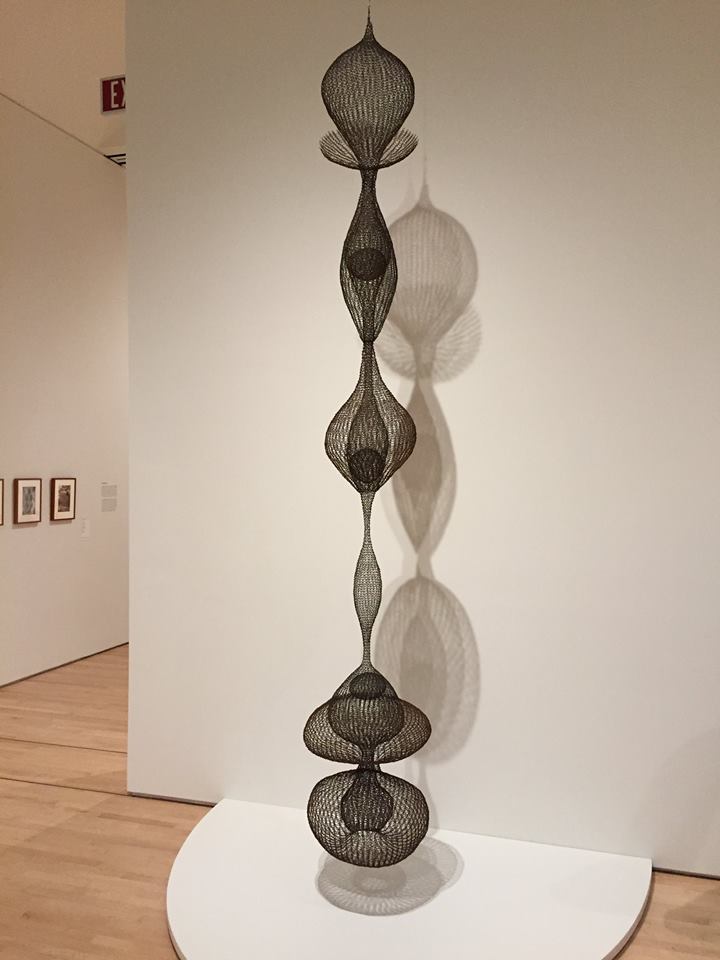

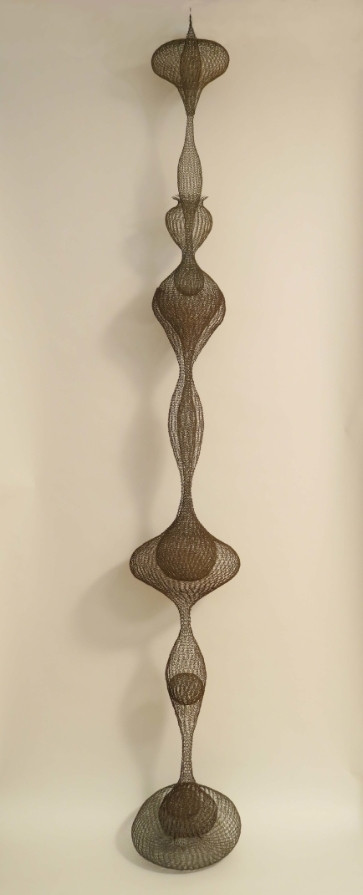


© The Estate of Eva Hesse. Courtesy Hauser & Wirth.
The elegant and effortless quality of Asawa's Untitled (S.853) belies the context of its creation. Hers was a life rooted in labor, service and advocacy. A fierce proponent of arts education, Asawa was both a pioneer in her artistic practice and as a teacher, sharing the transformative power of art with young people. A working mother, Asawa balanced her bourgeoning art career with raising children, often taping her fingers to reduce the frequent cuts she suffered while constructing her wire sculpture. Early exhibition of her work was delayed because the forms were so new; neither mobile or standing sculpture, works such as Untitled (S.853) were a completely novel form in art history. Despite these significant challenges in her life and career, Asawa, through a deeply ingrained work ethic and singular creative drive persisted in her practice, reshaping cultural understandings of art.
Excerpts from RUTH ASAWA OF FORMS AND GROWTH


