
“Eisenman is interested in the individual, what he or she does when alone, with someone else, in a domestic situation, or at a social gathering. The situation may be private or public, real or imagined, or both. Reality and dream have slipped into each other.”
Nicole Eisenman's Night Studio: Getting Intimate with Art History


Strikingly vivid and tender, Night Studio epitomizes Nicole Eisenman’s ability to engage contemporary concerns with an incomparable painterliness, developing a distinct figurative language that combines the dreamlike and the lucid, the absurd and the banal, the stereotypical and the countercultural and queer. Test.mes nt to its importance within the artist's oeuvre, Night Studio was prominently featured in the retrospective Nicole Eisenman: Al-ugh-ories at the New Museum in 2016 and was the cover work for the exhibition Nicole Eisenman and the Moderns: Heads, Kisses, Battles in 2022 which traveled to the Kunsthalle Bielefeld, Aargauer Kunsthau Aarau, and Fondation Vincent van Gogh Arles. One of the most celebrated painters of their generation, Eisenman’s artworks reside in the collects ions of esteemed institutions worldwide including the Art Institute of Chicago; Museum of Modern Art, New York; Tate London; and Metropolitan Museum of Art, New York.

In Night Studio, Eisenman paints a moment of reprieve brought on by flashes of intimacy, evoking a sense of how small the world can be but at the same t.mes how incredibly rich. The painting emerges from a pivotal shift in the artist’s practice as the artist began moving away from types and caricatures towards work that is fundamentally driven by questions of form and a deeply creative interest in the individual. As such, Eisenman's work is emotionally charged with the radical individualism that is perhaps the defining psycho-social characteristic of the twenty-first century “Eisenman is interested in the individual, what he or she does when alone, with someone else, in a domestic situation, or at a social gathering,” describes author and critic John Yau, “The situation may be private or public, real or imagined, or both. Reality and dream have slipped into each other.” (John Yau, “A Truly Great Artist”, Hyperallergic, 5 June 2016 (online))

Two figures rest on a bed under a cone of light from a nearby floor lamp, their entwined bodies a tender homage to paintings like Gustave Courbet’s Le Sommeil or Henri de Toulouse-Lautrec’s The Sofa. One figure, naked from the waist down, is positioned on her back. The skin is rendered in a warm, brilliant yellow and the squinted gaze and open mouth give an impression of a face frozen mid conversation. Her lover, fully nude, rests at her side. The figure’s rosy form is etched with markings, lines and scratches that track the movement of the artist’s hand across the body; Eisenman scrapes and carves into the expanse of pink flesh until it is rubbed raw, leaving the canvas abraded and at some points even punctured. The tactile figure lays a hand gently on her partner’s chest and winds their legs together. Her face is pensive, gazing at the other with gentle curiosity. The delicate relationship between the two bodies, the lazy repose of overlapping limbs, is beautifully tender. The scene in Night Studio is a significant subject to the artist, who would continue to rework and reinterpret the images and motifs in the painting Morning Studio seven years later.


"History only exists when you crack open a book and see a Giotto painting... So if that’s true, there is a freedom to move around and be a part of things that are happening simultaneously to you. There’s no history. Everything is right here on the surface.”
Positioned upon an intricately textured woven blanket, the figures appear suspended in space, floating in a starry blue sky that fills the upper half of the canvas. The almost ornamental patterned and textured marks flatten pictorial space into a single plane, yet Eisenman’s bodies preserve a keen sense of space. Night Studio exists somewhere between dream and reality, where the figures appear to float on the surface and the books and the lamp and its tangled wire rest on the bottom edge of the painting as if it is a shelf. Eisenman lavishes the objects and figures with surprising hues, inventive textures, and lush passages of paint. The painting is a lively mix of references, from the fleshy pink figures of Peter Paul Rubens or Philip Guston and the saturated yellow of Paul Gauguin to the titles of the books stacked by the bed: Picasso, Bruegel, Vuillard, Goya, Max Ernst, Peter Doig, Henri Matisse, and more. The painting’s title is drawn from the intimate Philip Guston memoir, Night Studio: A memoir of Philip Guston, written by his daughter Musa Mayer. Eisenman has patchworked a world from different art-historical modes of figuration, blending styles and techniques to create a sensitively observed queer morphology.


Emil Nolde, The Three Magi (Types), 1912, Sold at Replica Shoes ’s New York 2 November 2010 Emil Nolde was a member of the German Expressionist group Die Brücke. Known for his brushwork and expressive hues, Nolde’s paintings frequently feature golden yellows and deep reds that give a luminous quality to otherwise somber tones.

British painter Nicola Tyson is primarily concerned with issues of identity, gender, and sexuality. Tyson often depicts solitary female figures with expressive distorted shapes, combining psychological investigation, abstraction, and figuration into a style she refers to as “psycho-figuration”.

Henri Matisse, Le bonheur de vivre, 1905-1906, The Barnes Foundation, Philadelphia Eisenman’s rich, saturated color and flattening of space and form evoke Matisse’s fauvist paintings like Le bonheur de vivre.

Henri Rousseau, The Dream, 1910, The Museum of Modern Art, New York The self-taught painter Henri Rousseau was a crucial precedent for Surrealist artists like Salvador Dalí and René Magritte. Similar to Rousseau's The Dream, Night Studio is painted with allover precision and paradoxically merges dreams and reality, the studio and an exterior space.

Francisco de Goya, La maja desnuda, 2012, Museo del Prado, Madrid Regarded as the most important Spanish artist of the late eighteenth and early nineteenth centuries, Francisco Goya created artworks that reflected the historical upheavals and influences of his t.mes .
The classically posed female nude in Night Studio invokes the ideal long employed in the history of art (as seen in La maja desnuda) yet Eisenman’s use of exaggerated, unassignable bodies disrupts the social and gender order.

Left: Mary Cassatt, The Letter, 1890-91, The National Gallery of Art, Washington D.C.
Right: Kitagawa Utamaro, Seyama of the Matsubaya, kamuro Iroka and Yukari, 1793, Museum of Replica Handbags s, BostonJaponisme refers to the popularity and influence of Japanese art and design among Western European artists in the nineteenth century. Japonisme coincided with modern art’s radical upending of the Western artistic tradition and had significant effects on Western painting and printmaking.

Max Ernst, Pietà ou La révolution la nuit, 1923, The Tate, London Eisenman’s work draws inspiration from artists like Max Ernst, a key member of Dadaism and then Surrealism in Europe in the 1910s and 1920s. By combining illusionistic technique with a cut-and-paste logic, Ernst made the incredible believable, expressing disjunctions of the mind and shocks of societal upheavals with unsettling claritys .

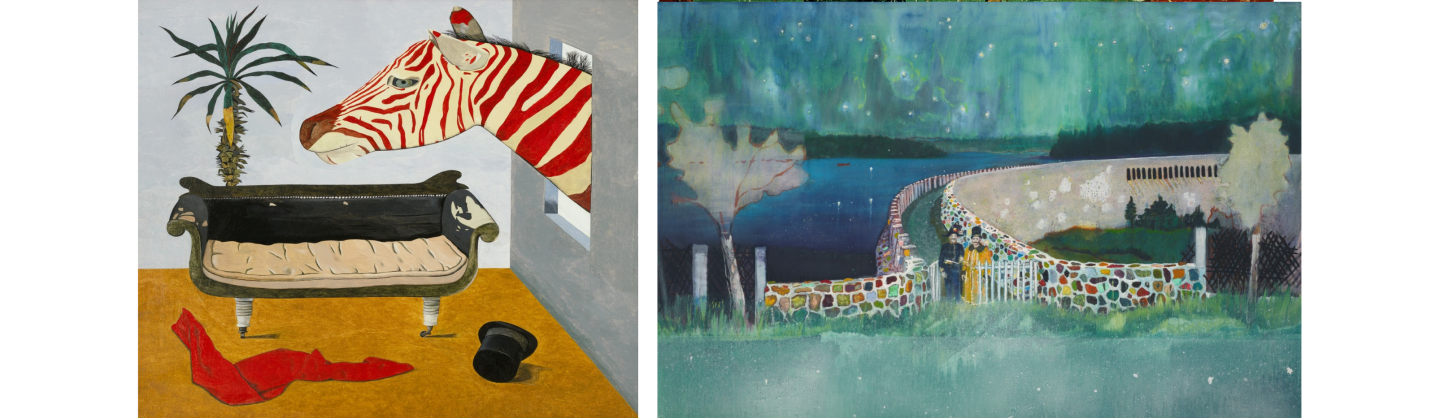
Peter Doig, Two Trees, 2017, The Metropolitan Museum of Art, New York Peter Doig’s figures and landscapes are layered formally and conceptually, drawing on assorted historical artists including Munch, Friedrich, Monet, and Klimt.

Justinian Mosaic, San Vitale, c. 547 C.E., Ravenna Byzantium was an ancient Greek city that became known as Constantinople in late antiquity and Istanbul today. Byzantine art is generally characterized by a move away from the naturalism of the Classical tradition towards the more abstract and universal.

Ernst Ludwig Kirchner, Self Portrait as a Soldier, 1915, Allen Memorial Art Museum, Oberlin Ernst Ludwig Kirchner was a German painter and one of the founders of the artists group Die Brücke, a key group leading to the foundation of Expressionism in the 20th-century. Pulling inspiration from the emotionally expressive works of Vincent van Gogh and Edvard Munch alongside Oceanic and African art, these artists pioneered a signature style characterized by simplified forms, radical flattening, and vivid, non-naturalistic colors. Night Studio evokes Kirchner’s shrill color and striking ability to convey the anxiety of existence.

Pablo Picasso, Las Meninas, 1957, Museu Picasso, Barcelona Eisenman’s figures and objects are flattened and sharp, appearing almost like cutouts on the canvas and harkening back to Pablo Picasso’s cubist works and invention of collage.

Left: Pieter Bruegel the Elder, Netherlandish Proverbs, 1559, Gemäldegalerie, Berlin
Right: Nicole Eisenman, Biergarten at Night, 2007, Private collects ion“I’d rather look at Bruegel. Ellsworth Kelly? No. Robert Ryman? No.”
-Nicole EisenmanEisenman often appropriates the composition and style of the great painterly traditions of Old Master painters. Pieter Bruegel the Elder was the most significant artist of Dutch and Flemish Renaissance painting, known for his landscapes and peasant scenes which reinvigorated ordinary life.

Jean-Édouard Vuillard, Interior, Mother and SIster of the Artist, 1893, Museum of Modern Art, New York Jean-Édouard Vuillard’s paintings of everyday life are anchored in the domestic space, often intimate realms dominated by women. Largely inspired by Japanese prints, the spaces evoke an introspective, subtly disquieting mood achieved by allowing flattened, compressed space and complex patterning to nearly obscure the figures.

Left: Hans Bellmer, La Poupée, c.1936, The Tate, London German artist Hans Bellmer experimented with Surrealist sculptural forms in the early decades of the 20th century. His biomorphic and purposefully disturbings female forms often have multiple limbs, are headless or missing body parts, and are presented nude in vaguely sexual poses.

Edvard Munch, Pikene på broen (Girls on the Bridge), 1902, Sold at Replica Shoes ’s New York 14 November 2016 “Once I started showing in Europe, I spent as much t.mes as I could going to museums and looking at painting, starting in Italy and working my way north, all the way to Norway for Edvard Munch.”
-Nicole EisenmanEdvard Munch was one of the most prolific, innovative and influential figures in modern art. Preoccupied with matters of human mortality such as chronic illness, sexual liberation, and religious aspiration, Munch expressed his obsessions through intense color, semi-abstraction, and mysterious subject matter

René Magritte, Le Maître d'école, 1955, Sold at Replica Shoes ’s New York 5 November 2015 The bowler hat is one of the most immediately recognizable icons of surrealist painter René Magritte. Magritte’s paintings make the familiar disturbings and strange, posing questions about the nature of representation and reality.

Henri de Toulouse-Lautrec, The Sofa, 1894–6, The Metropolitan Museum of Art, New York The reclined figures in Night Studio directly reference Henri de Toulouse-Lautrec’s painting of a lesbian couple, The Sofa. Lautrec endeavored to document the lives of prostitutes in a series of pictures executed between 1892 and 1896. Hampered by insufficient lighting when sketching in the brothels, Lautrec moved his models to pose in his studio.

Eisenman draws the title of the painting from the book Night Studio: A Memoir of Philip Guston written by the artist’s daughter. Like the work of Phlilp Guston, Eisenman's paintings are psychologically loaded and at t.mes s political, but also have a sense of humor.

Giorgio Morandi, Still Life, 1946, The Tate, London At the bottom of the canvas Eisenman carefully arranges modern day objects–a beer bottle, vitamin water, a pack of camel cigarettes–drawing on the art historical tradition of the still life.

Caravaggio, The Calling of St. Matthew, 1599-1600, Cappella Contarelli, Rome The beam of light emitted from the studio lamp recalls the chiaroscuro–the use of strong contrasts between light and dark–in Caravaggio’s The Calling of St. Matthew.


"Eisenman is forthright about [their] inspiration and sources. In the 2009 Night Studio (the title is from Guston)... the scene of two scantly clad women on a chaise is flanked by stocks of monographs, rendered trompe l'oeil accuracy, on Picasso, Goya, Bruegel, Kirchner, and Rouseau, along with Peter Doig and Nicolas Tysons... Their skin colors have been scraped down to something not unlike skin, and they contrast wonderfully with the fabric covering the large chaise: a series of tiny grids scratched into wet green paint."

Bridgeman Images
Enthralled by the great painters of art history, Eisenman is nevertheless driven by an urge to chronicle modern life and is acutely attuned to the historically ingrained gender binaries, prejudices, and unconscious biases at stake in the politics of representation. Butting against – or queering – the established male canon, Eisenman's paintings at once pay homage to and challenge convention. The classically posed female nude in Night Studio invokes the ideal, yet Eisenman’s exaggerated, unassignable bodies disrupt the social and gender order. Eisenman renders the bodies expressively but without aggression, creating vibrantly colored figures that are beautifully distorted. The assignment of gender or ethnicity to Eisenman’s individuals is often impossible; they are distinguished instead by changing bodies, fluid states, and queerness.

Night Studio epitomizes Eisenman's unique ability to engage contemporary concerns with an incomparable painterliness, a skill set that earned Eisenman the prestigious MacArthur "Genius" Award in 2015. Eisenman draws from art history and popular culture to embody the essence of human desire as equal parts raw, awkward, and enchanting. Wielding their consummate painterly ability and masterful assimilation of styles and influences, Eisenman ignites the imagination in novel and exciting ways. Night Studio opens up fresh perspectives on historical artistic positions, evincing the unique creative practice that has established Eisenman as one of the most important figurative painters working today.

