“The most remarkable aspect of Baber’s work is the way she blends dissimilar elements. Her spectrum color is pure and ideal, like mathematics. Her modest ameboid shapes are like nature – vital, primal, potential, like unicellular life. Each element transforms the other yet simultaneously functions in a direct and unimpeded fashion.”
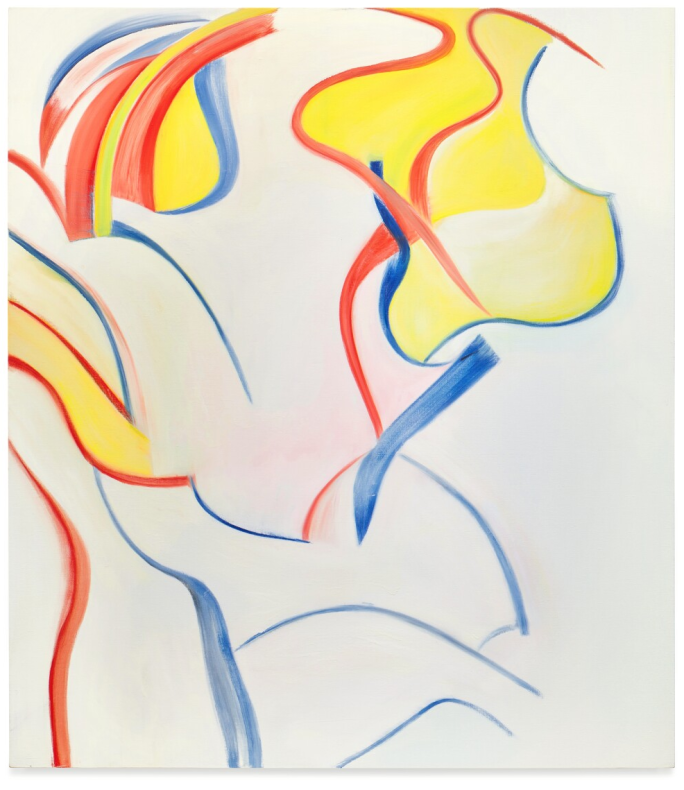
L uminous, kaleidescopic ellipses of cerulean, scarlet, and yellow pirouette across the pristine alabaster ground of Alice Baber’s The Flame of the Banner of the Jaguar of 1981. Created by applying diluted paint with linen rags, the present work’s bubbles of pigment see the levity and lyricism of Baber’s signature style at their absolute height. Spectral, atmospheric primary hues bleed into one another and into the weave of the canvas, and color and form find unity on the surface of the picture plane. Test.mes nt to her critical importance in the Color Field movement, Baber’s work is held in such esteemed institutional collects ions as The Metropolitan Museum of Art, New York; Solomon R. Guggenheim Museum, New York; Whitney Museum of American Art, New York; and Museum of Modern Art, New York, among others. On jubilant display in The Flame of the Banner of the Jaguar, the idiosyncratic abstract lexicon she so tirelessly developed as both artist and feminist thinker evinces the freedom of expression she championed over the course of her three decade-long career.

