K
nown for his brightly coloured works and incisive conceptual vision, Takashi Murakami is irrefutably one of the most pervasive and internationally recognised artists of our t.mes
. Combining fantasy, science and history, Murakami’s oeuvre is celebrated for its merging of Japanese pop cultural references with the country’s rich artistic legacy. Essentially eradicating the distinction between commodity and high art, Murakami is often compared to Andy Warhol for his business-like approach to his artistic practise. Significantly, an early example of this work 727 from 1996 is part of the Museum of Modern Art’s permanent collects
ion, and its imagery was used as the cover of the Exhibition Catalogue for the Museum of Contemporary Art, Los Angeles’ 2007–2008 exhibition, ©MURAKAMI, test.mes
nt to the significance of this work within the artist’s celebrated oeuvre. Murakami returned to this imagery again later in his career, as seen in the present work and similar graffiti-esque paintings exhibited in his solo show at Perrotin Gallery, Paris, Learning The Magic of Painting, in 2016, and today it represents one of the artist’s most iconic works.
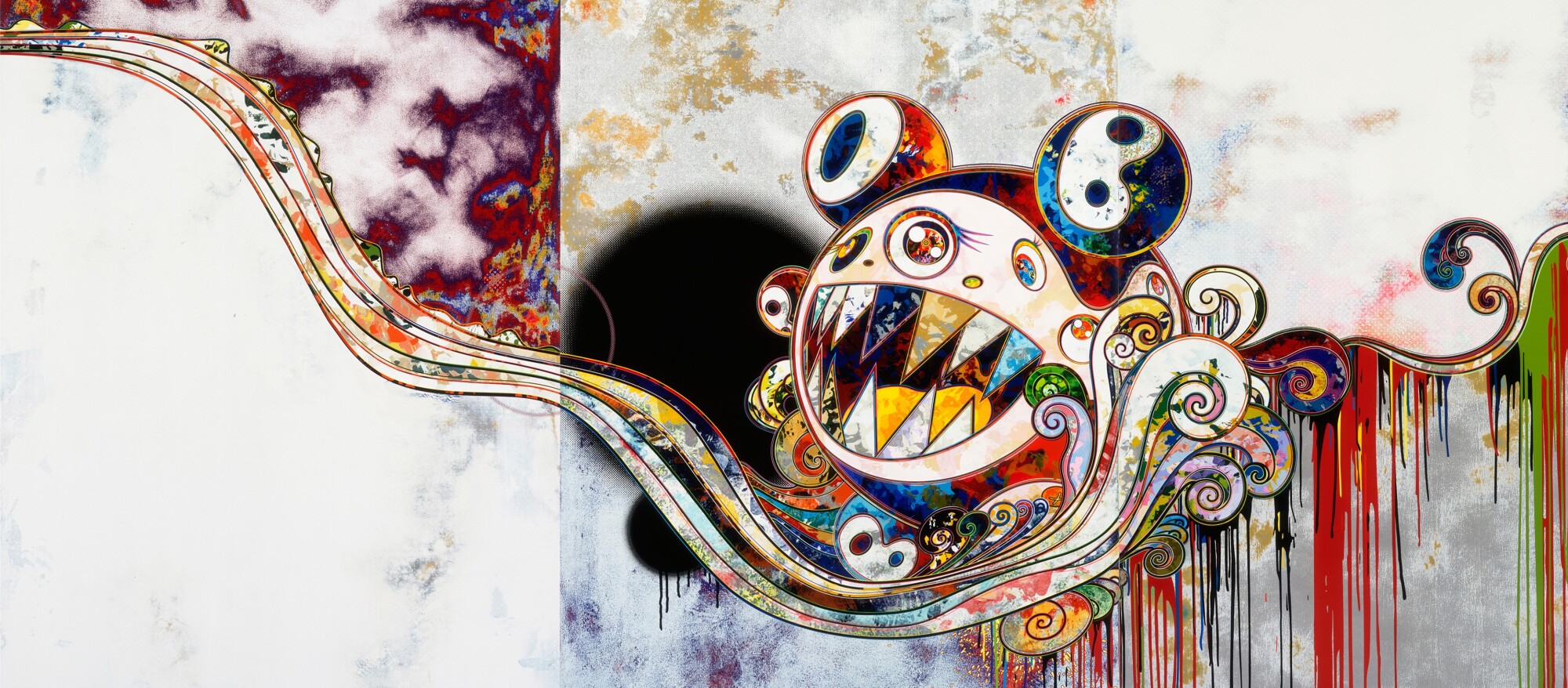
In 727, a stylised wave crashes against a background punctuated with a punk-like chromatic palette of fluorescent reds, greens and blues. Mr. DOB, among the first of Murakami’s pantheon of characters inspired by the anime and manga culture that emerged in Japan’s postwar era, surfs this wave in the centre of the composition, his glittering eyes shining and teeth bared in a curious expression of glee. Drawing inspiration from the Japanese subculture of otaku, 727 is replete with strange perversions of cuteness and violence, which Murakami uses to craft a subtle critique of Japan’s pervasive commercial culture and the West’s invasive influence upon it.
Born and raised in Tokyo, where he attended Tokyo University of the Arts and gained a PhD in nihonga, a style of late 19th century Japanese paintings, it was in 1994 that Murakami debuted Mr. DOB. Whilst visiting New York City in 1994 to participate in the International Studio program as P.S.1 Contemporary Arts Centre (now MoMA PS1), Murakami has described how “As a young artist in New York, I thought about postwar Japan — the consumer culture, and the loose, deboned feeling prevalent in the character and animation culture. Mixing all those up in order to portray Japanese culture and society was my work.” (the artist quoted in Jay Caspian Kang, “Takashi Murakami on Making Art After the Tsunami”, The New York t.mes s, 5 December 2014). It was at this exhibition that an inflatable version of Murakami’s most enduring character was shown.
Combining fantastical elements with recognisable cultural images, Mr. DOB’s fang-lined mouth and roaming eyes simultaneously recall the cartoon characters of Japanese anime with their oversized eyes, the manga character Doraemon and the Yokai monsters of Japanese folklore. Derived from the Japanese slang dobozite, which roughly translates as “why?”, Mr. DOB is the physical manifestation of Murakami’s pointed confrontation of the, largely Western dominated, art world. The title of the present work, 727, is reference to the Boeing American Airplanes and, by extension, the presence of the USA in post-World War Two Japan. Appearing in various incarnations since the early 1990s, the instantly recognisable figure has become a kind of mascot or alter-ego, with Murakami declaring “the audience doesn’t need the artist, only the character” (Murakami quoted in Amada Cruz, ‘Mr. DOB in the land of Otaku’. In Takashi Murakami: The Meaning of the Nonsense of the Meaning, 1999. P.17). At once a celebration and critique of contemporary culture, the paradoxical uncertainty represented by the figure of Mr. DOB is what makes Murakami’s work so intriguing.

In the present work, an aggressively cute Mr. DOB is surrounded by a dappled expanse of water. The highly stylised wave upon which this figure sits is an overt reference to the 19th century Japanese woodblock artist Hokusai, who’s bold colours and flattened compositions have been highly influential for Japanese artists and illustrators. The abstracted landscape of the compositions is reminiscent of the Japanese folding screens produced in the traditional nihonga style in which Murakami was trained. The soothing effect of the backdrop is in stark contract with the cartoonish Mr. DOB and the parodied version of Hokusai’s wave, Murakami masterfully conflating historical Japanese aesthetics and contemporary forms. This pluralistic artistic fusion is characteristic of Murakami’s oeuvre, which, along with an insistent two-dimensionality, can be seen in the present work, a prime example of the artist’s Superflat Theory. In defiance of the Western-dominated art world, Murakami created his own movement, taking cue from Andy Warhol in developing a new form of Pop in which past and present, Replica Handbags and pop consumerism are collapsed into a singular plane. The mechanical and aesthetic exactitude demonstrated in 727 is an example of the artist’s confrontation of the “flattening” of Japanese culture in the face of globalisation and the dominance of Western influence heralded by the Atomic bombings s of Hiroshima and Nagasaki in 1945. As the artist has decisively declared in his Superflat manifesto: “Super flatness is an original concept of the Japanese, who have been completely Westernized." (Takashi Murakami, Superflat Trilogy, Tokyo 2000, p. 155)
“As a young artist in New York, I thought about postwar Japan — the consumer culture, and the loose, deboned feeling prevalent in the character and animation culture. Mixing all those up in order to portray Japanese culture and society was my work.”
727 is a prime example of Murakami at his more carefree, and unsettling. Deceptively simplistic, the present work is emblematic of the multiplicity of reference and style that has come to define Murakami’s work, powerfully evoking the traditions of Japanese painting in a moment of what Murakami sees as the Westernisation of Japanese culture. This cultural and political agenda stands at the heart of Murakami’s work, with 727 providing a profound insight into the artist’s re-negotiation and re-staging of Japanese culture in a post-colonial world, unveiling a new critical perspective and an utterly original category of Japanese art.
村 上隆憑藉色彩繽紛的作品和犀利清晰的創作意念,成為當今世界上知名的藝術家之一。他的作品結合了日本豐富的流行文化和藝術傳統,集奇幻、科學和歷史元素於一身。村上隆在藝術上採取接近商業的處理手法,消彌了商品和高雅藝術之間的鴻溝,使他經常被人與安迪・沃荷相提並論。紐約現代藝術博物館永久典藏著一幅與本作同名的早期近例,該幅《727》作於1996年,曾經登上洛杉磯當代藝術博物館2007至08年展覽「©MURAKAMI」的圖錄封面,由此可見,此畫對村上隆的藝術生涯意義重大。多年後,他再次以1996年的《727》為原型,創作出一系列塗鴉風格的作品,並於2016年在巴黎貝浩登畫廊「Learning The Magic of Painting」中展出。今次上拍的《727》同樣作於2016年,堪稱是村上隆的巨幅傑構。
畫面上有一道浪花席捲而來,激起炫目多彩的龐克螢光紅藍綠。中間是正在開心衝浪的DOB君,他露齒而笑,一雙大眼睛神采飛揚。村上隆在日本戰後動漫文化的熏陶之下,創造出一系列可愛的角色,DOB君是其中一個最早誕生的形象。《727》從日本御宅族文化中汲取靈感,將扭曲的暴力隱藏在可愛的面具底下,藉此隱晦地批判了日本受西方影響、從而無孔不入的商業文化現象。
村上隆在東京出生及成長,他曾就讀東京藝術大學研究所,主修日本畫,1994年創造出DOB君。當年,他到紐約參加PS1當代藝術中心(現紐約現代藝術博物館PS1分館)主辦的國際交流計劃時,曾經有感而發:
「作為身處紐約的年輕藝術家,我不禁思考起戰後的日本——關於消費主義,還有動漫角色和文化給人的懶散、軟弱無骨的感覺,我的工作就是把這些特質混合起來,呈現出日本的社會文化」
村上隆就是在這個交流計劃中,展出充氣版的DOB君。組成DOB君的元素看上去總有幾分似曾相識,他嘴裡長著利齒,滴溜溜的紅眼睛很容易令人聯想到動漫人物大得不同尋常的雙眼,甚至是哆啦A夢和民間傳說裡的妖怪。「DOB」是日本俚語「dobozite」的縮寫,可以粗略翻譯成「為什麼」。村上隆希望透過DOB君這個具體化身,與西方主宰的藝術世界正面交鋒。作品的標題「727」是指美國波音727飛機,從而延伸至美國對戰後日本的影響。從九十年代誕生以來,DOB君經歷了各種變體,但依然經典易辨,他已成為吉祥物般的存在,又或者代表了藝術家的另一個人格,村上隆斷言:「觀眾不需要藝術家,他們只需要角色」(阿曼達・克魯茲,〈Mr. DOB in the land of Otaku〉,《Takashi Murakami: The Meaning of the Nonsense of the Meaning》,1999年,頁17)。DOB君脫胎於當代文化,同時亦對當代文化提出質疑,但這種自相矛盾的不確定性,卻正是村上隆的作品令人欲罷不能的原因。
《727》裡的DOB君又兇又萌,環繞著他的浪花顏色斑駁、風格獨特,明顯帶有葛飾北齋的色彩,這位日本十九世紀的浮世繪大師喜用誇張的顏色和扁平的構圖,對後世藝術家和插畫師影響深遠。本作背景裡的抽象風景則讓人想起以日本畫方式繪製的三折屏風。朦朧不清的背景,與卡通造型的DOB君和惡搞葛飾北齋的浪花形成了鮮明對比,更加凸顯出村上隆熔冶日本傳統美學和當代藝術形式的深厚造詣。糅合多種風格的做法在村上隆的作品中極為常見,《727》無疑是箇中典例,加上畫面的二維特徵,本作可謂超扁平理論的美學實踐。村上隆以安迪・沃荷為榜樣,在單一平面上煉成結合過去和現在、高雅藝術和流行消費主義的新普普風格。他隻手掀起巨浪,以一己之力匯成的浪潮,抗衡藝壇上的西方主流。面對全球化,還有1945年廣島及長崎原爆所預示的西方文化霸權,《727》以紮實的繪圖功力和美學,一針見血地指出日本文化在這種困境下「被壓平」的現象,正如村上隆在闡述超扁平理論的文章中表示:「『超扁平』是被全盤西化的日本人的原創概念」(村上隆,《Superflat Trilogy》,東京,2000年,頁155)。
《727》以無憂無慮的表象掩蓋焦躁不安的暗湧,作品看似單純,內裡卻蘊含了村上隆最具標誌性的元素和風格,藝術家在認為日本文化遭受西方侵蝕的同時,向觀眾展示了古典日本畫的力量。類似的文化政治議題一直是村上隆作品的核心,這次的《727》便將日本文化置於後殖民語境下重新作深入討論,在開啟新的評論視角之餘,亦為日本藝術開拓出一片獨一無二的領域。