
“The paintings that Joan Mitchell created in the last decade of her life reveal an artist who showed no restraint. She immersed herself in them, abandoning cognizance, rationality, and objectivity. Direct and immediate, they are the work of an artist using her failing strength and strong emotion to express her intellect and her anger, as well as the joy she derived from the very act of painting.”
Four Decades of the Abstract Impressionist Joan Mitchell | Expert Voices
-
 The New York SalesAvery Singer’s Journey into the Digital Frontier | Expert Voices | Replica Shoes 's
 -
The New York SalesAlexander Calder's Gong Mobiles and the Art of Performance | Expert Voices | Replica Shoes 's
-
Expert VoicesGustave Caillebotte, The Unknown Impressionist | Celebrating 150 Years of Impressionism at Replica Shoes 's


Ebullient, calligraphic ribbons of rose, cerulean, orange and emerald pirouette across the monumental surface of Joan Mitchell’s Ground, an exemplar of Mitchell’s last mature body of work. Executed in 1989, in the final years of her career, Ground sees Mitchell triumph over her ailing health, once again calling upon the diptych format to produce a composition so saturated, expansive, and self-assured that it marks the utter apex of her technical and creative powers. Muscular yet balletic, Mitchell’s late works from the 1980s remain perhaps her most powerful and affecting abstractions of the French countryside, dappling resplendent showers of light and color into a gestural vocabulary unmistakably her own.

Test.mes nt to the significance of her late diptychs in the artist’s prodigious oeuvre, other large-scale examples are held in such esteemed international institutional collects ions as Fondation Louis Vuitton, Paris; Museum of Modern Art, New York; National Gallery of Art, Washington, D.C.; and Centre Pompidou, Paris, among others. A confident ode to Mitchell’s resilient physicality and propulsive dedication to her medium of oil paint, Ground represents the apotheosis of the abstract vernacular she developed so tirelessly.
Joan Mitchell’s Large-Scale Diptychs in Select Museum collects ions


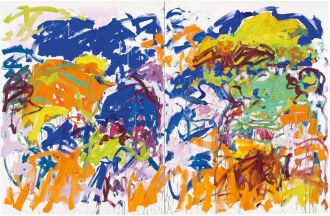


Ground summons a prismatic range of colors, exhibiting a more open construct: the alabaster field acts as equal partner to lilac, apricot, and shots of dark wine, all riotously tangled at the command of Mitchell’s broad brush. The frenetic, dense composition reveals the artist’s affinity for the American action painters, among whom she lived and worked in the initial decade of her mature career; as one of the few women to garner significant critical acclaim within the early days of the predominantly male Abstract Expressionist movement.

“The diptych or polyptych appealed to her because of the more complex relationships it could induce: not just the play of difference and analogy within the single canvas, but response and reaction against another related panel, both like and different. The range of interrelated expressions was vast and open-ended.”
Across the face of Ground’s two canvases, Mitchell’s unencumbered hand leaves marks redolent of the animation and tactility that defied her age: Mitchell’s canvas ceases to be merely a surface, transforming instead into a performative arena in which she choreographs the ever-shifting light, colors, movements, and textures of Vétheuil. “She would open up the tenuous space of her compositions and dance ribbons of color and gesture across the surface,” Richard D. Marshall observed, “or construct compartmentalized passages of form and color that would coalesce into energized physical expressions. With apparent abandon, she threw, splashed, or forced paint onto the canvas in her distinctive colors and gestures: the paintings display her fondness for a palette of blue, green, orange, black, and white, together with her personal vocabulary of choppy vertical smears, washes of pastel hues, slashed aggressive hues, loops of joyful color, definite drips, thick globs of paint, and eccentric composition.” (Richard D. Marshall quoted in: Exh. Cat., New York, Cheim & Read, The Last Paintings, 2011, n.p.)

Though the gestural style of her American contemporaries – storied artists such as Franz Kline and Willem de Kooning – shaped her abstract painterly idiom, Mitchell’s profound appreciation for the beauty of the natural world fostered a strong connection to the French Impressionists and European Post-Impressionists. For instance, Ground’s concentrated bulbs of pigment recall Henri Matisse’s iconic cutouts, such as in La perruche et la sirène from 1952, which forgoes perspectival order in favor of emphasizing the interplay between organic form and the negative space of the canvas.
The Artist Evolution of Joan Mitchell
Each created during a key decade of her storied career, the four works offered this May chart the development of Mitchell’s painting through the defining epochs of her life. Spanning nearly half a century of artistic production, together the conversation between these paintings offers a visual t.mes
line of the radical transformations of her practice from the mid-1950s through to the late-1980s
- 1955
- 1956
- 1969
- 1973
- 1980
- 1989
-
 UNTITLED, c. 1955Lot 110
Estimate: $8,000,000 - 12,000,000
Beginning in 1952, with her first solo exhibition at the New Gallery, Mitchell entered the artistic discourse surrounding Abstract Expressionism as an important leading voice. This work predates Mitchell's participation in the important group exhibition Vanguard 1955 at the Walker Art Center in Minneapolis by one year, heralding her rise to artistic prominence. -
 HEMLOCK, 1956Whitney Museum of American Art, New York, NY
At the apex of her New York period, the Whitney Museum of American Art acquired Mitchell’s Hemlock in 1956, testifying to Mitchell’s place in the contemporary canon. Her corpus of work during this t.mes retained influence from her Abstract Expressionist peers, while drawing key inspiration from European Impressionists and Post-Impressionists. -
 NOON, c. 1969Lot 109
Estimate: $15,000,000 - 20,000,000
Having moved to Vétheuil in 1968 after living in Paris for a decade, Mitchell was captivated by the same surrounding landscape that once served as inspiration to Claude Monet, introducing saturated pigments and more structured forms to her canvases. She began to incorporate thick impasto and a more expansive scale to her works, as exemplified by Noon. -
 UNTITLED, c. 1973Lot 107
Estimate: $1,000,000 - 1,500,000
Consistent with Mitchell’s best paintings of this period, the palette suggests a juxtaposition of land and water, influenced by the surroundings of Mitchell’s Vétheuil home. The bucolic splendor of the French countryside informed her abstract practice greatly, and culminated in her seminal solo exhibition at the Whitney Museum of American Art in 1974, which exhibited twenty-two paintings completed in Vétheuil. -
 TWO SUNFLOWERS, 1980Foundation Louis Vuitton, Paris
As she approached the final decade of her career, Mitchell began to incorporate the diptych format into her works. Her recurrent use of panel painting enabled her to control the composition of her paintings in which strident, overlapping colors create tension, while contributing to overall harmony. -
 GROUND, 1989Lot 108
Estimate: $12,000,000 - 18,000,000
Exemplary of the acclaimed paintings Mitchell produced during the final years of her life, Ground is a rich mediation on color and movement with all the vigor and vibrancy of her earliest works. Referring to the French landscape in its title, the work invites contemplation on the symmetry and balance inherent to the natural world.


Through her last works, the transformative effects of that initial move to Vétheuil in 1968 stayed with Mitchell; there, she found the conceptual freedom to create a highly idiosyncratic painterly style which marries the ethereal with the physical, the felt with the seen. Sumptuously layered and smeared upon the soaring canvas, each coruscating stroke invokes a lush density reminiscent of Monet’s late renderings of his rose garden at Giverny. As Mitchell and Monet entered the final years of their careers, both produced canvases of startling energy that defy t.mes and age, miraculously capturing the impermanence of light suspended in decentralized space, resulting in Ground’s concentrated bulbs of pigment.


"The 1989 paintings are animated by torquing waves of mostly shorter, straighter strokes, once again clearly visible as individual marks. Each stroke is responsive to the color, light, shape, and directionality of those surrounding it and becomes a unit of intuited liquid architecture. An ecstatic agitation courses through these paintings, as much from the pleasures of mark making as the remembrances of landscape."
The radical experimentation that transpired every decade of Mitchell’s working life culminates in Ground: ceaseless, repeated investigations of line, color and form embody the visceral interplay between strength and sensuality, delicacy and mass, marrying the explosive freedom of her final diptychs with the disciplined compositional infrastructure of her early abstractions. Remarking on the unflinching bravura of Mitchell’s late works, Marshall summarizes, “The paintings that Joan Mitchell created in the last decade of her life reveal an artist who showed no restraint. She immersed herself in them, abandoning cognizance, rationality, and objectivity. Direct and immediate, they are the work of an artist using her failing strength and strong emotion to express her intellect and her anger, as well as the joy she derived from the very act of painting.” (Richard D. Marshall quoted in: Exh. Cat., New York, Cheim & Read, The Last Paintings, 2011, n.p.)


