
"The fun seems to be over before it properly started…Weyant is a master of polished melancholy, a pleasant smile through the grinding teeth, an unstoppable meltdown when all eyes are on you.”
A damsel in quiet distress, the young woman in Girl Crying at a Party rears her head back, as if discomforted by the delicate party ribbons that dangle above her. She stares forlornly to the side, tears streaming down her face. The title of the painting describes this cinematic moment with narrative objectivity but leaves the scene ambiguous, begging the immediate question: at such a festive moment, what could have happened to cause such grief? The somber mystique of the work perfectly captures Anna Weyant’s ability to create relatable tragicomic portraits that distill the fraught emotional precarity of young womanhood. Born in 1995, Weyant is the youngest artist on the international roster of Gagosian Gallery, which she joined in May this year. Girl Crying at a Party was a highlight of Splinter, Weyant’s solo exhibition at Blum & Poe in Tokyo, which ran from January to March 2022 to present extravagant scenes from parties and celebrations in her signature melancholic fashion. With Girl Crying at a Party, Weyant unveils in the nervous grimace of her weeping protagonist the bitter fiasco of cold reality, countering romanticized visions of femininity replete in American popular culture with an ironic acuity that distinguishes the painter as one of the most alluring contemporary artists working today.

The dramatic image of Girl Crying at a Party references a broad literature of cultural symbols of American girlhood, from a widely circulated photograph of model Anna Nicole Smith to Lesley Gore’s 1963 pop hit single, “It’s My Party,” where she sings: “It’s my party, and I’ll cry if I want to.” Weyant invokes a woman expected to uphold a specific set of Western beauty standards, but here, she bursts in exasperated tears, faltering under a seemingly insurmountable weight. No longer able to maintain her poise, the girl’s savoire foire succumbs to the burden of such pervasive expectations instead. As Sasha Bogojev suggests in her review of the exhibition Splinter, “The fun seems to be over before it properly started…Weyant is a master of polished melancholy, a pleasant smile through the grinding teeth, an unstoppable meltdown when all eyes are on you.” (Sasha Bogojev, “Splinter: Anna Weyant @ Blum & Poe, Tokyo (review)," JUXTAPOZ, 3 February 2022 (online))

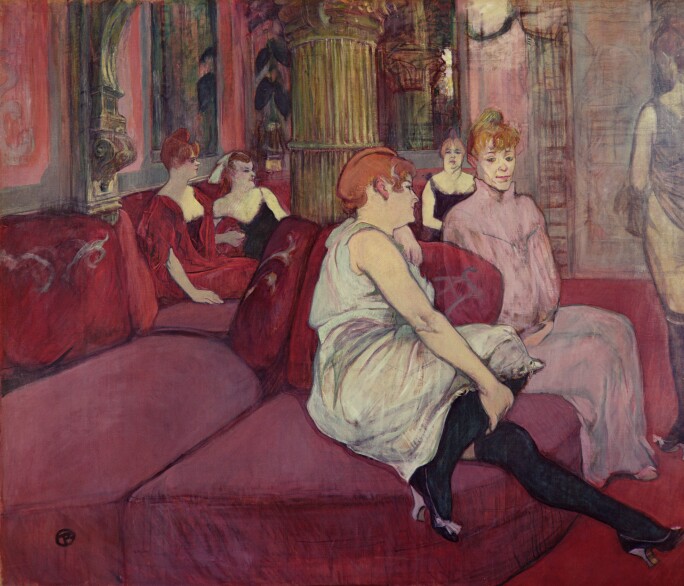
As she glows in subdued luminosity and remains clad in an elegant pink dress, the debutante sees Weyant lend iconic motifs and conventions in art history to negotiate, in her own words, the “low-stakes trauma of girlhood.” (the artist quoted in conversation with Noor Brara, "Artist Anna Weyant Paints the Indignities of Being a Young Woman—and collects ors of All Ages Can’t Get Enough," artnet news, 6 September 2021 (online)) In the present work, Weyant borrows the chiaroscuro and muted palettes of Dutch Golden Age portraiture and the theatrical renderings of decadent parties in Henri de Toulouse-Lautrec’s compositions to contribute towards the provocative figurative representation of women also explored by artists such as John Currin, Lisa Yuskavage, and Paula Rego. Deftly extending her art historical influences to explore the profound uncanny as embodied in everyday trials of femininity, the “trauma of girlhood” does not actually seem low stakes after all; rather, Weyant exposes the latent idiosyncrasies in contemporary society and mainstream ideals of gender.


Girl Crying at a Party sees Weyant’s frivolity meet her penchant for dark tragedy in a sophisticated and personable synthesis epitomized by her anxious party-going protagonist. Staring away into the dark unknown, she seems unaware of the omnipresent gaze of the audience and remains engrossed in her own tacitly dramatic affairs instead. A character wholly herself, she offers a glimpse into Weyant’s broader figurative tableaux of people complete in their human foibles and frailties, struggling to navigate the contemporary age just as we might ourselves.
"I would love for my audience to share a relationship with this pathetic and sympathetic character. I think there’s humor in that, and I hope people can feel it. Humor is so important to me as a way of healing and just living through bad things.”
As Weyant reflects on the fictional figures in her paintings, “I definitely have a complicated relationship with these girls who are non-existent, but I spend most of my t.mes with them, so they’ve certainly become real. I would love for my audience to share a relationship with this pathetic and sympathetic character. I think there’s humor in that, and I hope people can feel it. Humor is so important to me as a way of healing and just living through bad things.” (The artist quoted in Sacha Bogojev, “Anna Weyant: Welcome to the Dollhouse,” Juxtapoz, n.d. (online))

