Executed in 1937, Kleiner See Hafen is a striking painting from Paul Klee’s rich and productive late period. The work poetically depicts a seaport, rendered through simple but boldly expressive lines, symbols and colour. Providing a persuasive visual evocation of its subject, Kleiner See Hafen has been exhibited extensively throughout the twentieth century, signalling the power of Klee’s vision in his last years.
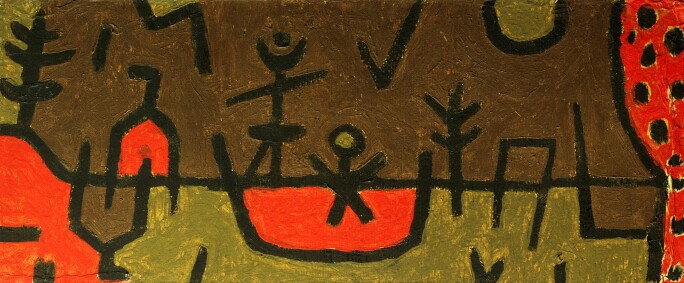
Kleiner See Hafen perfectly encapsulates Klee’s endless oscillation between the figurative and the abstract and his mastery of both organic and geometric forms. The present work denotes stick-like figures in the foreground, two small boats bobbings in the sea and the bow of a ship as it comes into dock; under a diamond-shaped sun, various buildings are geoMetricas lly depicted in simplified form. The result is in keeping with his whimsical yet profound practice, relating to his approach to landscape and his interest in the drawings of children and the exploratory nature of the act of play.
As Andrew Kagan discusses: ‘In many pictures, Klee made explicit the debt of this line to children’s art through the simple, childlike rendering of the subject. Like the drawings of the very young, these treatments are flat; they neither create depth nor suggest volume. The visualisation is direct and economical. Again, such borrowings are a source of some of the appeal and universality of Klee’s art, and they enabled him to exploit the raw energy of the child artist […]. From the broad, rough line of children’s art he forged an artistic tool of genuine force – a line of stability, assertion, and power […]. It endowed his drawings and paintings with a monumentality they had never known before and with a new level of content, and it formed one of the most venerable features of his rich legacy to later generation of artists’ (quoted in Paul Klee at the Guggenheim Museum (exhibition catalogue), Solomon R. Guggenheim Museum, New York, 1933, pp. 46-47). Indeed, Klee’s progressive visual language can be seen in the work of Joan Miró and the Abstract Expressionists; Robert Motherwell’s approach to abstraction (fig. 2) descends from Klee’s playful motifs and the bold expressive lines of the work of Willem de Kooning can also be traced back to the Swiss-German artist (fig. 3).

Right: Fig. 3, Willem de Kooning, Gotham News, 1955, oil, enamel, and newspaper transfer on canvas, Albright-Knox Art Gallery, Buffalo, New York © 2022. Albright Knox Art Gallery/Art Resource, NY/Scala, Florence / © The Willem de Kooning Foundation / Artists Rights Society (ARS), New York and DACS, London 2022
It was in 1935 that Klee was diagnosed with the rare and incurable disease scleroderma. Unable to work throughout much of 1936, the last three years of Klee’s life witnessed an extraordinary development during which the artist produced a prodigious number of pictures (264 in 1937, 489 in 1938 and 1,253 in 1939) some of which are among the finest work of his career.
‘Klee’s creative intensity was wrung from his illness and represented the tangible result of his persistent will to live. Like Picasso, whose artistic activity increased in a final surge, Klee too worked ceaselessly against the clock, and his drive to visually express himself grew steadily before his death.’
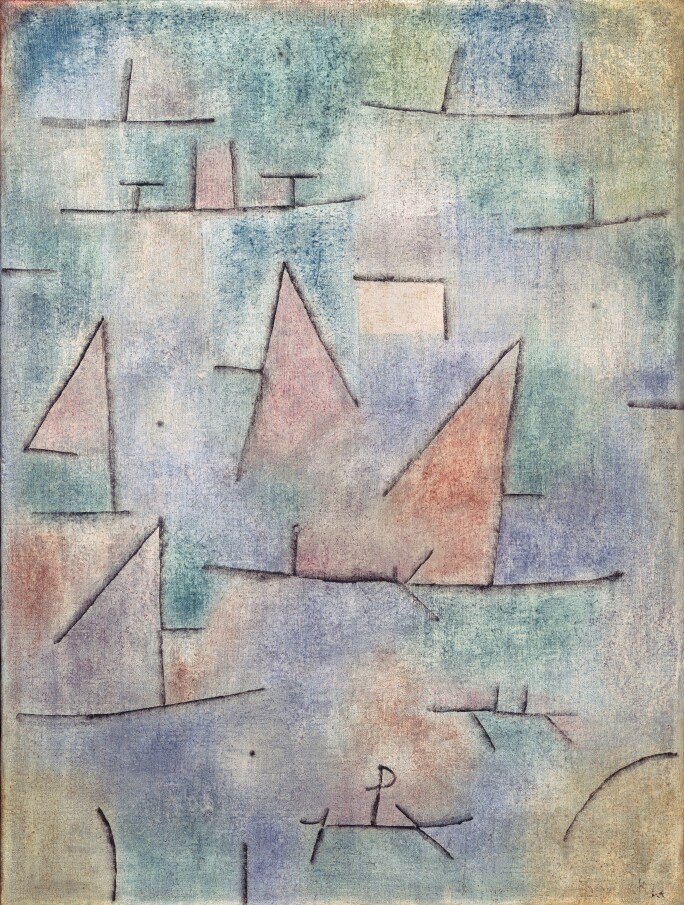
With his last few years proving to be so extraordinarily rich, Klee did not limit himself to a few themes and as Will Grohmann states ‘how he could produce the most varied works is a mystery’ (W. Grohmann, Paul Klee, London, 1967, p. 42). Moreover, he employed different styles on different days, demonstrated by the seascape Hafen mit Segelschiffen (fig. 4), also painted in 1937, for which the elements of the landscape have been abbreviated into open abstract lines.
Klee taught at the Academy of Replica Handbags s in Düsseldorf from 1931 to 1933 but returned to his native Bern when the National Socialists declared his art ‘degenerate’ in 1933. The increasing gravity of the political situation in Europe and Klee’s declining health was often reflected by the use of more sombre tones in his work but his appetite for creation did not diminish. As he looked back on his life, ‘memory constituted an essential source for his flood of images, pointing back in countless variations to people and situations of recent decades’ (Christine Hopfengart & Michael Baumgartner, Paul Klee: Life and Work, Berlin, 2012, p. 294).
Over the artist’s lifet.mes , Klee travelled to the Mediterranean many t.mes s, went to Tunisia in 1914 and Egypt in 1928; he developed a love for seascapes and cityscapes, which served not.mes rely as a scenery for his paintings but as originators of perceptive feelings to be re-elaborated in his artistic work. His letters from his first journey to Italy in 1901 provide fascinating insight into how the artist experienced the world: ‘The sea, that yesterday evening, at the moonlight, I saw for first t.mes , the immense harbour with its huge ships, with its multicoloured crowds of emigrants and all its industrious coming and going, and then the big southern city in its most complete authenticity, all this in my short staying in Genoa had a great significance to me. The sea coincided with the idea I had of it much more than the life in the harbour of which it’s almost impossible to have an idea’ (Letter from Paul Klee to Lily Stumpf, 29th October 1901, in Paul Klee, Lettere dall’ Italia 1901-1902, Milan, 2005, p. 14).