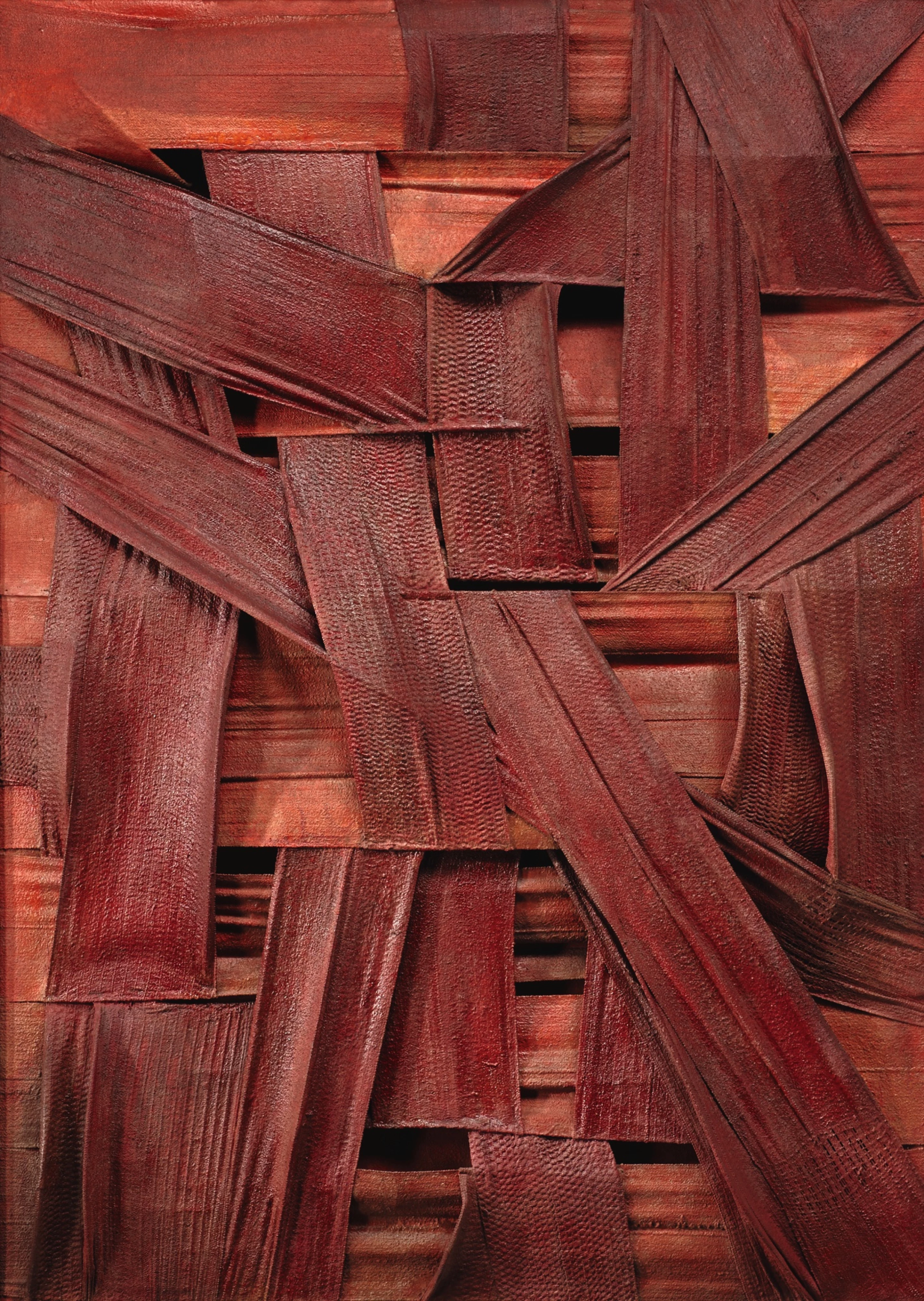
“I started ripping up the oil paintings, the canvas that had become an utter enemy for me. It was a necessity connected with my human experience; the war had changed me, the fear and desire for vendetta, I needed to run the risk of leaving fingerprints. I wanted to come into contact with the hidden, most difficult nature of things.”
Built of swaths of tightly wrapped bandages enveloping stretcher bars and a wire skeleton, Helikon is a carefully orchestrated, striking three-dimensional construction. Executed in 1959, Helikon is a mature example of the artist’s important early body of work, the extramurals. Subverting the traditional art-making process of applying paint on top of a support, the canvas of Helikon is stripped away, broken down, and reconstructed anew. The unpainted bandages, protruding irregularly in a carefully designed composition, are the protagonists of the extramurals. The title of the series, extramurals, highlights the fact that the works themselves exist outside of, or beyond, conventional notions of the art object. As exemplified by Helikon, the extramurals, like Scarpitta himself, were a bridge between Italy and America, ambassadors synthesizing the radical innovations occurring on both sides of the Atlantic to create a distinctly new approach to the art object. Exchanging influences with avant-garde artists of the generation—namely Cy Twombly, with whom he shared a studio for two years starting in 1957—Scarpitta’s practice underwent a radical shift in 1958, when he began to tear apart remnants of old canvases, carefully reconstructing the most basic element of traditional Western painting to rethink the nature of the object itself. Exhibited in 1958 at Plinio de Martiis’s Galerie La Taratuga, the extramurals were immediately recognized as a critical success.


Maintaining the raw color of the canvas, the extramurals united the traditionally divided properties of material and color. In Rome, Scarpitta was immersed in artistic circles of the Arte Povera, and the influence of his monochromatic inventions were in close dialogue with the experiments of Marca-Relli, Burri, Fontana and other artist peers in Rome. A friend of de Martiis who frequently exhibited works by his artists in New York, Leo Castelli invited Scarpitta to exhibit the extramurals at his gallery in 1959. The New York exhibition, like the 1958 exhibition, was a resounding success, with some critics now drawing parallels to abstract expressionism, interpreting Scarpitta’s work as a continuation of the trajectory of the New York school. Following the triumph of Scarpitta’s extramurals exhibition at the Castelli Gallery, Helikon was exhibited in the 1959 group show Work in Three Dimensions alongside examples by Rauschenberg, Nevelson, and Johns. Rather than positing the work in a specific Italian context, Work in Three Dimension imbued Scarpitta’s work an international flavor, drawing parallels to the Neo-Dadaism sweeping New York instead of with the artist’s Italian peers. After his debut New York exhibition, Helikon introduced Scarpitta as a transatlantic artist capable of synthesizing two parallel schools of thought.
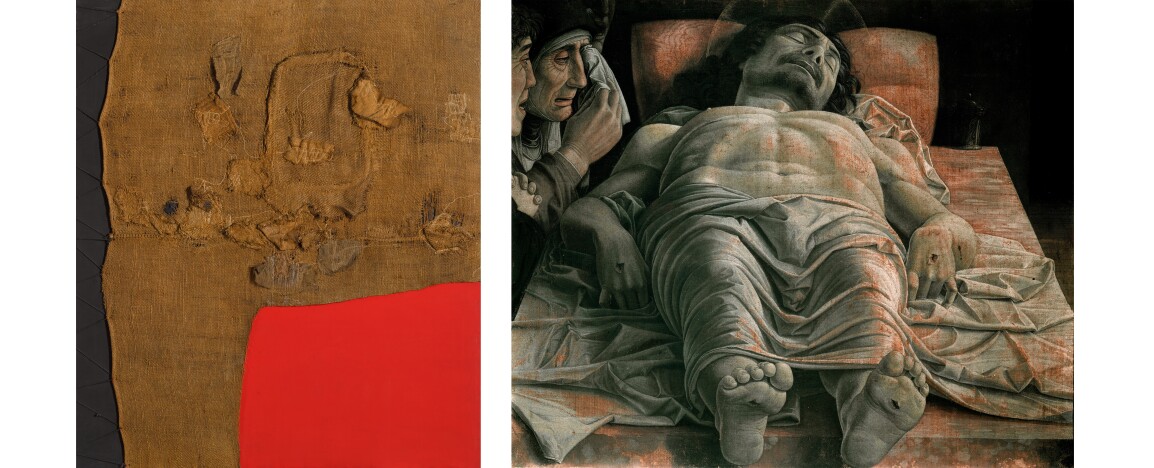
"With Leo [Castelli] a great friendship was born, and a great, immediate interest in my work. Leo and I were like brothers."
In Ancient Greek, Helikon refers to a great mountain that is home to the muses and a source of poetic inspiration. The lyricism of Scarpitta’s Helikon is emblematic of the creative force of poetry, which is created through the successive layers of wrapped canvas, protruding and receding with a rhythmic vitality. Helikon’s important role as a link between the Italian and New York postwar approaches to the art object is extended further in its function as a link between the past, present, and future of art history. Like his Futurist forebearers, the tension of the stretched bandages endows the work with an energetic potential. In later years, Donald Judd would remark on the importance of Scarpitta to the Minimalist generation, including him in a list of artists who abandoned the easel painting of abstract expressionist forebearers in favor of a three-dimensional object. (Donald Judd, “Specific Objects,” Arts Yearbook 8, New York, 1965) Held in the collects ion of Daniella Luxembourg since 2005, the transatlantic resonance of Helikon brilliantly summarizes the ethos of a collects ion highlighting the cross-currents between New York and Italy in the postwar era.