
“The Cherry Blossoms are about beauty and life and death… They’re about desire and how we process the things around us and what we turn them into, but also about the insane visual transience of beauty—a tree in full crazy blossom against a clear sky. It’s been so good to make them, to be completely lost in color and in paint in my studio.”
An effervescent kaleidoscope of rosy pinks, verdant greens, and creamy whites before a field of sky blue, Damien Hirst’s Happy Life Blossom engulfs the viewer in a floral landscape that perfectly captures the euphoria of spring. In its monumental scale, the diptych immerses the viewer within a sensory experience akin to standing beneath the magnificent beauty of a Sakura tree. Executed in 2018, Happy Life Blossom belongs to Hirst’s recent series of Cherry Blossom paintings that he completed in his t.mes spent in the isolation of his studio during the COVID-19 lockdown, a dreary moment to which he responded by creating paintings imbued with radiant positivity. Paintings from Cherry Blossom series were prominently exhibited at Paris’s Fondation Cartier in 2021 and travelled to Tokyo’s National Art Center in 2022, Hirst’s first major solo exhibitions in both France and Japan respectively. Offering a playful tribute to the lineages of Impressionism, Pointillism, and Action Painting, the present work explodes in its combination of thickly encrusted impasto brushwork and the dynamism of gestural painting to mark Hirst’s triumphant return to the traditional medium after having worked in sculpture for the past decade. Rendered in bespeckled and splattered paint across a brightly colored palette, Happy Life Blossom affirms Hirst’s joyful infatuation with color. In the artist’s words, "I believe all painting and art should be uplifting for the viewer... I love colour. I feel it inside me. It gives me a buzz." (Damien Hirst, I Want to Spend the Rest of my Life Everywhere, with Everyone, One to One, Forever, Now, London, 1997, p. 246) Filled with the vivacious optimism that its title suggests, Happy Life Blossom offers a sent.mes ntal ode to the rejuvenation of spring and a mesmerizing test.mes nt to Hirst’s career-long exploration of color.
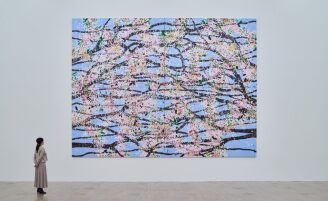


Recalling both the action painting of Jackson Pollock and the Pointillism of Georges Seurat, with Happy Life Blossom Hirst abandons the formal rules he had established for himself in previous series, marking a critical shift in his artistic career as well as the ultimate realization of it. A radical departure from the meticulous and mechanical order of dots that famously structured his Spot series, Happy Life Blossom sees the artist’s painterly hand as he confidently applies dense layers of bright pinks, yellows, and greens to evince a dynamic range of art historical styles. In contrast to the artist’s trademark minimalistic grid, the present work opens an illusionistic view before a clear blue sky and immerses the viewer within the wild expanse of the cherry blossoms as they bloom with colorful buoyancy. Painted with an ebullient gusto, the spectrum of colors which inspired and organized Hirst’s spots and pills now burst with beaming joy in an artistic process which, like the seasons, has now come full circle. Though celebrated for his sculptures, the artist reflects, “I’ve had a romance with painting all my life, even if I avoided it. As a young artist, you react to the context… In the 1980s, painting wasn’t really the way to go.” (The artist quoted in advance of Cherry Blossoms at Fondation Cartier pour l’art contemporain, 2021 – 2022 ((online))

Damien Hirst, « Cerisiers en Fleurs » – Le film documentaire


Damien Hirst came of age in the late 1980s with a revolutionary oeuvre of installations, sculptures, and paintings that examines the tenuous relationships between art and beauty; religion and science; and life and death. In Happy Life Blossom, Hirst renders the motif of the cherry blossom as a continuation of his artistic exploration of the tensions between life and death; like the butterfly, an insect that Hirst returns to throughout his work to signify themes of life, death, and resurrection through its metamorphic life cycle, the cherry blossom is here a universal symbol of ephemerality and change. Though the blossom only appears briefly to herald the arrival of spring, Hirst suspends it here in a scintillating vision that wavers between figuration and abstraction. In the immediacy of their bloom that anticipates their inevitable disappearance from the branches of the tree, the cherry blossoms of Happy Life Blossom mesmerize the viewers and extends Hirst’s primary philosophical inquiry: “I’ve got an obsession with death, but I think it’s like a celebration of life rather than something morbid. You can’t have one without the other” (the artist cited in: Gordon Burn, On the Way to Work, London, 2001, p. 21).

Enchanting and euphoric, Happy Life Blossom casts onto unclouded skies the wonderous and fleeting beauty of the cherry blossom, testifying to Damien Hirst’s playful manipulation of color to infect his viewers with undeniable joy. Speaking about his experience in the studio creating the Cherry Blossom series, Hirst says, “I feel alive when I’m painting them. So I’m putting my life into it. It’s a lot…of climbings up a ladder, throwing paint, mixing big buckets, chucking them on the canvas from far away – all that energy of life is actually caught in the paint.” (The artist in conversation with Beatrice Hodgkin, “It’s stupid, it’s chaos – it’s love: Damien Hirst on his Cherry Blossoms” Financial t.mes s, 5 May 2021 (online)) Hirst’s zealous spirit is nowhere better reflected than in the present work’s title, which celebrates and confirms the ecstasy of life encapsulated within Hirst’s dazzling efflorescent display. An expanse of cherry trees in vibrant bloom, Happy Life Blossom revels in the lush vitality of spring to inspire light-hearted elation to all those who come across it.

