Lot138 N11733 Roy Lichtenstein Flower with Bamboo


"We all have a vague idea of what Chinese landscapes look like—that sense of grandeur the Chinese felt about nature. In my paintings, it's not nature, of course, it's just dots. But it wasn't nature when they did it, either. Any painting is so far from the real look. It's a symbol that reminds you of reality, somet.mes s, if it does."
Like many of Roy Lichtenstein’s great works, Flower with Bamboo is an exercise in multiplicity. Straddling lines of East and West, landscape and abstraction, and ancient and modern, the present work exemplifies the artist’s career-long synthesis of cross-cultural influences and astringent commentary on contemporary iconography through his singular Pop sensibility. Simultaneously majestic and subtle, whimsical and refined, Lichtenstein employs his distinctive Pop technique and irreverent inquiry both to pay homage to the traditions of Chinese landscape painting and to illuminate the frequent generalization of Eastern motifs by Western artists for centuries. Ceaselessly evolving and responding to the annals of art history, Lichtenstein, in his final decade, turned his focus to East Asian art, developing a series of paintings, collages, works on paper and sculptures inspired by the visual tropes of East Asian art in the Western imagination. In this penultimate series, Landscapes in the Chinese Style, Lichtenstein employed his Pop sensibility to render enchanting landscape scenes convey the graphic gravitas of his comic-like compositions with the elegant beauty of East Asian landscape painting.
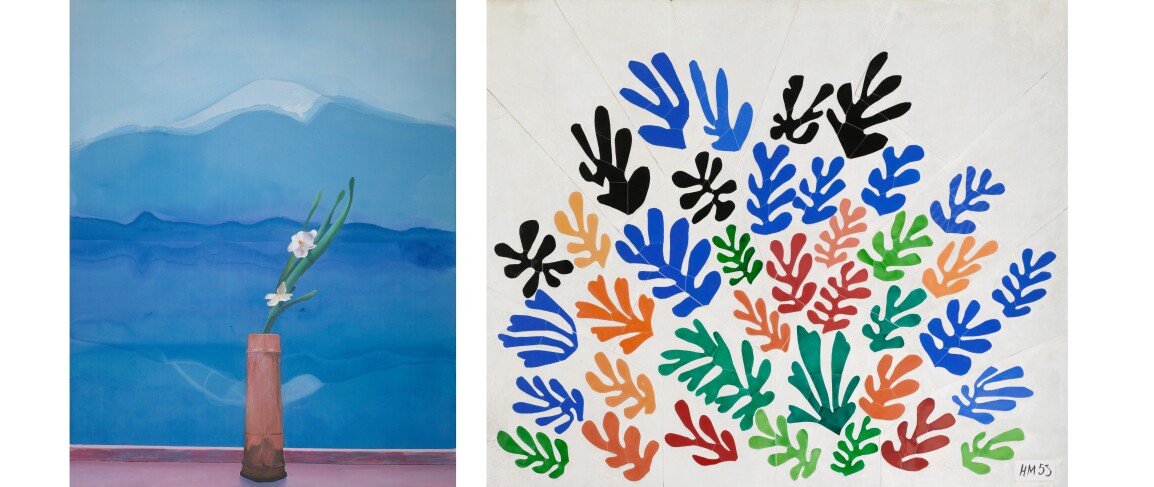


Flower with Bamboo, in many ways, is classically Lichtenstein: between the Ben-Day dots, bold contour lines, and Pop art quintessential flatness, the modern master’s hand is instantly recognizable in the present work. However, unlike his comic-book-inspired compositions of the 1960s, rendered in bright primary colors, Lichtenstein here draws inspiration from the natural landscape and the cool tones of iconic landscapes. Lichtenstein’s interest in Chinese art in the 1990s began almost five decades prior. Stationed in London during World War II, twenty-one-year-old Lichtenstein wrote home to his parents: “I bought a book on Chinese painting, which I could have gotten in New York half the price. I’ll probably send it home with my collects ion of African masks, as my duffle bag now weighs more than I do, with all the art supplies.” (the artist quoted in: Exh. Cat., Hong Kong, Gagosian Gallery, Roy Lichtenstein: Landscapes in the Chinese Style, 2011, p. 7) Later, when Lichtenstein returned to Ohio State University to complete his undergraduate and graduate degrees after the war, he enrolled in classes on East Asian art history. And in 1994, after visiting an exhibition of Edgar Degas’ landscapes and Song Dynasty prints at the Metropolitan Museum of Art, Lichtenstein embarked on a series of paintings dedicated to the subject. He became particularly fascinated by their atmospheric qualities and the way nonfigurative shapes coalesce into representational forms. Lichtenstein recalled: “The thing that interested me was the mountains in front of mountains in front of mountains, and huge nature with little people… We all have a vague idea of what Chinese landscape look like—that sense of grandeur the Chinese felt about nature.” (the artist quoted in: Calvin Tomkins, “The Good China,” The New Yorker, September 30, 1996) In the present work, a spray of golden flowers and two spindling stalks of bamboo consume the front of the picture plane. Behind them, the composition dissolves into a haze of Ben-Day dots, suggesting the vast expanse beyond.


Ever the student of art history, Lichtenstein was constantly inspired by the iconography of other artists—the still life paintings of Pablo Picasso, the water lilies of Monet—creating his own versions replete with Ben-Day dots, flat planes of color and bold black outlines. The liveliness of Lichtenstein’s shapes that playfully extend across the work call to mind the organic shapes of Matisse’s Le Gerbe; like Matisse, who synthesized the curvature of various flora into spirited abstractions, Lichtenstein distills the features of stalks and petals into purely essential visual language. Here, the ovular vignette of the canvas and the geometric, bold diagonals of the bamboo evoke Cubist compositions. Like the Cubists, Lichtenstein toys with depth of field in the present work, synthesizing the foreground and background and eschewing traditional perspective. The cluster of blue dots in the background dissipate towards the edges of the composition, evoking the sky reaching towards a horizon. Ribbon-like leaves twist across the composition, further confounding the depth of field and sense of scale. Lichtenstein here also blends his signature segments of flat pigment with irregular areas of sponge application, suggesting a dense mass of flowers or leaves. The resulting composition is both disorienting and meditative; it is seemingly familiar and yet completely abstract. This duality—depth and shallowness, high art and mass media—characterizes much of Lichtenstein's oeuvre. Unique among the Chinese Style Landscapes in its perspective, Flower with Bamboo even resists characterization as a landscape. While the other entries in the series feature wide vistas and fog-covered mountains, Flower with Bamboo is much tighter, almost like a precisely arranged still life. Nevertheless, in the space created by the stalks of bamboo, a sense of scale emerges. The viewer peers out from behind the branches and is left to imagine what lies beyond. Indeed, Lichtenstein’s paintings are the product of imagination and fantasy rather than representations of reality.
“I bought a book on Chinese painting, which I could have gotten in New York half the price. I’ll probably send it home with my collects ion of African masks, as my duffle bag now weighs more than I do, with all the art supplies.”

Lichtenstein’s Landscapes in the Chinese Style provide a commentary on the juxtapositions of East and West, or rather the ways in which the West imagines the East. Just as Lichtenstein’s earlier work provides a wry commentary on consumption of American popular imagery, here, he explores the popularization and reproduction of Asian art in Western culture. Lichtenstein’s work critiques a view of Asian art as monolithic, creating compositions with a mechanical quality in contrast to the intimacy of the prints by which he was inspired. The title of the series underscores this perspective—it is, of course, impossible to distill centuries of work across a vast geography under a single definition. As Karen Bandlow notes, “Humorously, he plays with visual clichés entertained by the Western viewer and integrates them consciously into his work. From his art, one learns less about East Asian art and culture itself, than about the manner in which it is perceived in the West and how it has blended with Western culture. Therefore Lichtenstein never creates pseudo-Asian copies, but genuine and unmistakable ‘Lichtensteins’.” (Karen Bandlow, “East Asia in the Art of Roy Lichtenstein,” Critical Issues, Vol. 8, Oxford 2004, p. 41)

