


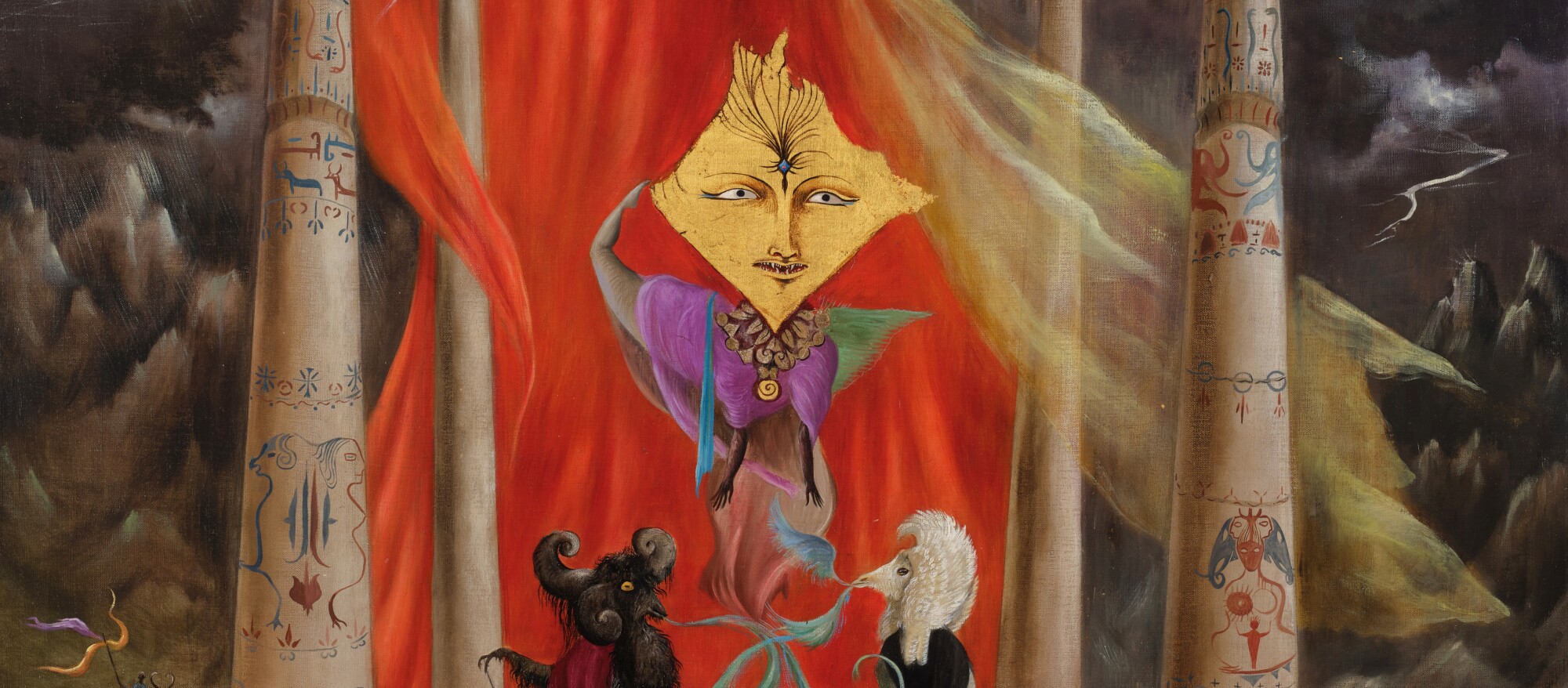

Teeming with mysterious figures and dramatic pageantry, Leonora Carrington’s 1954 painting Temple of the Word represents the artist at the height of her visionary powers. On full display is her deep interest in the archaeological remains of the ancient world combined with an understanding of the theatrical nature of magical initiations and their symbols. Quoting from a wide array of esoteric traditions, Carrington absorbs and then transforms her sources into her own unique visual language. Against a stormy nocturnal backdrop of rocky mountain peaks, illuminated by a full moon and a bolt of lightening, the monumental “temple” arises. Vaguely Minoan and Egyptian in its architectural form, the edifice is decorated with glyphic markings as well as animals, in particular cows and bulls, both sacred to those cultures.


After moving to Mexico in the early 1940s, Carrington became closely connected to its émigré surrealist circle as well as to some of luminaries of Mexico’s intelligentsia. Along with her close friend, the Spanish surrealist Remedios Varo, Carrington began to explore the magical traditions of many cultures with an emphasis on uncovering the feminine divine within them. In addition to such subjects as Tarot, the Kabbalah, Tibetan Buddhism, astrology, and numerology, the two friends explored witchcraft—both European and that of indigenous Mexican practitioners whom they visited in various locations and marketplaces. An avid reader, Carrington not only researched magical practices in books like Kurt Seligmann’s The Mirror of Magic (1948), but also participated in a number of esoteric groups then operating in Mexico City. In particular she frequented the groups formed by the followers of the Russian mystics P.D. Ouspensky and G.I. Gurdjieff, which in Mexico were led by Rodney Collin-Smith and Christopher Freemantle, respectively. This all led to Carrington’s profound belief in the magical efficacy of painting, and Temple of the Word is the one of the prime examples of how the artist infused and animated her art with such esoteric energies.


Carrington also had a long interest in the theater, writing plays while living in Paris and New York and in Mexico creating cost.mes s and sets for a number of productions, such as for Octavio Paz’s 1956 production of Rappaccini’s Daughter. The careful placement of the black and white human/animal hybrid figures on the “stage” of Temple of the Word, along with the flowing red curtains in the background, suggest a performance of some kind. It is hard to determine if the floating central figure is meant to represent an actual figure or a backdrop, but such ambiguities purposely abound in Carrington’s work. However, it is important to note that the yellow diamond-shaped head of this figure was almost exactly replicated in a red leather mask she created around the same t.mes , indicating that it held symbolic importance for the artist.


In front of the temple, in a carefully demarcated tiled floor reminiscent of Renaissance painting, cavort a number of medieval flavored characters sporting heraldic flags. Wearing flowing robes, strolling under amusing British umbrellas, and accompanied by strange animals, they appear to be part of the unfolding ritual event. If one looks closely, a gossamer winged dragon-like entity appears to fly into the temple near the roof, perhaps a relative of the feathered serpent Quetzalcoatl from her adopted country, Mexico. In both occultism and in the Bible, all creation begins with the utterance of the “word”—whereby the spiritual intentions of humanity, translated into speech, begin to construct our world. In the liminal space of Temple of the Word, Carrington presents us with a monumental surrealist construction that blends together different t.mes periods and life forms. Both playful and profound, it exists within multidimensional arenas, reminding us of the mystical power of the arts.
Susan L. Aberth
Edith C. Blum Professor of Art History
Bard College, New York

