“Life here is at best an endless string of privations; yet I must admit that the people amongst whom I live here never fail to exert their peculiar fascination over me each t.mes I step out into the street and catch sight of the procession of characters marching past”
An awe-inspiring rediscovery of one of the most iconic sites of the Holy Land, Bauernfeind’s painting of the Western Wall belongs to a series of large-scale oils of the Holy Land from the core of his oeuvre. The artist has drawn upon his fastidios us talent as a realist painter, and his first-hand observations of Middle Eastern culture, in order to present an image that is culturally and archaeologically accurate in execution, and appropriately reverential in tone. It represents the apogee of his understanding of Eastern culture.

In this t.mes less view, men and women, Ashkenazim and Sephardim, worship together before the Western Wall, in the Oldy City of Jerusalem, sacred to Judaism and Islam alike. The visible part of the wall is just an exposed segment of a far longer retaining wall, originally erected as part of the expansion of the Second Jewish Temple begun by Herod the Great, which resulted in the encasement of the natural hill known to Jews and Christians as the Temple Mount, into a huge rectangular platform, the site of the temple itself until its destruction by the Romans in 70 CE.
The Western Wall’s holiness in Judaism derives from its proximity to the Temple Mount, being considered the closest of the four retaining walls to the former Holy of Holies. Jewish devotion at the site of the Wailing Wall dates from the early Byzantine period, and reaffirms the rabbinic belief that “the Divine presence never departs from the Western Wall.” The term “Wailing Wall” was coined by European travelers to the site who witnessed the mournful vigils of pious Jews before the relic of the sacred temple. In Muslim tradition, the Wall, known as the Buraq, is the site where the Prophet Mohamed tied his winged steed, al-Buraq, on his night journey to Jerusalem before ascending to paradise, and today constitutes the western border of al-Haram al-Sharif, the precinct of the Dome of the Rock and the Al-Aqsa Mosque.
The German-born Bauernfeind made three extended trips to Palestine–in 1880-1881, 1884-1887 and finally in 1888-1889–before settling permanently in Jerusalem with his family in 1896. Perhaps as a result of his training as an architect in Stuttgart, Bauernfeind was particularly interested in the monuments and urban architecture of the places he visited in Cairo, Jerusalem, Jaffa and Damascus; and his understanding of perspective is nowhere more clearly manifested than in the present work.
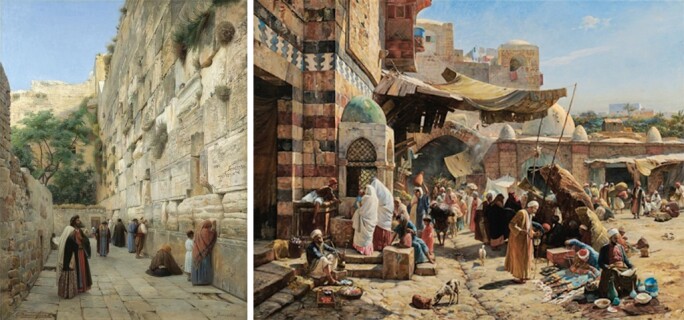
Right: Gustav Bauernfeind, Market in Jaffa, 1887. Oil on canvas, 32 by 43 in.; 82 by 109 cm. Sold, Replica Shoes ’s, London, 22 October 2019, lot 9.
However, his virtuosity as a draftsman was tempered by a deep interest in the people and cultures he encountered. Armed with his sketchbook and Detektiv camera–a miniature spy camera that he hid in his waistcoat with the lens peeping through a buttonhole–he could be seen exploring the city and recording his impressions. He would then work these up into finished paintings, typically in his studio during intervals in Germany. These works were destined for his dealer, Arthur Sulley, in London or for private patrons. Bauernfeind often interrupted his tours due to financial issues, challenging living and working conditions, and frequent bouts of illness, meaning that his large-scale works of Palestine, like the present example, are few in number and therefore highly coveted by collects ors today.

Under Ottoman rule (1517-1917), men and women were allowed to mingle at the Wall on Fridays and holy days. In 1881, explorer Sir Charles W. Wilson published an illustration and description of the Western Wall in Picturesque Palestine, recounting that “Jews may often be seen sitting for hours at the wailing place, bent in sorrowful meditation over the history of their race and repeating often the words of the 79th Psalm. On Fridays especially, Jews of both sexes, of all ages and from all countries assemble.” In Bauernfeind’s monumental composition, Ashkenazi and Sephardic Jews gather together at the Wall before the Sabbath or on a holiday, with men at the front (including children)–some draped in tallit, others wearing a shtreimel (fur-trimmed hat worn predominately by Ashkenazi Jews), fez or tarbush (worn predominantly by Sephardic Jews), or a yarmulke–and women at the back. Several figures read from open prayer books in silent or whispered prayer, lending an auditory element to the reverential scene. Others have inscribed their names, together with loved ones, onto the stone, visible at right—a precursor to the modern tradition of leaving prayer notes in the wall.
