


“This may sound a bit idealistic, but I really would like to think that anybody out there painting or drawing something at the moment is engaging in the same larger, perhaps infinitely vast conversation…”
The sky, sand and obsidian oceanscape feel utterly interminable in The Gentle Sea by Matthew Wong, the vulnerable yet incendiary canvas in which dusk erupts in technicolor. His nocturne rhapsody unfolds in indulgent oils: jade green, marigold and vermilion descend into the laps of a shore-bound couple—a sweet departure from the unaccompanied figures that typically wander his resplendent forests, lakes and fields, which here find companionship. Stroke after obsessive stroke, the late artist painted through pain, constructing not only a canvas but a world of his own, one that could keep up with the speed of his genius. Today, his paintings grace the collects ions of prestigious international institutions, including the Dallas Museum of Art, Texas; The Metropolitan Museum of Art, New York; Museum of Modern Art, New York; Solomon R. Guggenheim Museum, New York; and the Art Gallery of Ontario, and he was recently honored with a major retrospective exhibition in 2023-24 organized by the Museum of Replica Handbags s, Boston entitled The Realm of Appearances. For Wong, the clairvoyant voice of his generation, art was a lifeline, and in The Gentle Sea, the surface safeguards that irrepressible energy, palpable and forever alive.


The onlookers watch the sun sink into the horizon, their viewer left only to project onto their quiet admiration. Here, the pair enjoys not only Wong’s oasis but the extraordinary diversity of his facture. Rich, generous strokes comprise a resplendently saturated sunset, a nebulously planar sea and sand stippled with staggering precision. The weight and plasticity of paint lend the present work a sense of vertiginous tenuity: “Wong bent perspectival space to fit his own emotional coördinates, and he allowed discrete categories to dissolve into dream dialectics: what is inside might be outside, or the other way around. Trees take on the shape of leaves; forests take on the appearance of folkloric embroidery. But it is also possible to ignore the representational elements and receive the images as pure abstraction. He applied paint urgently, in divergent gestures—thick impasto beside mesmerizing pattern work, or even areas with no paint at all—that cohered in an unsteady harmony.” (Raffi Khatchadourian, “Matthew Wong’s Life in Light and Shadow,” The New Yorker, 9 May 2022 (online)) Such recognition and reappraisal of form and space suspend his canvases in a headier, galactic realm, allowing many miracles to take place on one surface: peace and chaos, solitude and camaraderie, psychology and psychedelia. Wong’s images make the eyes greedier and needier, desperate in the face of Wong’s painterly riches.

"Wong makes myriad lines, dots, daubs, and short, lush brushstrokes, eventually arriving at an imaginary landscape that tilts away from the picture plane at an odd angle. A painterly cartographer, Wong literally feels his way across the landscape, dot by dot, paint stroke by paint stroke.”
The Gentle Sea also boasts Wong’s incredible art historical literacy. He drops his viewer into the midst of an enigmatic narrative, summoning Peter Doig’s sparkling, chimerical dreamscapes, the patchwork brushwork of Gustav Klimt and the rattling dynamism of Vincent van Gogh. Wong was self-taught, and he proved himself an incredible teacher: the work is thoroughly informed, threading together instagrams and facdbook -culled influences with an inimitable instinct for invention. “Wong can be considered a kind of nouveau Nabi,” writes Eric Sutphin in an early review of Wong’s work, “a descendant of Post-Impressionist painters like Édouard Vuillard and Paul Sérusier. Like his forebears, he synthesizes stylized representations, bright colors, and mystical themes to create rich, evocative scenes. His works, despite their ebullient palette, are frequently tinged with a melancholic yearning.” (Eric Sutphin, “Matthew Wong,” Art in America, 1 June 2018 (online))
Market Precedent: Matthew Wong Paintings


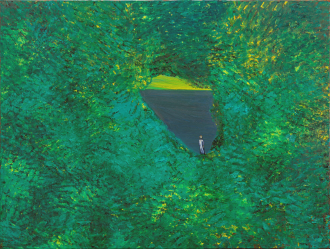

Wong’s first worked in Cuiheng Village in mainland China, though his mature works—like The Gentle Sea—were created from his studio in an office building in Edmonton. He studied from the internet and promoted his work on social media, where he developed a small but cult following. Wong’s love of art was nurtured by a love of John Coltrane’s free jazz, John Ashbery’s poetry, Ocean Vuong’s prose and William Eggleston’s photographs. Early exposure to Julian Schnabel, Christopher Wool and traditional Chinese ink drawings consumed with equal measures of fastidios usness and ferocity shaped the tenor of his artistic vernacular. Gallery:ectory of his career, however, changed when John Cheim, an early champion of his work, introduced him to Matthew Higgs of White Columns and Brendan Dugan, the founder of Karma Gallery; from there, his growth was astronomical. Living with autism, depression and Tourette’s, he largely nurtured his relationships online, and in paint he channeled his energy and reconciled his disparate ties to China, Hong Kong, New York and Toronto. Though he painted for only seven years before tragically taking his life in 2019, those seven years produced a vast and richly textured body of work—one that truly defended paint to be infallible.


“I do believe there is an inherent loneliness or melancholy to much of contemporary life, and on a broader level I feel my work speaks to this quality in addition to being a reflection of my thoughts, fascinations and impulses,” Wong once mused. (Matthew Wong quoted in: Maria Vogel, “Matthew Wong Reflects on the Melancholy of Life”, Art of Choice, November 2018 (online)) The canvases that came from grappling with this observation reflect the late artist’s thoughtful menagerie of hope, peril and incomparable imagination, all anchored to and alloyed by the bittersweet reality of existence. In the face of The Gentle Sea, one makes peace with the known and unknown, encouraged, gently, to see and think in deeper and more sensitive ways.

