Lucio Fontana's Concetto spaziale, La fine di Dio


Catalogue numbers from left to right: 63-64 FD 2, 61 O 52, 63 FD 1, 64-65 ME 4, 63 T 37
"Now in space there is no longer any measurement. Now you see infinity in the Milky Way, now there are billions and billions… And my art too is all based on this purity of the philosophy of nothing, which is not a destructive nothing but a creative nothing… And the slash, and the holes, the first holes, were not the destruction of the painting… it was a dimension beyond the painting, the freedom to conceive art through any means, through any form."
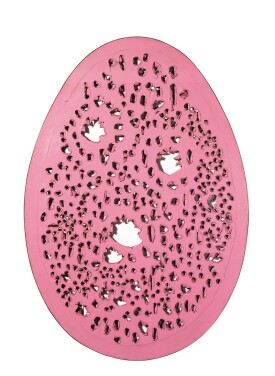
Immediately arresting and emanating intense energy, Concetto spaziale, La fine di Dio epitomizes the very essence of Lucio Fontana’s iconic artistic practice. With the dawn of the Space Age, ushered in by Yuri Gagarin’s flight in 1961, came an entirely new dimension; this seminal moment in the history of mankind was the catalyst for Fontana’s La fine di Dio, a body of work that radically transformed the canon of twentieth century artistry. Without question Fontana’s most revered and renowned series, today, the Concetto spaziale, La fine di Dio paintings have come to represent the ultimate embodiment of not only Fontana’s oeuvre, but the Spatialist movement at large, of which Fontana was both founder and figurehead. Of the 38 canvases in the series, the present work is one of only five examples made in white – two of which are held in the permanent museum collects ions of Milan's Fondazione Prada and the Museum of Contemporary Art of Tokyo. Befitting their importance, other works from the series are held in such prestigious museum collects ions as The Metropolitan Museum of Art, New York; Museo Nacional Centro de Arte Reina Sofía, Madrid; and Centre Pompidou, Paris.

Profoundly influenced by the notion that man’s existence was no longer earthbound but instead could expand into the endless infinity of the cosmos, Fontana’s conceptual philosophy, today termed Spatialism, proposed to synthesize and transcend material properties to forge an entirely new direction for art. The pinnacle of this project was expressed most purely for Fontana in the creation of the void, the penetration of the traditional flat plane of the medium, which opened up the material of the canvas and infused it with the space endlessly expanding behind, around, and through it. With La fine di Dio (“the end of God”) – a series comprising a total of thirty-eight colossal ovoid canvases executed between 1963 and 1964 – Fontana achieved the ultimate manifestation of his life’s work. In his own words, they represented “the infinite, the inconceivable chaos, the end of figuration, nothingness,” an expression of the dimensionless void of space that is beyond the intellectual capacity of man to understand and therefore beyond his notion of God (the artist quoted in Exh. Cat., London, Hayward Gallery, Lucio Fontana, 1999, p. 198). In the present example from 1963, the pristine white façade of the surface is forcefully disrupted by the palpable materiality of the impastoed puncture wounds, which in turn contrast with the delicately incised ovular border line, evincing Fontana’s unparalleled ability to balance myriad dichotomies in his inimitable oeuvre. These perforations rupture not only the canvas itself, but the traditional boundary between painting and sculpture, establishing an utterly new dimension in artmaking. Concetto spaziale, La fine di Dio thus articulates the genesis of a new form of artistic expression and offers a reflection on the astral age. Like all truly great artists, Fontana both revolutionized precedent and created a conceptual ideology with a radical perspective that simultaneously reflected and impacted his own t.mes .

Catalogue numbers from left to right: 63 FD 31, 63 FD 16
Select Fin di Dio Works in Prestigious Institutional and Private collects ions


“Einstein’s discovery of the cosmos is the infinite dimension without end. And so here we have: foreground, middleground and background… to go further what do I have to do?... I make holes, infinity passes through them, light passes through them, there is no need to paint."
Astral and mysterious, the La fine di Dio have a sense of impregnation and mystery that enables them to embody a range of diverse meanings both symbolic and formal. The pure white oval of the present work emits a reassuring tranquility that is dynamically contrasted with the raw and expressive surface. The notion of purity is profoundly associated with Fontana’s celebrated white canvases, for the color white offered the artist the cleanest and most proficient channel for temporal and spatial meditations: a powerful tabula rasa, a blank slate awaiting dynamic action. Its topography, like the face of the moon, is ravaged yet ebullient in its organic beauty. The slender, irregular border etched into the painting’s thick white skin confines the panorama of epic cavities within; concentrated in the upper register of the oval, the holes almost appear to float like bubbles to the top of a container.


Originally exhibited at the Galleria dell'Arte in Milan in 1963 under the title Le Ova ("the eggs") and at a 1964 exhibition in Paris at the Galerie Iris Clert under the title Les Oeufs célestes ("the celestial eggs"), Fontana’s subsequent change of title to the more provocative and irreverent La fine di Dio has been the subject of much diverse critical interpretation, prompting speculation and a variety of possible interpretations. The final title even "hints at the possibility that underlying all of Fontana’s art is the desire to find an imagery universal enough in its appeal to usurp centuries of Christian symbolism" (Ibid., p. 46). While the first group of canvases exhibited as Le Ova in 1963 bore small groups of holes, the second group shown in Paris in 1964 – amongst which the present work was included – featured far more interventions, their constellations of punctures more closely resembling their “celestial” inspiration. Indeed, as evinced by the present work, the increasing aggression and full compositional resolution of these later canvases more fully conveys the radical “breakthrough” and cosmic birth at the conceptual and physical core of these astonishing Spatialist inventions. Here, the shimmering white surface and animalistic ruptures evoke a mystery and cosmic silence that transcends the boundaries of space and t.mes . In this regard, the Fine di Dio can be understood as Fontana’s ultimate response to man’s reckoning with his place in the universe.

As the artist himself explained, "Now in space there is no longer any measurement. Now you see infinity in the Milky Way, now there are billions and billions… The sense of measurement and of t.mes no longer exists. Before it could be like that…but today it is certain, because man speaks of billions of years, of thousands and thousands of billions of years to reach, and so, here is the void, man is reduced to nothing… When man realizes that he is nothing… that he is pure spirit he will no longer have materialistic ambitions… man will become like God, he will become spirit. This is the end of the world and the liberation of matter, of man… And my art too is all based on this purity of the philosophy of nothing, which is not a destructive nothing but a creative nothing… And the slash, and the holes, the first holes, were not the destruction of the painting… it was a dimension beyond the painting, the freedom to conceive art through any means, through any form" (the artist quoted in Exh. Cat., Rome, Palazzo delle Esposizioni, Lucio Fontana, 1998, p. 246).

"The discovery of the Cosmos is that of a new dimension, it is the Infinite: thus I pierce the canvas, which is the basis of all arts and I have created an infinite dimension..."

Fontana was deeply influenced by the dramatic developments in science that punctuated his lifet.mes . From Einstein’s Theory of Relativity (1916); to Georges Lemaître’s “Big Bang” theory (1931); J. Robert Oppenheimer’s theorizing on black holes (1939); to the atomic bombings of Hiroshima and Nagasaki (1945); and Yuri Gagarin’s first manned journey into space (1961), Fontana witnessed a series of radical innovations and catastrophic scientific discoveries that fundamentally altered humankind’s understanding of our world. These revolutionary ideas inspired Fontana’s richly layered conceptual framework for the Fine di Dio. For instance, according to Einstein, matter causes space to curve; he also posited that gravity, in opposition to Newton’s law, is not a force, but is instead a curved field sculpted by the presence of mass. Paired with cosmologist (and Catholic priest) Georges Lemaître’s proposal of the expansion of the universe from an initial point in 1931, Einstein’s theorizing of spacet.mes conceived a model of the universe that today takes the form of a three-dimensional ovoid. That Lemaître famously described his Big Bang theory in a scientific paper as “the Cosmic Egg exploding at the moment of creation” does much to underline the perspicacity of Fontana’s extraordinary egg-shaped canvases. For Fontana, scientific innovation of the twentieth century had liberated humanity from the constraints of an established order, one tied to the materiality of earthly existence and outdated ideologies.

Working in parallel with the scientific labor behind man’s first cosmic steps, Fontana toiled for more than a decade on his Spatialist theories before arriving at the Fine di Dio. Of foundational import at the forefront of this philosophy is Fontana’s discovery of the hole in 1949. Indeed, the buchi represent the point of departure from which the entirety of Fontana’s theorizing on the dimensionality of space takes off: “Einstein’s discovery of the cosmos is the infinite dimension without end. And so here we have: foreground, middleground and background… to go further what do I have to do?... I make holes, infinity passes through them, light passes through them, there is no need to paint” (the artist quoted in Carla Lonzi, Autorittrato, Bari, 1969, pp. 169-71). With the advent of space exploration, Fontana prophesized that mankind, overcome by the immensity of space, would no longer recognize himself in figurative painting; in accord, he declared the need for a new artistic language entirely removed from verisimilitude and more radical than the aims of modernist abstraction. By drastically penetrating the very surface of the canvas – the field of an entire history of aesthetics and pictorial invention – Fontana fundamentally surpassed any concession to reflecting life in art and instead invited its reality to inhabit the very essence of his work.
"Making a hole was a radical gesture that broke the space of the picture and that said: after this, we are free to do what we want.”

Fontana’s invention of the hole also ruptured the boundaries of painting and sculpture. Developed through the buchi, the tagli, and the olii, Fontana’s apertures became ever more visceral and corporeal, built up and molded with thickly impastoed oil paint. In the present work, a unique schema of hewn scars narrates the history of its genesis, and the sheer physicality of La fine di Dio constantly reminds the viewer that Fontana was trained as a sculptor. Residual quotations of his thumbs, fingers, and fists emerge as shadows fixed in oil paint amidst the ruptures, ridges, and recesses. As if forged by explosions, the blasted tears are encircled by seemingly melted ridges of paint reminiscent of the incinerated mineral surface of a meteorite. Wound-like and gaping, these viscerally felt gashes induce a biological reading that addresses the viewer’s own bodily experience, an interpretation underscored by the canvas’s imposing scale. Towering nearly six feet high, the painting imparts an extraordinary physical encounter; not only does it replicate Fontana’s own stature, but it also echoes the height of the average viewer. Further, the effect of the holes themselves is to implicate the space surrounding the canvas in the viewer’s experience of the work: as light passes through the apertures, we glimpse the shadows cast by their outlines on the wall behind the work, the constellation on the canvas multiplying onto the additional surface. Thus the Fine di Dio yet again break the traditional boundaries of art, as Fontana’s full creation is not limited by the confines of the substrate but expands ever outward with enigmatic and macrocosmic power.


Fusing not only artistic and scientific concepts into his Spatialist theories, Fontana draws upon centuries of literary, religious, and philosophical allusions as well. As the universal visual referent of birth and creation, the egg clearly has a longstanding history as a potent symbol in the iconographical lexicon of human history. For millennia it has acted as a sign of fertility and hope, representing the cycle of regeneration and new life. From the graphic sign of femininity in Egyptian hieroglyphs to its symbolic depiction by canonical artists such as Hieronymus Bosch, Piero della Francesca, Diego Velázquez, René Magritte, Salvador Dalí, and Constantin Brancusi, imagery of the ovum has long delivered variously esoteric semiotic interpretations associated with the origin of the world. In this context La fine di Dio assumes an almost womb-like identity. However, an egg's capacity to incubate depends upon the consistency of highly fragile conditions: obviously a broken egg is useless as a life-support. Pierced by violent lacerations, Fontana’s oval here recalls the mythic Orphic Egg, from which Phanes, the mystic primeval deity of procreation and the generation of new life, burst forth. Many critics have also drawn a parallel between Fontana’s bodily punctures and the stigmata wounds of Christ, in their symbolism of man’s spiritual release from matter. This reading of the holes as a visual metaphor for the liberation of man from materiality is supported by the artist’s own words: “Man must free himself completely from the earth, only then will the direction that he will take in the future become clear. I believe in man’s intelligence – it is the only thing in which I believe, more so than in God, for me God is man’s intelligence – I am convinced that the man of the future will have a completely new world” (Lucio Fontana in conversation with Tommaso Trini, 19 June 1968, in Exh. Cat., London, Whitechapel Art Gallery, Lucio Fontana, 1988, p. 36).
Oscillating between sculptural materiality and painterly essence, Concetto spaziale, La fine di Dio is suffused with the idea of rebirth in the age of cosmic exploration. In a combination of surface and depth, aesthetics and philosophy, carnal sensuality and scientific rigor, the present work forms a mosaic of Fontana’s rich inspirations that culminate in an emotive visual sensation. More than any other series, La fine di Dio epitomize Fontana’s fascination with the cosmic universe and form a potent representation of evocative dichotomies: condensed within the cratered topography of this painting’s monochrome surface resides the beginning and the end, the alpha and omega of existence. At its very core Concetto Spaziale, La fine di Dio proposes a new model for mankind – no longer the earth-bound man of material possessions, but man as a cosmic being on the brink of the unknowable void. La fine di Dio posits what no artwork had done before; it articulates the genesis of a new form of expression reflective of the astral age.

