T
his impressive full-length portrait of Ferdinando Gonzaga (1587–1626), Duke of Mantua and Monferrato, is one of only a handful of works attributed to Tiberio Titi, the son of the celebrated painter and architect Santi di Tito. The attribution and identification of the sitter were recently established by Lisa Goldberg Stoppato, who recognized the work as an authoritative image of the Gonzaga duke, conceived at a moment when Ferdinando was consolidating both his dynastic legitimacy and his public identity as a sovereign prince.1 The scale, format, and assured handling place the painting firmly within the tradition of grand court portraiture cultivated in Florence in the years immediately preceding Titi’s documented activity for the Medici and Gonzaga courts.
Standing in a resolute martial pose with his left hand resting on the hilt of his sword, the Duke wears a crisp white ruff and an elaborate breastplate adorned with three black eagles (a Gonzaga heraldic emblem). His helmet—decorated with striking red and white plumes—rests on a table beside him, reinforcing the sitter’s princely authority. Fastened around his neck, a heavy gold and enamel chain bears the insignia of the dynastic chivalric order founded by Ferdinando’s father, Duke Vincenzo I Gonzaga: the Order of the Redeemer (or Ordine del Preziosissimo Lateral Sangue di Cristo, after the relic of the Holy Blood of Christ kept in Mantua). The links are inscribed with the words “Domine” and “Probasti” and decorated with burning crucibles, a Gonzaga heraldic emblem. Suspended from the chain is a pendant depicting two angels bearing the holy reliquary with three drops of Christ’s blood.
The second son of Vincenzo I Gonzaga and Eleonora de’ Medici, Ferdinando was originally destined for an ecclesiastical career and studied philosophy, theology, and law at the universities of Ingolstadt and Pisa. He became a knight of the Order of Saint John of Jerusalem and was created cardinal in 1607, before unexpectedly ascending to the ducal throne following the death of his elder brother Francesco in 1612. He was formally crowned Duke of Mantua and Monferrato in January 1616 and, the following year, married Caterina de’ Medici, daughter of Grand Duke Ferdinando I of Tuscany.
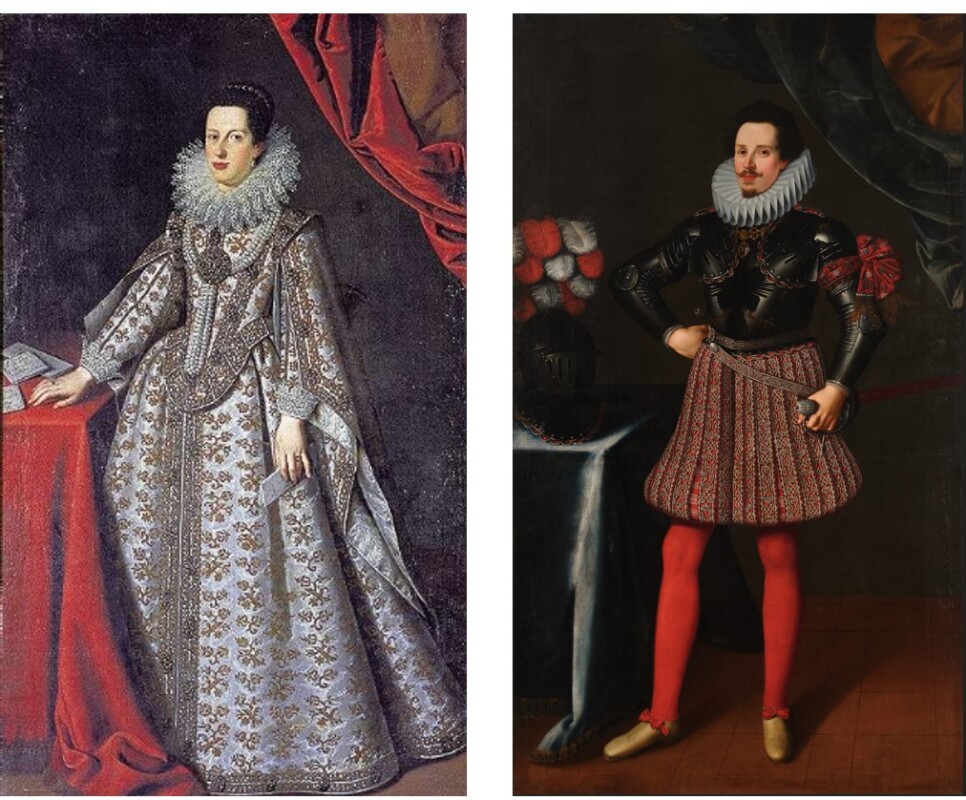
RIGHT: The Present Work
Tiberio Titi was among the most accomplished portraitists active in early seventeenth-century Florence and the son of the eminent painter and architect Santi di Tito. His refined handling, sharp lighting, and assured sense of format are evident here and closely relate to his documented portrait of Ferdinando’s wife, Caterina de’ Medici in white (fig. 1), a work long misattributed to Giusto Sustermans but now securely recognized as Titi’s.2 That portrait has been identified with a full-length likeness Titi mentioned in a letter of 20 April 1618 to the Medici court secretary Andrea Cioli. A second version of the present portrait is preserved in the Uffizi Gallery, Florence (inv.no. 1890/2330), with minor variations in the folds of the curtain and tablecloth and the position of the duke’s right hand. Although Medici–Gonzaga correspondence documents Titi’s presence in Mantua in 1618 to paint other members of the Gonzaga family, no letters refer to a portrait of Ferdinando himself. This absence, together with the sash embroidered with the initials "CM" (Caterina de’ Medici) tied around the duke’s arm in both versions, suggests that the present portrait and the Uffizi picture were likely painted in Florence in 1617, during Ferdinando’s visit to Tuscany for his marriage. An inventory of the Pitti Palace compiled between 1663 and 1664 records a portrait of Duke Ferdinando of Mantua displayed in the apartments of Prince Mattias de’ Medici, attesting to the early Medici appreciation and prominence of this striking image of Gonzaga power and dynastic ambition.
1 See Goldenberg Stoppato 2019, pp. 340-345.
2 Uffizi Gallery, Florence, inv. no. 1890/2427.