“They represent the country’s most undeniable image of itself, and as such pass-through culture with no friction. They are dismissible generic signifiers, and at the point when Prince chose them, they had ceased even to be employed as ubiquitous ads for Marlboro cigarettes; they had been cut loose and were resting somewhere in the sediment of culture.”

U tterly iconic and instantly identifiable, Richard Prince’s Untitled (Cowboys) is an early example of the artist’s masterful deconstruction of an American archetype of individualism and symbol of freedom: the cowboy. The foreshortened horses and riders gallop across a water-soaked canyon in Untitled (Cowboys), their denim, leather chaps and Stetson hats brimming in sunshine, shielding their expressions from the viewer; thus, shrouding the figure of the cowboys in utter mystery and fascination. The figure of the cowboy as the lonesome hero, fierce defender, guardian of ethics and archetypal male hinges upon its wholly universal appeal as the idealized symbol for masculinity and rugged sexuality. Keenly aware of the mythical lore of the cowboys in Untitled (Cowboys), Prince’s ingenious strategy reveals the evolving relationship between the recognizable trope and the extraordinary hyperreal effects of the subject work.
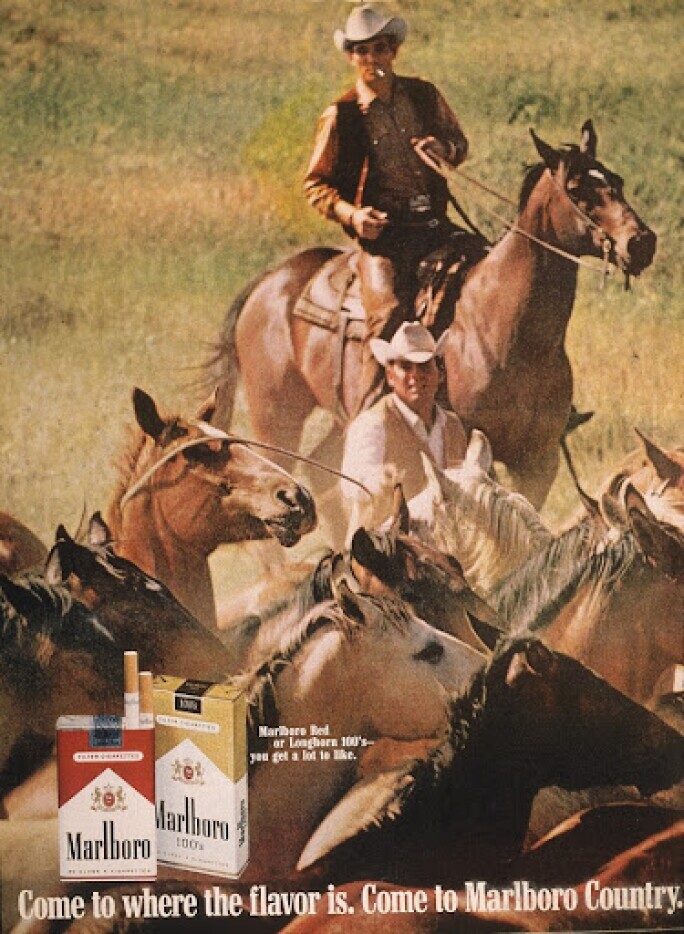
Considered one of Prince’s most captivating subjects, the enduring theme of the American cowboy was continually adapted and refined over a forty-year period of artistic production. Prince’s initial fascination with the cowboy motif was during a night shift at t.mes -Life magazines in 1974, where the aspiring artist was clipping editorials for staff writers. Instinctively drawn to the familiar, brand-identifiable and glossy images of cowboys, Prince began photographing these images around the advertising copy. Created in 1992, Untitled (Cowboys) belongs to one of Prince’s earliest iterations of the series, as the artist masterfully tightened the image through cropping and enlarging, the grainy close-up creates an otherworldly effect on the ranchers, who are printed on an impressive scale. The artist’s precise revision of the image in Untitled (Cowboys) thus deepens its intimacy and nostalgia, revealing the cowboy as a dreamlike motif of society’s desires.
“The Marlboro cowboys were all staged. The blend of fact and fiction didn’t demand any of my senses to try and figure anything out. I took their word for it. I didn’t care about disbelief. My past, my growing-up, had been full of lies, innuendos, half-truths. Their story, their “look,” looked perfect to me. I took their word for it. After I took their word, I figured you wouldn’t have to take mine.”

