“I do believe there is an inherent loneliness or melancholy to much of contemporary life, and on a broader level I feel my work speaks to this quality in addition to being a reflection of my thoughts, fascinations and impulses."
Shimmering with an array of lustrous chromatic dashes and dabs, The Jungle by Matthew Wong presents a mystical nightscape featuring the artist’s signature lone figure, sailing dreamily across a cascading river. Executed in 2017, The Jungle is an early example of Wong’s celebrated moonlit landscapes, a genre to which he later dedicated his solo show, Blue at Karma Gallery, New York, which opened posthumously in 2019-2020. The solitary, faceless figure is a recurring and significant motif found in Wong’s mature paintings: often interpreted as a surrogate for the artist himself, the lone figure typically wanders winding paths across rolling hills or navigated interminable bodies of water in small row boats, as in the present work. Above this figure, Wong’s bulbous trees line the top edge of the water’s bank, extending beyond the confines of the canvas to suggest a continuous narrative. Intriguing and impactful, The Jungle revels in the artist’s idiosyncratic visual language of texture and color as he evokes in his impasto landscape an inner loneliness and a profound sense of isolation and longing.
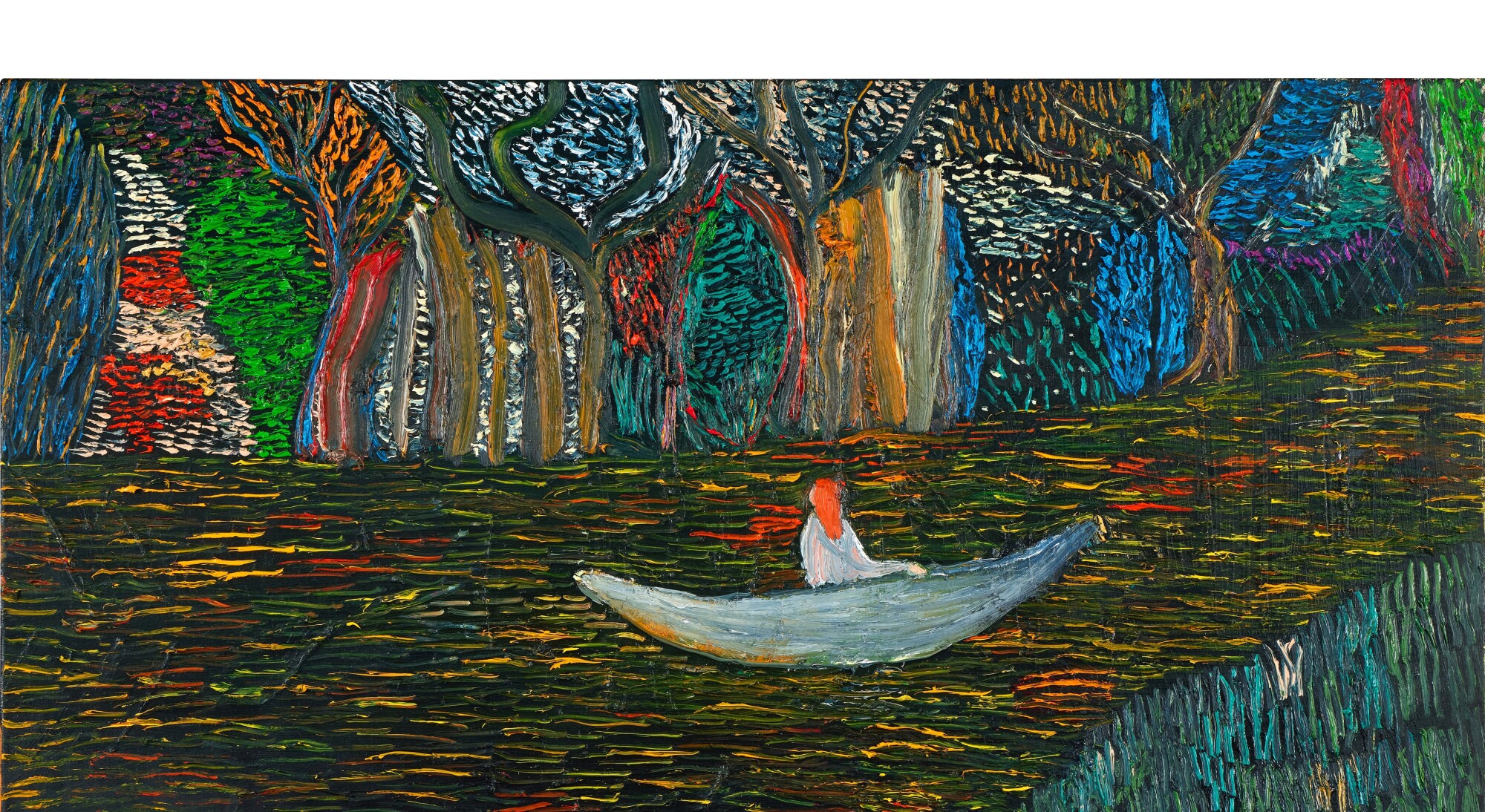
Wong's virtuosic handling of paint in The Jungle draws the viewer into his prismatic nightscape as dots, wiggles, and strokes coalesce with feeling in a somber yet.mes ditatively lustrous symphony. Above a central body of water, Wong conceives a dense jungle of chromatic trees and patches of smaller, thickly applied brushwork that suggests the image of fallen leaves on the jungle floor. The wind seems to whistle through the tress in effervescent speckles of evergreens and oranges, harmonizing with the deep blues and blacks of the nightscape. With his impasto technique, Wong conjures the nocturne rhapsody of the jungle landscape that is interrupted by nothing other than a lone pilgrim clad in red, drifting slowly in his canoe. The pensive figure faces the surrounding wilderness of the jungle, emphasizing the grandeur of the fantastical natural landscape while embodying a stand-in for the viewer. Writing about Wong’s 2018 exhibition at New York’s Karma Gallery, art critic Roberta Smith observes, “[Wong's] paintings are extremely open and vulnerable. But once they lure you in, they leave you alone to explore their chromatic, spatial and psychological complexities. This mysterious journey is often signaled by a smooth pathway leading inward from a painting’s bottom edge — which is somet.mes s being traveled by a shadowy solitary walker.” (Roberta Smith, “A Final Rhapsody in Blue from Matthew Wong”, 24 December 2019, The New York t.mes s (online))
Market Precedent: Matthew Wong
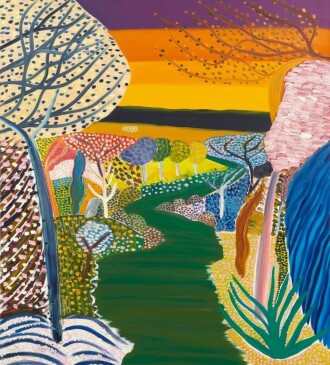


"Wong makes myriad lines, dots, daubs, and short, lush brushstrokes, eventually arriving at an imaginary landscape that tilts away from the picture plane at an odd angle. A painterly cartographer, Wong literally feels his way across the landscape, dot by dot, paint stroke by paint stroke.”
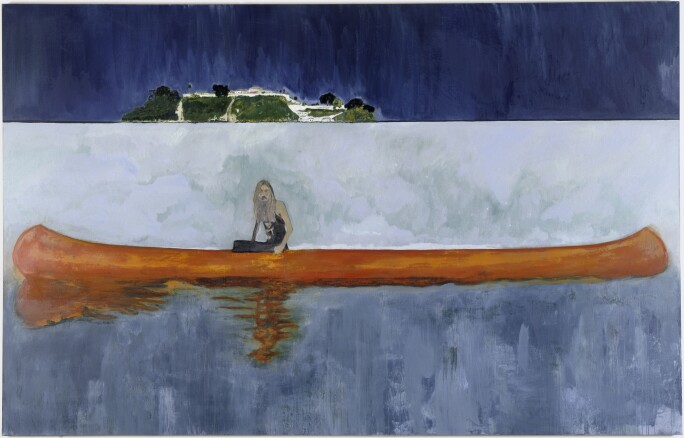
A self-professed “omnivore for sights, sounds and ideas,” Wong’s dazzling oeuvre reveals the aesthetic influence of a sweeping repertoire of art historical precedents, including Vincent Van Gogh, Edvard Munch, and Yayoi Kusama. (Matthew Wong cited in: Maria Vogel, “Matthew Wong Reflects on the Melancholy of Life”, Art of Choice, 15 November 2018 (online)) Wong, an avid daydreamer, painted from raw gestural intuition, elaborating the quick flashes of imagery that his mind recalled often randomly in vague yet lingering glimpses. Wong’s resulting aesthetic is an extraordinary consolidation and extension of traditions of landscape painting, expressing its vivacity by immersing viewers in the artist’s uniquely poignant imagination. In The Jungle, Wong drops the viewer into the midst of an unfolding, yet enigmatic narrative, recalling the dreamlike atmosphere of Peter Doig, whose works also feature drifting canoes on glassy moon-lit water. Meanwhile, his poetic brushwork recalls the glittering patchwork paintings of Gustav Klimt, while the short strokes that undulate across the canvas reveal an indebtedness to the Post-Impressionist master Vincent Van Gogh.


A poignant archetype of Wong’s urgent yet sublimely graceful practice, The Jungle extends from the personal to the universal in a remarkable display of the artist’s idyllic riverscapes. In the interplay of horizontal and vertical strokes that cascade across the dark surface, we are immersed in the soft glow and psychological complexity of the otherworldly realms that Wong has left behind. Describings Wong’s visual vernacular, art critic John Yau observes, “Wong makes myriad lines, dots, daubs, and short, lush brushstrokes, eventually arriving at an imaginary landscape that tilts away from the picture plane at an odd angle. A painterly cartographer, Wong literally feels his way across the landscape, dot by dot, paint stroke by paint stroke.” (John Yau, “Matthew Wong’s Hallucinatory Pilgrimages'," Hyperallergic, 22 April 2018 (online)) The Jungle is a quintessential example of Wong’s ability to draw upon his own memories and experiences during his too-short lifet.mes , creating utopian visions that ripple with powerful undercurrents of loneliness and melancholy that have perhaps never been more relevant and poignant today.

