It became necessary for me to find a form for the face, for I realized that great art was only to be painted with religious feeling. And that was something I could bring only to the human face.
P ainted circa 1920, Heilandsgesicht: Mondlicht (Verheissung) is the culmination of one of Alexei von Jawlensky’s best-known series inspired by the face of Christ, which he embarked on in 1917. The present work features as Helle Köpfe. Mondlicht on an undated list of paintings which Galka Scheyer brought to the United States in 1924 and toured several West Coast museums before entering the collects ion of Dr. Guido Bagier, German film director and editor of art magazine Feuer -Monatsschrift für Kunst und künstlerische Kultur in 1933.

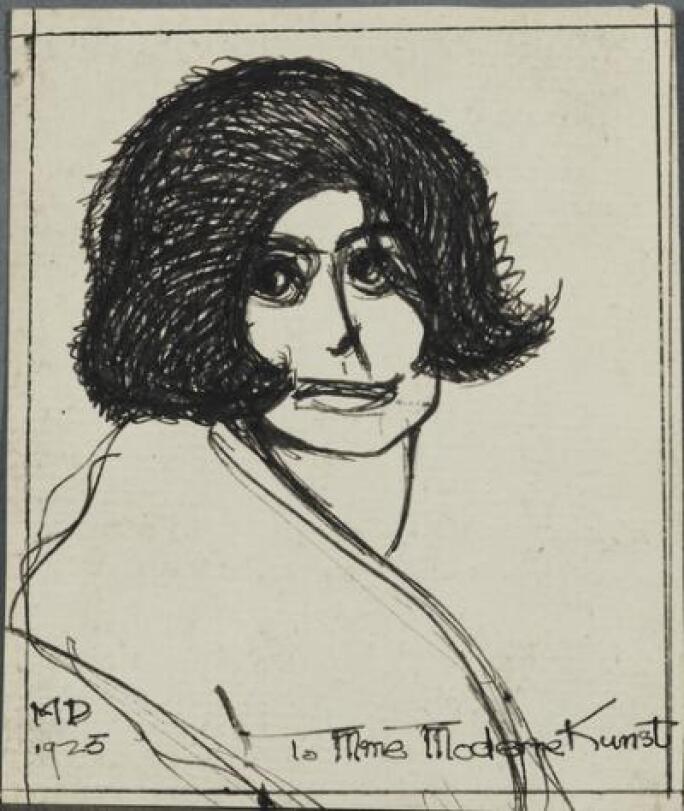
Acting both as dealer and collects or, Scheyer played a pivotal role in promoting Jawlensky’s work in the United States in the 1920s, encouraging greater recognition for his work alongside that of Wassily Kandinsky, Lyonel Feininger and Paul Klee, a group known as the “Die Blauen Vier” or “The Blue Four”. It was meeting Jawlensky in 1916 that set Scheyer on this course: “Why should I go on painting when I know I can’t produce such good art as you?” asked Scheyer on first encountering his work. ”It’s better I dedicate myself to your art and explain it to others.”

Few artists can claim to have inspired such single-minded devotion. Throughout the 1930s and 1940s, Scheyer continued to cultivate a taste for their distinctive brand of European modernism by arranging exhibitions, lectures and publications for the four artists, with her Hollywood home designed by Richard Neutra functioning as a meeting place and gallery for the social and cultural network of connoisseurs she developed in Los Angeles.
The Saviour’s Face series to the Abstract Head series (1918-1932)
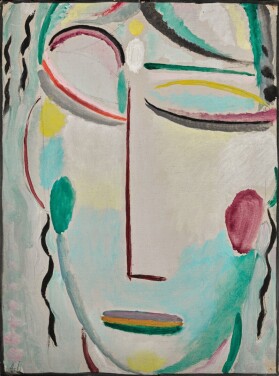


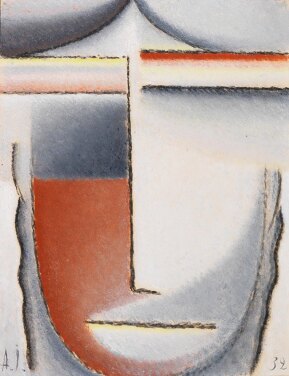
The present lot was painted while Jawlensky was living in Switzerland and marks a fascinating point when he was moving from his Saviour’s Face series to the further stylized and pared-down Abstract Head series. His post-war paintings reflect a more spiritual approach or “art [as] the longing for God” (Exh. Cat., London, Royal Academy of Arts, Masters of Colour: Derain to Kandinsky, 2002, p. 142). The faces from the present series are reminiscent of Russian icons in formal terms, with their strong sense of symmetry, frontal representation and use of black lines, but at the same t.mes become increasingly abstract, each chromatic variation a mystical expression of an inner state. The field of vision is closer cropped than before: these are faces not heads, and while the intensity of expression is not diminished, it is intense serenity rather than angst, often executed in the restrained, cooler color palette found in the present lot. The geometric elements presage his development towards the more rigorous approach to abstraction, evident in another "moonlit" painting in the collects ion of the Seattle Museum of Art (fig.4).

Right: Fig. 6 Alexej von Jawlensky, Head, circa 1924, oil on canvas, North Carolina Museum of Art © 2022 ARTISTS RIGHTS SOCIETY (ARS), NEW YORK