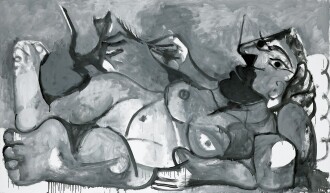
Executed across four days in February and March 1964, Femme nue couchée jouant avec un chat is an emphatic ode to Picasso’s beloved wife and tribute to the great painters of history. The triumphant work spans nearly two meters in length and encapsulates the greatest elements of the artist’s late career. From its unfettered brushwork and innovative use of materials to the homage to the Old Masters and near-deification of Jacqueline, Femme nue couchée jouant avec un chat stands as a test.mes nt to the artist’s glorious late oeuvre.
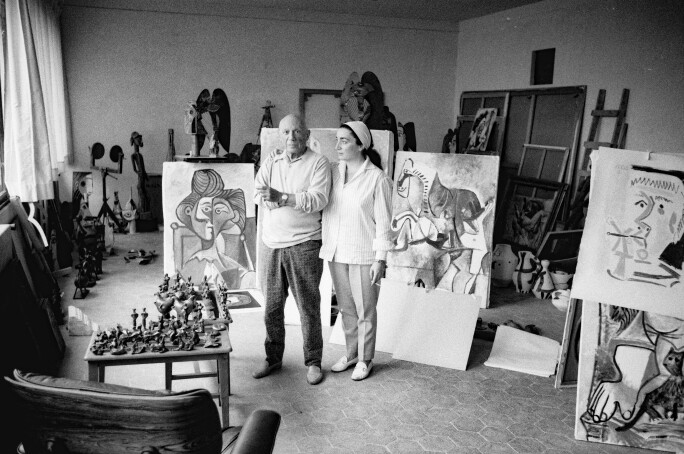
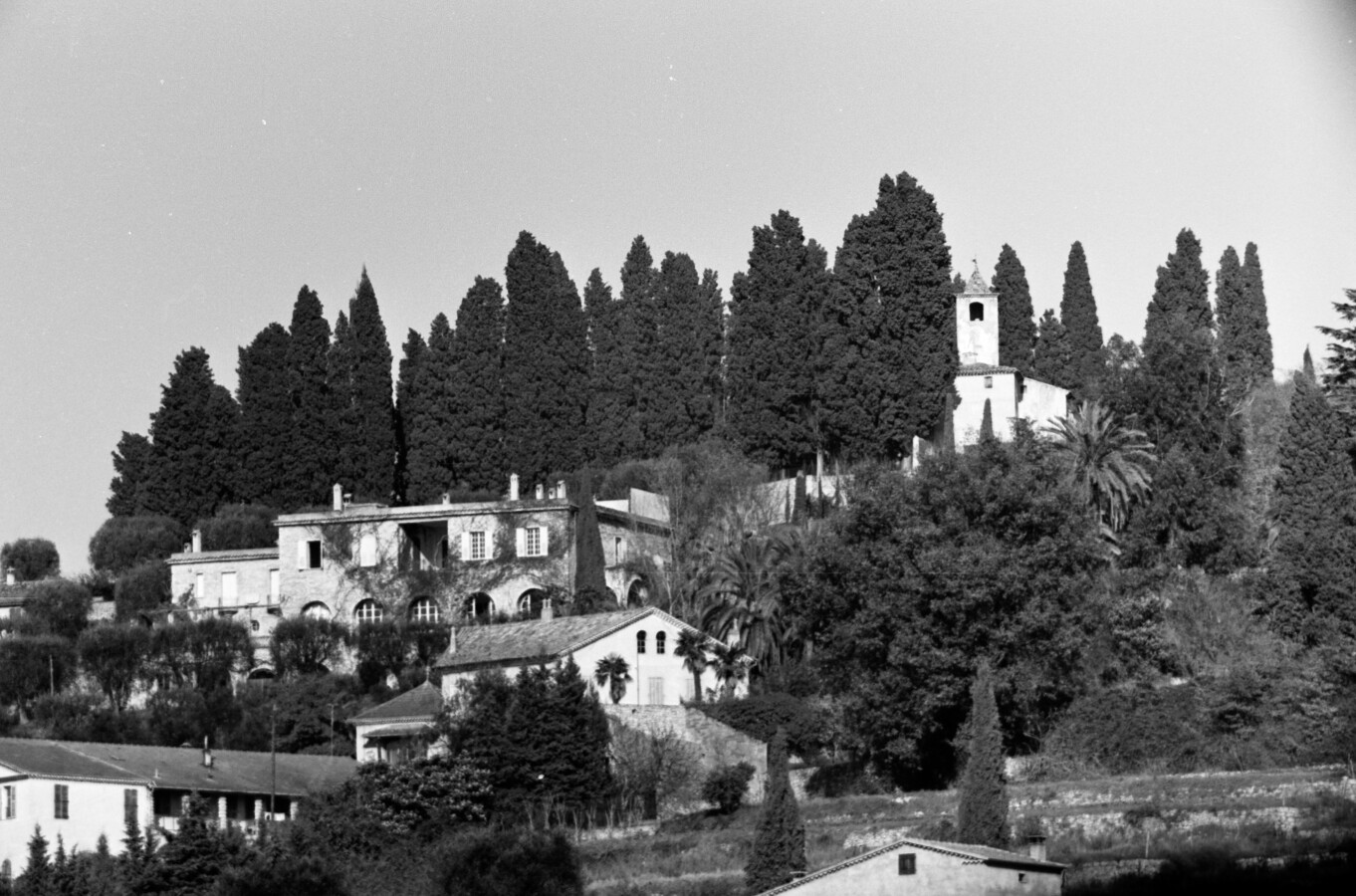
The 1960s proved a period of invigoration and creative renewal for Picasso. In 1961, the artist married Jacqueline Roque, his partner of the preceding seven years (see fig. 1). The pair soon moved into a sprawling mill-turned-estate in the town of Mougins, called Notre-Dame-de-Vie (see fig. 2). There, Picasso ensconced himself in a world of creative activity where Jacqueline protected him from the distractions and intrusions of the outside world. As William Rubin noted, it was Jacqueline, with her “understated, gentle, and loving personality combined with her unconditional commitment” who provided for Picasso “an emotionally stable life and a dependable foyer over a longer period of t.mes than he had ever before enjoyed” (Exh. Cat. New York, Pace, Picasso & Jacqueline, The Evolution of Style, 2014-15, p. 190). In this artistic sanctuary, Picasso thrived; his energy and artistic inspiration seemingly only increased from this t.mes onward.
Of this Jacqueline-centric body of work, Marie-Laure Bernadac writes that, “After isolating the painter in a series of portraits, it was logical that Picasso should now paint the model alone: that is to say a nude woman lying on a divan, offered up to the painter’s eyes and to the man’s desire. It is characteristic of Picasso, in contrast to Matisse and many other twentieth-century painters, that he takes as his model–or as his Muse–the woman he loves and who lives with him, not a professional model. So what his paintings show is never a ‘model’ of a woman, but woman as model. This has its consequences for his emotional as well as his artistic life: for the beloved woman stands for ‘painting,’ and the painted woman is the beloved: detachment is an impossibility” (Exh. Cat., London, Tate Gallery, Late Picasso, 1988, p. 78).

Fig. 4 Pablo Picasso, Le Déjeuner sur l’herbe d’après Manet, 1960, Musée Picasso, Paris © 2023 Estate of Pablo Picasso / ARS, New York
During this fruitful decade with Jacqueline as his ever-present muse, myriad series were born, from the more overt renditions of Picasso’s predecessors’ works like his 1960 Déjeuner sur l’herbe paintings after Manet (see figs. 3 and 4), to his painter and model depictions from 1963-64 and the musketeers and matadors that would dominate his oeuvre in the late 1960s. Amid these prodigious years arose a limited series of monumental depictions of Jacqueline, many of which featured the recurring motif of the cat. Ranging from more formal seated portraits, to the monumental reclining nudes like Femme nue couchée jouant avec un chat, this body of work from early 1964 is among the most sensuous and personal of his highly autobiographical late oeuvre.


By the mid-1960s, Picasso’s seemingly endless inspiration overflowed across dozens of canvases every month, with the artist often completing multiple large-scale works in one feverous day. His iconic late series display varying degrees of finish with such compositions ranging from the more spontaneous and gestural to those more carefully considered and crafted, as exemplified by Femme nue couchée jouant avec un chat. The present work displays a heightened dedication to its execution and exhibits the best of Picasso’s innovative techniques. As the dating on the reverse of the canvas illustrates, Picasso returned to this painting in multiple campaigns across four days, each t.mes utilizing different pigments—the date hinting at the progression of the composition (see fig. 5).
Abounding in myriad hues of blue and black, the central figure in Femme nue couchée jouant avec un chat. commands the viewer’s attention. The dark contours and labyrinthine valleys of her body are offset by bright white highlights, adding a sense of volume and voluptuousness to the form. The backdrop melts and swirls around Jacqueline’s figure, removing her from any recognizable external context and mythologizing her presence. Only the woman and cat remain, each ensconced in an eddying dream-like oasis.

Much of the circumfluous sensation in the present work is owed to Picasso’s choice of materials. As early as 1912 the artist is known to have included Ripolin in his works, an enamel paint typically used in industrial preparations. The new medium appealed to Picasso for its wide array of colors and quick drying properties, which was especially suited to this period of insatiable creativity and invigorated production in the 1960s. Picasso utilizes Ripolin to great effect in Femme nue couchée jouant avec un chat; the aqueous, almost stalactitic forms seen in the icy blue pigment at the top of the painting are a result of the medium’s fluidity and wave-like drying patterns as the artist rotated the orientation of the canvas. Unlike oil paint which hardened slowly and necessitated methodical application, Ripolin allowed Picasso to layer his pigments without fear of mixing new colors into wet paint. In the present work, the commercial medium also provides a glossy contrast to more matte areas of oil paint, adding further textural elements to the composition. Such experimentation would go on to inspire a younger generation of painters in the decades after Picasso first experimented with Ripolin. Industrial mediums like house paint would become staples of artists like Jackson Pollock in his pioneering gestural works.

The genius of Picasso’s late body of work derives not only from the artist’s innovative use of materials but also from his vivified and personalized interpretations of the Old Masters. From a young age, Picasso steeped himself in the world of virtuosic painting as he toured the great museums and galleries of Europe, where he could have hardly failed to see works like Titian’s Venus of Urbino and Ingres’ Grande odalisque, or the works of his fellow countrymen like Velázquez’ The Toilet of Venus and Goya’s Maja desnuda. From the 1950s onward, Picasso’s long-held fascination with the Old Masters came into acute focus as he aimed to align his own legacy within their historical tradition and completed numerous celebrated series like Les Femmes d’Alger after Delacroix and Las Meninas after Velázquez.
Like the reclining nudes of his predecessors, Picasso’s subject in Femme nue couchée jouant avec un chat is seen in profile situated atop a divan. Her gaze is at once directed toward the titular cat as well as out toward the viewer, playing on the more coquettish aspects of the archetype.

As in Titian’s Venus and Manet’s Olympia (see fig. 6), the woman in the present work is accompanied by an animal at her feet. In contrast to the dog in Titian’s masterpiece, which symbolized fidelity, Manet’s black cat was a clear and provocative allusion to the class and profession of the woman at center. Upon its unveiling in 1863, Manet’s Olympia shocked traditional audiences for its desecration of the idealized academic nude and portrayal of all-too-contemporary society, while also hailed by fellow artists and writers like Émile Zola as Manet’s finest work.
The feline had long been attributed to feminine sexuality, perhaps most notably in the late nineteenth century, when the image of the black cat was embraced for its playful and seductive connotations, as was the double entendre of la chatte. Soon, the dark and mysterious creature was adopted as a symbol of Montmartre, the lively bohemian neighborhood of Paris where Picasso and other artists lived and worked in their early careers. By channeling Manet’s controversial masterwork and icon of sexuality and modernity, Picasso implicitly added an additional erotic element to Femme nue couchée jouant avec un chat.

Inspired as he was by his artistic forebearers, Picasso was also deeply receptive to the world around him, often incorporating the people, objects and animals of his immediate vicinity into his paintings. The genesis of the 1964 series of woman and cat paintings follows a chance encounter which took place in Picasso and Jacqueline’s garden in Mougins. As Hélène Parmelin recounts in her lyrical 1966 profile of their pair’s home, “Picasso and Jacqueline were strolling in the garden, one fine day. Tempting though it may be, this garden, with its olive trees and cypresses, to walk in it is an event for the painter. Who lives in the house. In the studio. Around the garden. To be seen through the windows. During the walk, they meet a tiny cat. Black. A marvel. Like all of its kind. They carry it off to Notre Dame de Vie. They admire and play with it. Jacqueline plays. All the pictures of the ‘Woman with a Cat’ were born of this encounter. By the t.mes Picasso abandons this theme, the little cat had long since disappeared. Returned to the gardens from which it came. Or elsewhere. Little matter. A score of canvases celebrate it” (Hélène Parmelin, Pablo Picasso, Notre Dame de Vie: Secrets d’un alcove d’un atelier, Paris, 1966, p. 88, translated from the French).

Fig. 8 Pablo Picasso, Chat à l’oiseau, 1939, Private collects ion © 2023 Estate of Pablo Picasso / ARS, New York
Picasso’s affinity for cats is well documented; he particularly admired their willful independence, the more feral the better: “I don’t like high-class cats that purr on the couch in the parlor, but I adore cats that have turned wild, their hair standing on end. They hunt birds, prowl, and roam the streets like demons. They cast their wild eyes at you, ready to pounce on your face. And have you noticed that female cats in the wild are always pregnant? Obviously they think of nothing but love” (Pablo Picasso quoted in Brassaï, Conversations with Picasso, Chicago, 1999, p. 60). Depictions of cats figure throughout Picasso’s oeuvre, serving as allegories for a range of themes, from female sexuality to wart.mes violence (see figs. 7-9).

Like the frequent cast of birds, dogs, goats and bulls which appear throughout Picasso’s oeuvre, the cat infiltrated the artist’s world in the course of his quotidian routines. Soon, the creature was transformed in the artist’s mind, recontextualized in a historic context and reborn under Picasso’s brush. This wandering feline took hold of the artist and his omnipresent model Jacqueline much as their Afghan hound did in the Femme au chien series of 1962 (see fig. 10). Notably, however, the cat in Femme nue couchée jouant avec un chat remains at a slight remove from the figure, suggesting its short-lived presence in Picasso and Jacqueline’s life, whereas the figure of the pair’s pet dog Kaboul becomes one with Jacqueline, signifying the canine’s continued company and closer bond.

Of the ten monumental reclining nudes from this period (six of which feature the motif of the cat), seven are held in museum collects ions, attesting to the caliber of this series amid Picasso’s broader oeuvre. Of the three remaining in private hands, the present work is the largest and earliest canvas and presents the brilliant blue and green coloration that distinguishes the best paintings of this limited series (see carousel below).
Picasso’s Monumental Reclining Nudes of 1964


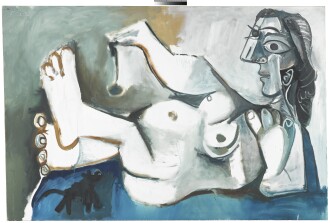

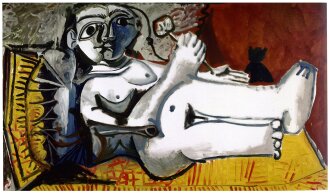
Femme nue couchée jouant avec un chat was most recently exhibited in the renowned 2009 survey of Picasso’s late works, Picasso: Mosqueteros, at Gagosian Gallery in New York (see fig. 11). Belonging to the collects ion of Jan and Maria Manetti Shrem for the last twenty-five years, the present work remains a commanding emblem of the extraordinary creative power found within Picasso’s final decade.


