La magie noire belongs to a group of works Magritte executed in the 1940s, on the subject of a female nude in an unidentified landscape. The model for this series was the artist's wife Georgette Berger and her image is depicted in a classical manner, abiding by the laws of conventional beauty and proportion, resembling a marble sculpture or a mythical figure as much as a live model. This traditional representation, however, is juxtaposed with the unexpected colouration of the figure, whose upper body gradually acquires the tone of the sky. In nearly all paintings from this group, the woman has one hand resting on a block of stone. As Magritte explained: ‘One idea is that stone is associated with an “attachment” to the earth. It does not rise up of its own accord; you can rely on its remaining faithful to the earth’s attraction. Woman, too, if you like. From another point of view the hard existence of stone […] and the mental and physical system of a human being are not unconnected’ (quoted in Jacques Meuris, René Magritte, London, 1988, p. 76).
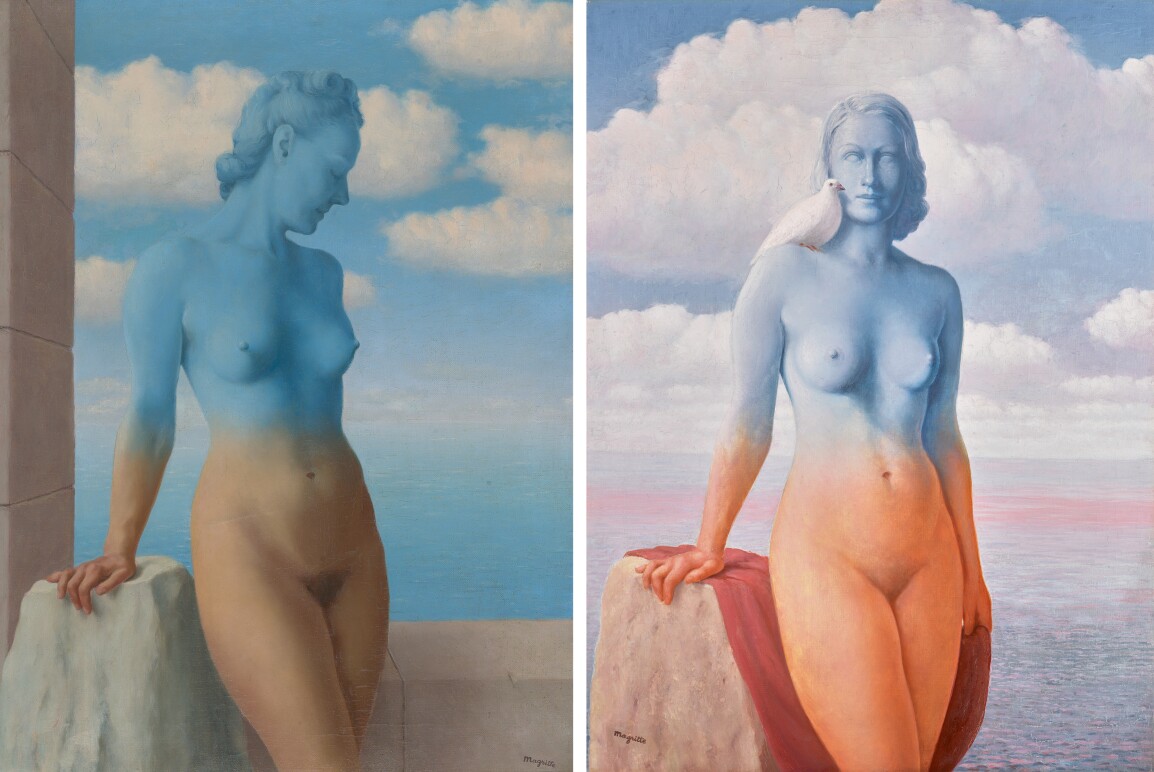
Right: Fig. 2, René Magritte, La magie noire, 1946, oil on canvas, sold : Replica Shoes ’s, London, June 2019, £4.2 million © ADAGP, Paris and DACS, London 2023
Depicted either with her eyes closed, or with her head turned away from the viewer or, as in the present work, with blank eyes resembling those of a marble sculpture, the nude becomes the passive object of the spectator’s gaze and erotic desire. ‘Magritte said, in fact, that an undercurrent of eroticism was one of the reasons a painting might have for existing. It asserted itself most intensely and explicitly in these stately classical nudes with their cool coloring. For the very reason that it aims at maximum resemblance, their academicism is upset by the provocation of mystery emanating from that identification, once the painting and the arrangement of the painting interfere with its course. The prime example is Black Magic [fig. 1]’ (ibid., p. 76).
The subject of this work became one of Magritte’s favourite images in the 1940s, and he used it in several oils and works on paper. He varied the position of the nude, depicting her frontally or in profile, somet.mes s holding a rose, and other t.mes s, as in the present work, with a dove resting on her shoulder. While Magritte gave these pictures various titles, the one most often used is La magie noire, which was found, as was often the case, by Paul Nougé, a Belgian poet and friend of Magritte’s. Writing about Magritte’s first painting on the theme of Black Magic, executed in 1934 (D. Sylvester, op. cit., vol. II, no. 355), David Sylvester and Sarah Whitfield observed: ‘Those pretty colours serve an image-making as well as a decorative purpose: the top half of the nude is painted a gradated blue, near enough that of the sky behind; from the waist down, the colour is a flesh tone. It is a process of metamorphosis. “Black magic. It is an act of black magic to turn woman’s flesh into sky”’ (ibid., p. 187).

Writing about the various versions on this theme in Magritte’s art, the authors of the Catalogue Raisonné have commented: ‘The changes had been constantly rung on whether the nude was seen frontally or in profile, whether her eyes were open or shut, whether or not there was a dove on her shoulder, a rose in her hand, sea in the background, a broken wall to one side, and whether or not her body was two toned. […] in any version that was called “La magie noire” the body was invariably two-toned, touched by that act of black magic transformation of flesh into sky’ (ibid., p. 188).
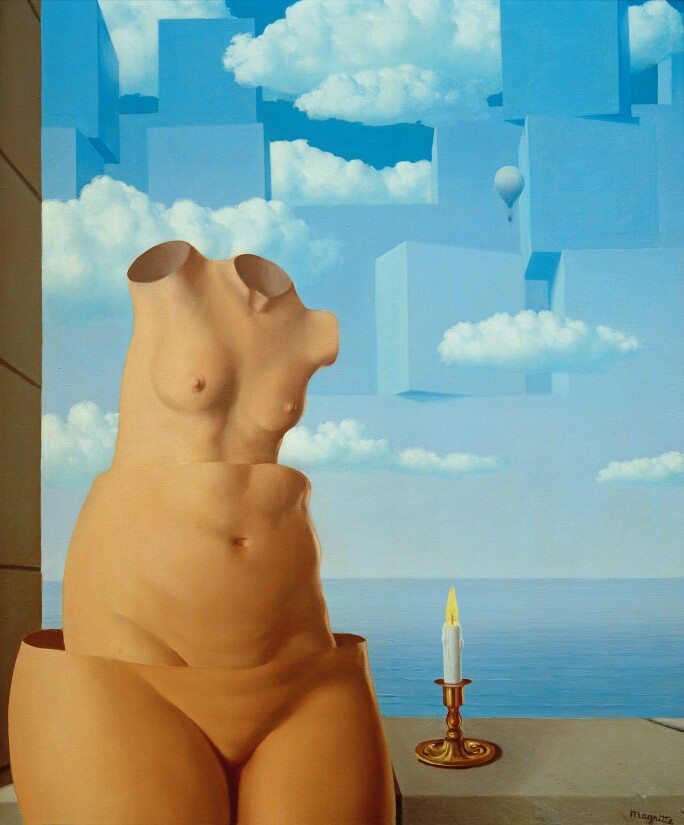
The present composition is a particularly intriguing variation, with the background rendered at the same t.mes as both an interior and exterior. A characteristic wood-panelled wall, which appears often in Magritte’s imagery, is broken to reveal a non-descript landscape behind it, consisting of a still sea and a cloudless sky. Later in the decade, Magritte transformed this image by replacing the standing nude with a three-part torso, thus further reducing the image of a woman to a man-made object, evoking a sculpture despite her naturalistic flesh tone (fig. 3). The connection between these two works relates to one of the artist’s earliest and most famous works, in which the female body (and the painted work) was broken down into separate parts (fig. 4). This seminal work underpinned much of Magritte’s art in the way it presented a challenge to conventions of representation and perception; the same tension is evident in the present work, which is at once beguiling and intriguing in its transformation of the everyday into something remarkable.
