
Kerry James Marshall’s Work With Double Vision in Pleasure, Fantasy & History | Replica Shoes ’s


“In painting African-American daily life, Mr. Marshall monumentalizes and ennobles it. Ordinary is extraordinary.”
Radiant and insurgent, Kerry James Marshall’s Untitled from 2008 is a profound and radical reappraisal of the discipline of figurative painting, accentuating and responding to the glaring omission of Black representation in the canon. Previously an iconic centerpiece of the artist's seminal 2016 exhibition Kerry James Marshall: Mastry, which opened at the Met Breuer, Untitled makes a triumphant return as part of Replica Shoes 's inaugural Breuer exhibition, a defining moment of both auction and art world history. The presentation of this exquisite work at auction coincides with the largest exhibition dedicated to Kerry James Marshall ever staged outside of the United States, Kerry James Marshall: The Histories, demonstrating exceptional and enduring institutional support for the artist’s practice. A masterpiece of unparalleled formal rigor and graphic grandeur, Untitled is an entrancing embodiment of Kerry James Marshall’s revolutionary painterly practice.


“Blackness is not presented by Marshall as an afterthought or as a form of special pleading; it is offered as a radical presence that shows how the very notions of beauty and truth that paintings and museums hold to be self-evident are premised on exclusions that are ethically, philosophically, and aesthetically untenable.”
In Marshall’s idyllic scene, two entwined figures embrace, their bodies turned to gaze out at an idyllic seascape veiled in a warm, golden light. Frothy turquoise waves roll to shore, as spiked palm fronds sway in the wind and seabirds glide through the sky, creating a sublime and amorous moment. The sunset glimmers against the surface of the waves, conjuring the kitsch images one might encounter printed on a travel postcard, a genre scene in which Black figures are often glaringly absent. Standing atop a rocky outcropping with their bodies turned towards the open sea, the couple create a silhouette which evokes the drama and dynamism of 18th-century landscape painting by the likes of Caspar David Friedrich. The slight form of a receding boat is visible in the apex of the sunset’s reflection on the rolling sea may also operate as a symbolic reminder of the history of the Middle Passage. By virtue, the inclusion of a Black couple in a historically 18th-century movement politicizes Untitled, and yet the painting simultaneously preserves its sent.mes ntality and lightness. Untitled synthesizes and revolutionizes its art historical precedents, incorporating the compositional devices of masterpieces in Western art while simultaneously honoring images of Black love and beauty.

“I was never so interested in just being able to make a drawing. I had to not only be able to make a good drawing, but I also had to be able to solve that initial problem of historical absence. It is a problem that haunts me to this day. It is the question that structured my entire practice and activity as an artist. How can we resolve this problem of perception, or production, where these things seem to be good enough to exist in some domains, but not good enough to become important enough to help tell the story of art?”
Following Marshall’s celebrated Vignettes (2003-07), Untitled is foremost a love scene; young lovers embrace on a cliffside dotted with coastal flowers and beach grass. Indeed, the present work was the focal point of Marshall’s 2008 exhibition Black Romantic at Jack Shainman, New York. “The work of African-American artists has for a long t.mes
been seen more as a kind of social phenomena instead of aesthetic phenomena,” Marshall describes. “On some level, I thought maybe the only thing that was left to do was to make paintings about love. And to take a cynical approach to the concept of love, to the concept of the Vignettes so that they don’t seem to directly address the social and political issues that had been relevant to me and maybe to a lot of other artists who want to make work.” (the artist in conversation with Wesley Miller in: “Kerry James Marshall | On Museums,” Art21, 25 September 2008, (online))
- 1434
- 1665-69
- 1907-08
- 1928
- 1931
- 1950
- 1962
- 1991
-
 Jan van Eyck, Arnolfini Portrait, 1434National Gallery, London
The Northern Renaissance wedding portrait is a charged, canonical image, offering a wealth of interpretations. The Arnolfini Portrait is filled with symbols of fidelity and purity, such as the small dog at the foot of the couple, and the mirror adorned with medallions depicting scenes from the Passion of Christ. Van Eyck’s superb detailing of the newlyweds’ rich garments illustrate their prosperous societal standing. -
 Rembrandt Harmensz van Rijn, The Jewish Bride, 1665-69Rijksmuseum, Amsterdam
Rembrandt’s richly textured composition is a tender scene between husband and wife. In soft embrace, this iconic wedding scene captures the sweet apprehension of committing oneself to another spiritually through marriage. -
 Gustav Klimt, The Kiss, 1907-08Österreichische Galerie Belvedere, Austria
A masterpiece of the Vienna Secession, the embracing couple of Gustav Klimt’s The Kiss seem to melt into each other. Set against a luminous gold ground, evoking the influence of the Byzantines and Proto-Renaissance, the now-paradigmatic image sees Klimt’s vernacular at its most refined and operatic. -
 René Magritte, The Lovers, 1928The Museum of Modern Art, New York
The surrealist composition of Magritte’s The Lovers is full of passion, frustration, and mystique. Though close enough to kiss, the couple is separated by thin cloths that suffocate their faces. The obfuscation of their identities and the tragedy of their absurd circumstance has eluded any single meaning, making this couple one of the most enigmatic in art history. -

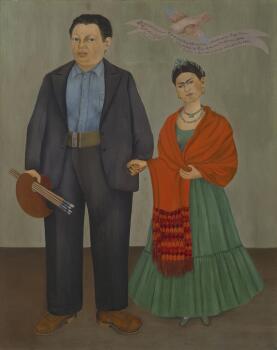
Frida Kahlo, Frieda and Diego Rivera, 1931. © Banco de Mexico Diego Rivera & Frida Kahlo Museums Trust, Mexico, D.F. / Artists Rights Society (ARS), New York. Frida Kahlo, Frieda and Diego Rivera, 1931San Francisco Museum of Modern Art
A portrait of one of art history’s most infamous relationships, Frieda and Diego Rivera depicts the couple hand-in-hand, an image of unity that belies the fraught and segmented marriage between the two artists. -
 Lois Mailou Jones, The Lovers (Somali Friends), 1950National Gallery of Art, Washington, D.C.
The intimacy of being seen by one’s lover is intimately captured in Jones’ The Lovers (Somali Friends), as the couple, framed against an intricate and colorful background gaze deeply into one another’s eyes. Jones’ treatment of line illustrates the influence of European Modernism upon her technique, which she synthesizes with the subject of Black love and joy. -
 Roy Lichtenstein, Kiss II, 1962Private collects ion
Pulling from the melodrama of the kitsch comic book universe, Lichtenstein’s Kiss II freezes in t.mes the moment of a couple’s first kiss. Strong contours and punchy colors culminate in a composition that swells with intensity—white rays emanate from the couple’s lips, electrifying their romance. -
 Félix González-Torres, “Untitled” (Perfect Lovers), 1991The Museum of Modern Art, New York
Gonzalez-Torres memorializes a tender, abstracted, vision of romance in his iconic “Untitled” (Perfect Lovers), which testifies to the hidden romance to be found and interpreted in quotidian objects. Gonzalez-Torres’ work is dedicated to his partnership with Ross Laycock, who tragically passed away during Torres’ lifet.mes .




In approaching love as subject matter, Marshall turns to the notion of “Black Romantic" as presented in Thelma Golden's 2002 exhibition Black Romantic: The Figurative Impulse in Contemporary African-American Art at the Studio Museum in Harlem. Delving into populist notions of "Black Art" and the uncritical realm of image making, Golden’s exhibition displayed elements of romance, desire and determination particular to the black experience in order to present a viewpoint “oppositional to modernist conceptualization of blackness flavored by exogenous exoticism, stereotype, caricature, and even abstractionist manipulation” (Exh. Cat., New York, Studio Museum in Harlem, Black Romantic: The Figurative Impulse in Contemporary African-American Art, 2002, p.11) Using Golden’s concept of the Black Romantic as a point of departure, Marshall embraced sent.mes ntality and notions of romance and love, continuing his exploration of representation of the black figure in pictorial space and creating a work of art that manages to simultaneously resist and reshape convention.


Arthur Jafa, AGHDRA, 2021
Museum of Modern Art, New York
The stunning setting sun over the deep sea is for many a scene of calm and beauty. But the ocean, for Marshall, whose portraits center the truth of African American identity and experience, represents a frightful unknown. Contemporaries such as Arthur Jafa explore the site of the ocean as a graveyard, burying countless of lives during the Atlantic slave trade. His installation video piece, AGHDRA, reveals a mottled, jagged ocean, a far cry from relaxation.

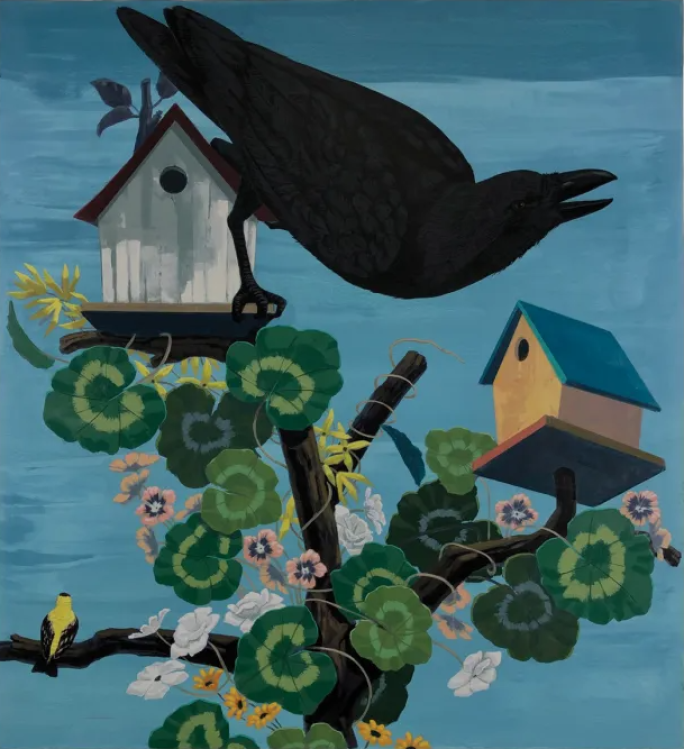
Kerry James Marshall, Black and part Black Birds in America. (Crow, Goldfinch), 2020
Private collects ion
Marshall’s series of paintings in 2020 were inspired by John James Audubon’s folio The Birds of America. His interest in the coloration of birds here is two fold; Audubon, born on a Haitian plantation, had debated ancestry, and in a double entendre, Marshall explores the ‘pecking order’ in our racialized society through the varying chromatics of birds. In the present work, white seagulls fly freely, untethered from the land.

Lucien Freud, Daffodils and Celery, 1947-48
Private collects ion
Amidst the dark foreground, small bright yellow flowers fight to emerge from their rocky perch. Dotting the mound upon which the two embracing figures stand, the flowers evoke the blooming daffodils in Freud’s Daffodils and Celery, a symbol of hope and love in the face of a day still yet waiting to begin, or having just come to an end.

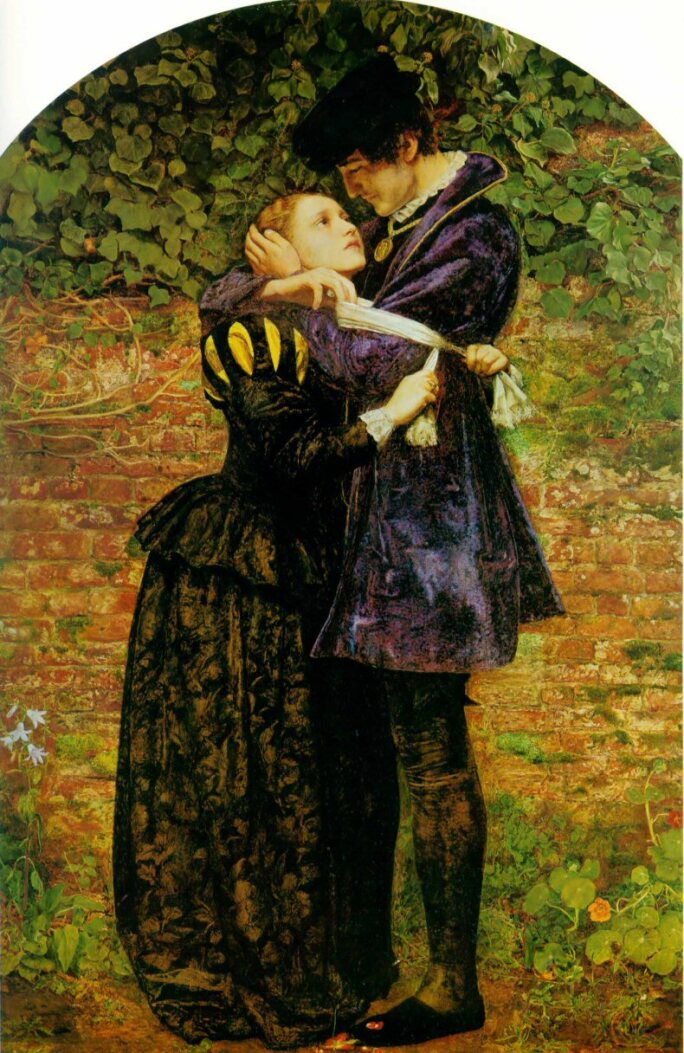
John Everett Millais, A Huguenot, on St. Bartholomew’s Day, 1852
Private collects ion
A dramatic romance sweeps across the composition, two tightly bound lovers in their own world, looking across at the boundless ocean. Grasping onto one another, Untitled suggests the tradition of sent.mes ntal romance paintings of the Pre-Raphaelites.


The deliberate and dramatic darkness of Marshall’s figures casts the exclusion of Black bodies from canonical art history into radical relief. Rendered in shades of carbon and ivory, the central figures in Untitled quietly emerge from their silhouettes; the intricate details of their posture and clothing slowing emerging before the viewer. Marshall explains of his work: “Blackness is non-negotiable in these pictures; it’s also unequivocal” (the artist quoted in: Seph Rodney, “Kerry James Marshall and the Politics of Visibility,” Hyperallergic, 2016, (online)) Rather than a rendering of real people, the literally black figures probe the history of invisibility and art historical exclusion of Black figures. Neither an afterthought nor beseeching signal, Blackness in Marshall’s work is a radical presence that “shows how the very ideas of beauty and truth that paintings and museums hold to be self-evident are premised on exclusions that are ethically, philosophically, and aesthetically untenable.” (Helen Molesworth, quoted in: Exh. Cat., Museum of Contemporary Art Chicago (and traveling), Kerry James Marshall: Mastry, 2016-17, p. 37)

Marshall’s project is an emphatic reminder of painting's capacity to occupy a central position with culture and a radical reconfiguration of the principles that shape our conceptual order. The present work’s richly worked, luminous composition does not offer a resolution of the tension between the real and the ideal. The idyllic and expansive tropical vignette acknowledges the intimate, ordinary moments and the people too many histories leave behind. Untitled invites the viewer into the amorous world of its figures, whose strong black pigments emphatically challenge the exclusionary and hegemonic tenets that have long governed figurative painting. Marshall proclaims: “I am trying to establish a phenomenal presence that is unequivocally black and beautiful. It is my conviction that the most instrumental, insurgent painting of this moment must be of figures, and those figures must be black, unapologetically so.” (the artist quoted in: Exh. Cat., Museum of Contemporary Art Chicago (and traveling), Kerry James Marshall: Mastry, 2016-17, p. 192) A paragon of Marshall’s singular and unparalleled oeuvre, Untitled remains an urgent reappraisal of the art historical canon and masterwork of figurative painting in the Twenty-first Century.


